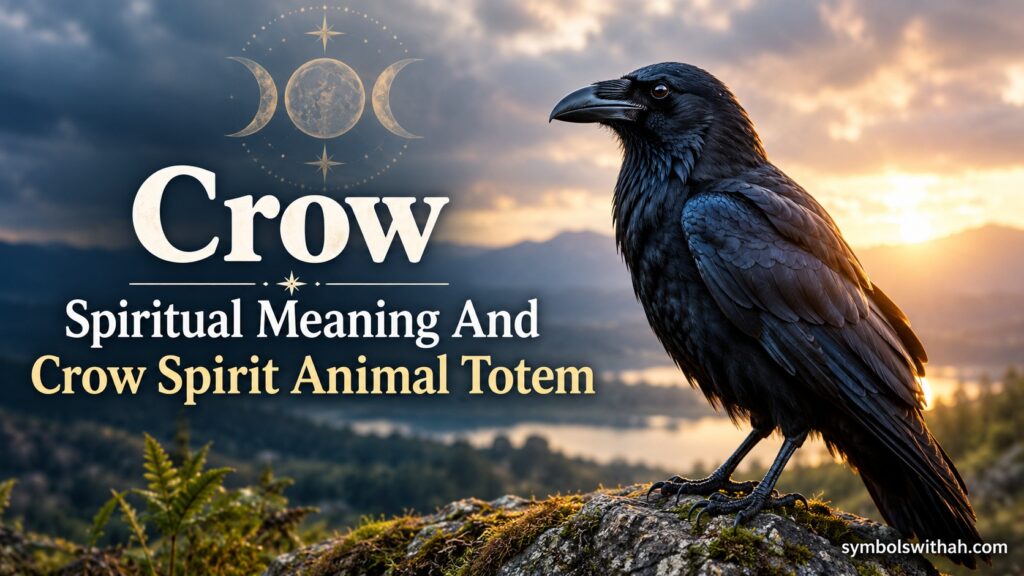

A crow can look ordinary until it pauses, watches, and seems to study the world around it. That quiet intelligence helps explain why crow spiritual meaning and crow spirit animal totem ideas continue to fascinate people in the United States. For many modern readers, the crow represents intelligence, adaptability, awareness, mystery, and transformation.
Yet crow symbolism is far more complicated than the familiar image of a black bird linked with bad luck. Crows appear in mythology, folklore, literature, art, and everyday American landscapes. They can symbolize wisdom in one tradition and death or misfortune in another.
Today, people may notice a crow during a major life change, choose crow imagery for a tattoo, or wonder about repeated encounters. Those experiences can feel meaningful without requiring one fixed supernatural explanation. The most useful approach is to understand the history first, then consider what the symbol means within a personal or cultural context.
Read More: Period on Full Moon Spiritual Meaning and Symbolism
Quick Answer
Crow spiritual meaning and crow spirit animal totem symbolism commonly centers on intelligence, observation, transformation, adaptability, and awareness in modern American spiritual culture. Broader traditions also connect crows and related ravens with messages, trickster figures, battle, death, memory, and powerful change.
TL;DR
- Crows commonly symbolize intelligence, adaptability, awareness, and transformation.
- American crows are highly social, clever, and remarkably adaptable birds.
- Ancient traditions often gave corvids complex rather than purely negative meanings.
- Indigenous traditions differ greatly and shouldn’t be reduced to one “crow meaning.”
- Modern tattoos often use crows to represent mystery, resilience, or change.
- A crow encounter can inspire reflection without proving a supernatural message.
What Does a Crow Symbolize?
The crow carries a remarkably broad symbolic vocabulary. Its black feathers, sharp intelligence, social behavior, and unusual calls all contribute to its cultural image.
In modern American symbolism, the crow often represents awareness and intelligence. It can also suggest someone who watches carefully rather than rushing into action.
Core Crow Symbolism
Common modern associations include:
- Intelligence and clever problem-solving
- Transformation during major life changes
- Awareness of hidden details or overlooked possibilities
- Adaptability when circumstances shift unexpectedly
- Mystery because of the bird’s dark appearance and folklore
These meanings are symbolic rather than scientific claims about spiritual powers. The real bird itself provides plenty of inspiration.
American crows can live around farms, forests, parking lots, lawns, beaches, cemeteries, and cities. They adapt remarkably well to human environments. (All About Birds)
That flexibility makes adaptation one of the most grounded interpretations of crow symbolism.
Crow Spiritual Meaning in the United States
In the United States, crows have an unusual place in everyday life. They’re common enough to become familiar, yet their behavior can still feel mysterious.
American crows occur across most of the lower 48 states. They frequently live near people, including in parks, agricultural areas, neighborhoods, roadsides, and urban spaces. (All About Birds)
Why Americans Associate Crows With Mystery
Several visible traits shape this reputation.
A crow is:
- Completely black, including its bill and legs.
- Loud enough to attract attention from a distance.
- Social and often seen in groups.
- Comfortable around cities and human activity.
- Active in places people associate with endings, such as cemeteries.
However, these natural traits don’t prove that crows predict death or misfortune.
Instead, they help explain why folklore developed around them. Humans have always attached stories to animals that behave in unusual or memorable ways.
The American Crow as a Symbol of Adaptability
Few American birds illustrate adaptability better than the crow.
Cornell researchers note that American crows can use tools, solve problems, recognize social relationships, and live successfully in changing environments. (All About Birds)
Symbolically, that creates a powerful modern message:
Change doesn’t always require surrender. Sometimes it requires ingenuity.
That idea fits American experiences of moving, rebuilding, changing careers, starting over, and adapting to unfamiliar circumstances.
Crow Appearance and Symbolic Details
Symbolism often changes according to how the crow appears.
A single crow on a quiet branch creates a different emotional impression from hundreds gathering above a city.
Black Feathers
Black is frequently associated with:
- Mystery
- The unknown
- Protection
- Elegance
- Endings
- Depth
- The unseen
However, black doesn’t automatically mean evil.
In fashion, design, photography, and tattoos, black can communicate sophistication and strength. The same color can therefore carry completely different meanings depending on context.
The Crow’s Watchful Posture
A crow standing still and observing can symbolize attention.
Its head movements and alert behavior naturally encourage human interpretations involving vigilance and awareness.
That makes the crow a useful symbolic image for someone entering a period that requires careful observation rather than impulsive action.
A Crow in Flight
A flying crow can represent movement, freedom, transition, or leaving something behind.
For tattoo designs, a flying crow may therefore suggest:
- Personal transformation
- Independence
- A new chapter
- Emotional release
- Moving beyond the past
The symbolism depends heavily on the surrounding imagery.
Ancient Roots of Crow and Raven Symbolism
Corvid symbolism reaches far beyond modern spiritual culture. However, an important distinction comes first: crow and raven traditions are often blended together today, even though they are different birds.
Ancient cultures sometimes treated them as closely related symbolic figures because both belong to the corvid family.
Greek Traditions
Greek mythology includes stories connecting the crow with Apollo.
In one famous myth recorded in Ovid’s Metamorphoses, Apollo’s crow was originally white. After delivering troubling information concerning Coronis, the bird was punished, and its feathers became black.
This story creates a fascinating symbolic tension.
The crow becomes associated with truth, warning, consequences, and dark transformation rather than simply death.
Norse Traditions
Norse mythology provides a stronger example involving ravens.
Odin is traditionally accompanied by Huginn and Muninn, whose names are commonly translated as Thought and Memory. They travel through the world and return with information. (HRAF)
These are ravens, not American crows.
That distinction matters because modern articles sometimes transfer every raven tradition directly onto crows. Historically, the two birds share symbolic territory but shouldn’t automatically be treated as interchangeable.
Irish Mythology
Irish mythology contains powerful corvid imagery surrounding the Morrígan and Badb.
Badb is particularly associated with the battle crow and with warfare, prophecy, and transformation. Medieval Irish traditions therefore present the crow as a complex figure connected with both conflict and foreknowledge.
The important lesson is simple:
Ancient crow symbolism was rarely limited to “bad luck.”
It could involve knowledge, battle, prophecy, transformation, and the boundary between life and death.
Crow Symbolism and Indigenous Traditions
This subject requires particular care because there is no single universal Native American crow meaning.
Hundreds of Indigenous nations have distinct languages, histories, ceremonies, and relationships with animals. The Smithsonian National Museum of the American Indian specifically cautions against treating the non-Native concept of a generic “spirit animal” as though it represents all Native traditions. (National Museum of the American Indian)
The Apsáalooke and the Crow Nation
The Crow Nation is an Indigenous nation whose traditional name is Apsáalooke. Smithsonian materials explain that the name is connected with the “Children of the Large Beaked Bird.” (National Museum of the American Indian)
That history is important, but it shouldn’t be simplified into the idea that every Apsáalooke person follows a generic “crow spirit animal” belief.
Apsáalooke cultural life includes specific clan relationships, histories, sacred places, ceremonies, and community traditions. Smithsonian sources describe strong connections between kinship, spirituality, land, and cultural continuity. (National Museum of the American Indian)
Why “Spirit Animal” Needs Context
The phrase spirit animal is popular in modern American spirituality.
However, applying it broadly to Indigenous peoples can flatten very different traditions into one convenient label. A respectful article should distinguish modern spiritual language from specific Indigenous teachings.
Some Indigenous traditions do include powerful animal relationships, stories, ceremonial roles, and clan connections. Their meanings must be understood within the individual nation and tradition rather than treated as one universal system. (National Museum of the American Indian)
Crow Spirit Animal Meaning
In contemporary spiritual practice, people often use “crow spirit animal” to describe qualities they admire or feel connected to.
This interpretation is best understood as personal symbolism, rather than a universal religious doctrine.
Intelligence and Strategic Thinking
The crow can represent thinking before acting.
That association has a strong natural foundation. American crows are recognized as skilled learners and problem-solvers, and some have demonstrated tool use. (All About Birds)
Symbolically, the lesson becomes:
Look closely. Learn quickly. Then act deliberately.
Transformation
Crows are often linked with transformation because they appear in stories about thresholds, endings, and change.
A person experiencing a major transition may therefore find crow imagery meaningful.
The symbol doesn’t need to predict the future. Instead, it can serve as a reminder that change often requires flexibility.
Awareness
A crow’s alert behavior lends itself naturally to symbolism about observation.
A crow spirit animal interpretation might therefore represent:
- Paying closer attention
- Noticing patterns
- Questioning assumptions
- Learning from experience
- Trusting careful observation
These interpretations are modern symbolic frameworks, not universal claims about what every crow encounter means.
Crow Spirit Animal Totem Meaning
The phrase crow spirit animal totem combines several modern spiritual ideas that have different cultural histories.
In contemporary usage, people may use the term to describe a symbolic animal associated with personal traits or life lessons.
What a Crow Totem May Represent
A modern symbolic reading may connect the crow with:
- Resourcefulness when circumstances become difficult
- Intuition when a situation feels unclear
- Adaptability during major transitions
- Social intelligence and awareness of relationships
- Transformation after an ending or major realization
The important distinction is that these are interpretive meanings, not fixed rules.
A person may connect with the crow because it represents independence. Another may see it as a symbol of memory, mystery, or resilience.
Crow Symbolism and Psychology
Crow imagery can create strong emotional reactions because humans respond to color, movement, sound, and cultural memory.
A black bird calling from a bare tree may feel ominous. The same bird feeding its young can appear intelligent and protective.
Why the Crow Feels Mysterious
Several psychological associations overlap:
Black color can evoke uncertainty or seriousness.
Unexpected appearances can feel significant because unusual events attract attention.
Repetition can strengthen perceived meaning when someone notices the same symbol repeatedly.
Cultural stories can shape expectations before a person encounters the bird.
These factors can make a crow encounter feel personally meaningful without requiring a supernatural explanation.
The Crow as a Shadow Symbol
In modern symbolic language, the crow sometimes represents the parts of life people prefer not to examine.
That can include:
- Fear of change
- Grief
- Hidden emotions
- Difficult memories
- Uncertainty
- Personal limitations
Rather than treating these associations as predictions, the crow can function as a metaphor for facing what feels uncomfortable.
Crow Meaning in Dreams
Dreams about crows have no single universal interpretation.
The emotional setting matters more than the bird alone.
A Calm Crow
A calm crow may symbolically suggest observation, patience, or awareness.
If the dream feels peaceful, the bird may carry a very different emotional tone from an attacking crow.
A Crow Flying Away
A crow leaving can symbolize separation, transition, or releasing something.
However, personal associations matter. Someone who loves crows may experience this dream differently from someone who fears them.
A Group of Crows
A gathering may symbolize social pressure, community, collective attention, or overwhelming thoughts.
American crows naturally gather in large winter roosts, sometimes numbering from hundreds to enormous concentrations. (All About Birds)
That real behavior can influence dream imagery without requiring a supernatural explanation.
Crow Spiritual Meaning in Everyday Encounters
Seeing a crow can feel significant when it appears during an emotionally important moment.
Still, symbolism works best when it encourages reflection rather than certainty.
| Encounter | Common symbolic interpretation | Natural context |
| One crow watching | Awareness or observation | Crows often remain alert |
| Crow calling nearby | Communication or attention | Crows have complex vocal behavior |
| Crow in flight | Transition or freedom | Normal movement between locations |
| Several crows together | Community or collective energy | Crows form social groups |
| Crow near a home | Protection or vigilance | Crows commonly live near people |
| Crow appearing repeatedly | Personal reflection or pattern recognition | Familiar birds may revisit useful areas |
American crows have complex vocal communication and can recognize individual birds within family or neighborhood groups. (Bird Academy)
That makes the bird’s social behavior especially interesting when interpreting its symbolism.
Crow Symbolism in Tattoos, Art, and Decor
Crow imagery has become a flexible visual language in modern American culture.
A tattoo can make the crow mysterious, elegant, rebellious, spiritual, or reflective depending on the design.
Crow Tattoo Meanings
Common interpretations include:
- Transformation after hardship
- Independence and individuality
- Intelligence and strategy
- Mystery and the unknown
- Memory and remembrance
- Resilience through change
A single crow often feels minimalist and introspective.
Several crows can create a darker, more dramatic atmosphere.
Crow Tattoos With Other Symbols
A crow paired with a moon can emphasize mystery and intuition.
A crow with a skull can highlight mortality and remembrance.
A crow with flowers can create a contrast between life, beauty, and darkness.
A crow with a clock may represent time, memory, or change.
A crow with an eye can emphasize observation and awareness.
The surrounding imagery often determines the tattoo’s strongest message.
Crow Decor
Crow imagery appears especially often in autumn and Halloween decorations.
In that setting, the bird commonly represents:
- Mystery
- Night
- Folklore
- Autumn
- The supernatural
- Gothic aesthetics
That cultural association is powerful, but it doesn’t mean every crow image has a negative meaning.
Crow Symbolism in Halloween and American Pop Culture
Few American holidays have embraced crow imagery as strongly as Halloween.
The bird fits the holiday’s visual language because it combines dark feathers, sharp silhouettes, nighttime folklore, and old stories about death.
Yet American pop culture has also made the crow more sympathetic.
Books, films, photography, and wildlife documentaries frequently highlight its intelligence and social behavior.
This creates a fascinating dual image:
The crow can be both eerie and admirable.
That tension is one reason the bird remains culturally durable.
Crow Meaning, Death, and Bad Luck
The association between crows and death is real, but it is not universal.
Crows may appear around carcasses because they are opportunistic omnivores. American crows eat many foods, including insects, seeds, fruit, garbage, and carrion. (All About Birds)
Their presence near dead animals therefore has a straightforward ecological explanation.
Why the Death Association Became Strong
Several elements reinforce the symbolism:
- Black plumage resembles darkness.
- Crows sometimes feed on carrion.
- Their calls sound harsh to human ears.
- They appear in old battle and death stories.
- Their silhouettes fit gothic artistic traditions.
However, seeing a crow does not establish that death is approaching.
That is a folklore interpretation rather than a demonstrated fact.
Crow and Raven: What’s the Difference?
Crow and raven symbolism overlap so heavily that the two birds are often confused.
Scientifically, however, they are distinct birds.
| Feature | American Crow | Common Raven |
| Typical length | About 16–21 inches | About 27 inches |
| Wingspan | About 34–39 inches | About 46 inches |
| Tail shape | More rounded or squared | More wedge-shaped |
| Bill | Moderate | Larger and heavier |
| Common habitat | Cities, fields, towns, open woods | Forests, mountains, deserts, rural areas |
| Famous mythology | Many varied traditions | Strong association with Odin |
Cornell identifies American crows as substantially smaller than common ravens, with different tail, bill, and wing characteristics. (Bird Academy)
This distinction matters symbolically too.
For example, Huginn and Muninn are ravens, not crows. (HRAF)
Misunderstandings and Controversies Around Crow Symbolism
Crow symbolism has accumulated several misleading shortcuts.
One of the biggest is the belief that all crow symbolism means death.
That ignores traditions connecting corvids with intelligence, communication, transformation, memory, trickster figures, and even divine knowledge.
Avoiding Cultural Overgeneralization
Another problem is calling every Indigenous interpretation “Native American crow symbolism.”
That phrase can suggest one shared Indigenous belief system.
The United States contains hundreds of distinct Indigenous nations. Their traditions are not interchangeable. (National Museum of the American Indian)
Avoiding the “Crow Means Bad Luck” Shortcut
A crow may appear in a frightening story, but the bird itself isn’t evidence of bad luck.
Its symbolic meaning changes according to the culture, story, artwork, and personal interpretation.
That complexity is actually what makes crow symbolism interesting.
How Crow Symbolism Has Changed Over Time
The crow’s symbolic identity has never stayed fixed.
Ancient traditions could portray corvids as messengers, observers, tricksters, battle figures, or supernatural companions.
Later European folklore increasingly emphasized darkness, death, and omens.
Modern American culture now holds several interpretations simultaneously.
From Omen to Intelligent Neighbor
The most interesting modern shift may be the growing appreciation of the real bird.
Scientific research has highlighted crows as intelligent, social, adaptable animals. They can recognize individuals, solve problems, use tools in some circumstances, and maintain complex family relationships. (All About Birds)
Consequently, modern symbolism increasingly includes intelligence and resilience alongside older ideas about mystery and death.
That gives today’s crow a more nuanced identity.
Frequently Asked Questions About Crow Spiritual Meaning
What does a crow symbolize spiritually?
In modern spiritual interpretation, a crow often symbolizes intelligence, transformation, awareness, adaptability, and mystery. These meanings vary by tradition and personal belief.
Is seeing a crow a spiritual sign?
Some people interpret a crow encounter as personally meaningful, especially during periods of change. However, there is no scientific evidence that seeing a crow automatically predicts an event or delivers a supernatural message.
What does a crow mean as a spirit animal?
In contemporary spiritual language, the crow may represent cleverness, adaptability, observation, and transformation. The term “spirit animal” should not be treated as a universal description of Indigenous traditions.
What does a crow symbolize in Native American culture?
There is no single Native American crow meaning. Indigenous nations have distinct traditions, and animal relationships can involve clan identity, stories, ceremonies, spiritual teachings, and local history. (National Museum of the American Indian)
Are crows a symbol of death?
Crows have been connected with death and battle in some traditions. However, they also symbolize intelligence, communication, adaptability, memory, and transformation, so death is only one part of their broader symbolism.
What does a crow mean in a dream?
A crow in a dream can represent awareness, change, mystery, memory, or something emotionally unresolved. The dream’s setting and your personal feelings usually matter more than a fixed dream dictionary definition.
Conclusion
The Crow Spiritual Meaning And Crow Spirit Animal Totem tradition is much richer than the familiar image of a black bird predicting bad luck. In modern American symbolism, the crow can represent intelligence, adaptability, awareness, mystery, transformation, and resilience.
History adds even more layers. Ancient cultures connected crows and ravens with prophecy, memory, battle, divine knowledge, and transformation, while modern science has revealed remarkable intelligence and social complexity in American crows. (All About Birds)
For someone drawn to crow imagery, the most useful interpretation may be simple: watch closely, adapt wisely, and don’t fear change merely because it looks unfamiliar. A crow can remain mysterious without needing to become an omen.