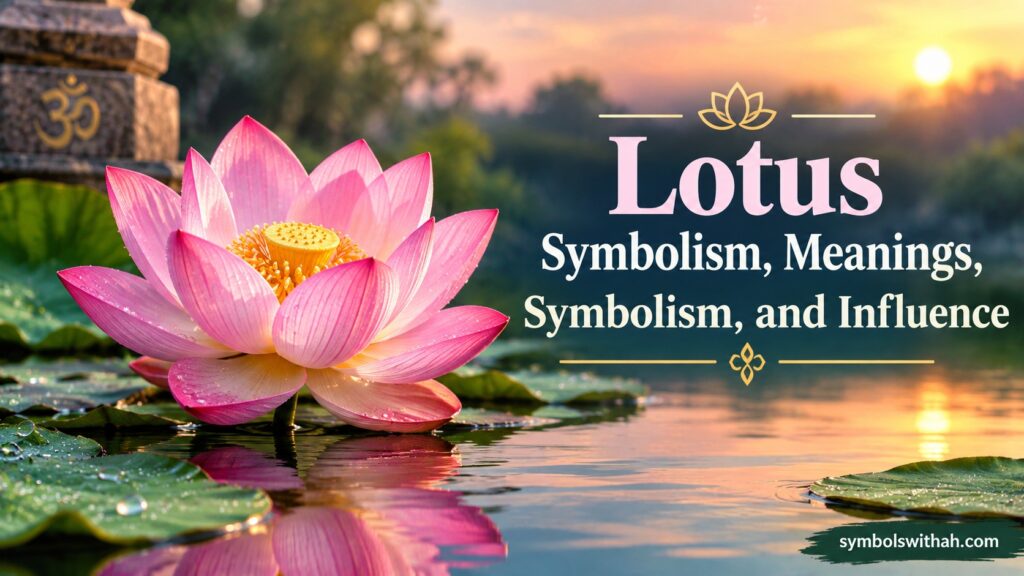

The Lotus Symbolism, Meanings, Symbolism, and Influence story begins with a remarkable natural image. A lotus grows from muddy water, rises through the surface, and opens into a striking flower above it.
That transformation explains much of its symbolic power. For thousands of years, people have connected the flower with renewal, purity, creation, beauty, spiritual awakening, and resilience. Ancient Egyptian art used lotus imagery around ideas of regeneration and the sun, while Hindu and Buddhist traditions developed rich and distinct meanings around the flower.
Today, Americans encounter lotus imagery in tattoos, meditation spaces, jewelry, artwork, gardens, yoga culture, and spiritual design. However, its meaning isn’t simply “overcoming hardship.” The lotus has different meanings within different cultures, so context matters.
Read More: EVB Meaning in Text: What Does EVB Mean in Chat?
Quick Answer
Lotus Symbolism, Meanings, Symbolism, and Influence commonly centers on purity, renewal, spiritual awakening, resilience, and the movement from darkness toward light. In the United States, the lotus is especially popular as a symbol of personal growth, peacefulness, transformation, and inner strength.
TL;DR
• Lotus symbolism often connects beauty with growth through difficult conditions.
• Ancient Egypt associated lotus imagery with the sun, regeneration, and rebirth.
• Hindu traditions connect the lotus with divinity, beauty, creation, and prosperity.
• Buddhism uses the lotus to express awakening and freedom from attachment.
• Americans often use lotus imagery for growth, wellness, tattoos, and personal identity.
• Different lotus colors can carry different symbolic meanings.
What Does the Lotus Symbolize?
The lotus is one of the world’s most recognizable spiritual flowers. Its symbolism comes partly from the way it grows and partly from centuries of religious and artistic interpretation.
The flower’s journey provides a powerful metaphor. Its roots remain underwater while the stem moves upward and the blossom opens above the surface.
The Core Meanings
The lotus is commonly associated with:
• Purity emerging from difficult surroundings
• Spiritual awakening and expanded awareness
• Renewal after an ending or transition
• Resilience through adversity
• Beauty, grace, and inner development
• Creation, fertility, and divine presence
However, these meanings shouldn’t be treated as one universal definition. A Buddhist interpretation can differ from an ancient Egyptian one, even when both use the same flower.
Why the Mud Matters
The mud isn’t merely background decoration in lotus symbolism. It creates the central contrast between difficult origins and visible beauty.
That contrast makes the flower especially powerful for modern audiences. Someone rebuilding life after hardship may see the lotus as a reminder that circumstances don’t necessarily define the future.
How Does the Lotus Flower Look and Grow?
Understanding the actual plant makes its symbolism easier to understand. The sacred lotus, Nelumbo nucifera, is an aquatic plant that grows from muddy environments.
Its leaves and flowers rise above the water, creating a dramatic contrast between submerged roots and the visible bloom. The plant also has notable water-repelling properties, which have contributed to its reputation for remaining remarkably clean.
Important Visual Features
The lotus usually has:
• Broad, round leaves floating or standing above water
• Long stems lifting flowers above the surface
• Layered petals arranged around a central seed structure
• Large blossoms in colors including pink, white, and red
• Thick roots anchored beneath muddy water
The visual structure itself encourages symbolic interpretation. The flower appears elevated while its roots remain connected to the dark water below.
Lotus or Water Lily?
The distinction matters historically. Ancient Egyptians called certain water lilies “lotus,” including species such as the blue and white water lilies. The sacred Asian lotus is a different plant, Nelumbo nucifera.
Modern popular writing often blends these flowers together. However, their botanical identities and cultural histories aren’t identical.
Ancient Egyptian Lotus Symbolism
Ancient Egyptian lotus imagery is among the oldest major traditions associated with the flower. Egyptian artists used lotus forms in architecture, objects, funerary art, and religious imagery.
The flower’s daily cycle strongly influenced its symbolism. Egyptian sources connected its opening and closing with the sun’s cycle, regeneration, and renewed life.
The Lotus and the Sun
The flower’s morning opening made it a natural image for renewal. It appeared to emerge with the rising sun and withdraw again as darkness arrived.
This pattern helped connect lotus imagery with regeneration. Egyptian religious thought often viewed death and renewed life through cyclical imagery.
Nefertem and the Lotus
The blue lotus was closely associated with Nefertem, a deity connected with beauty, fragrance, and the life-giving power of the primeval lotus.
Lotus imagery also appeared in funerary contexts. The flower therefore carried ideas of regeneration beyond simple floral decoration.
Lotus Symbolism in Hinduism
The lotus holds a major place in Hindu religious art and philosophy. It appears in stories, sacred imagery, sculpture, painting, and representations of deities.
Rather than having only one meaning, the flower can express purity, beauty, divine presence, creation, prosperity, and spiritual development.
The Lotus and Hindu Deities
Several Hindu deities are traditionally shown seated on or holding lotus flowers. Lakshmi, associated with prosperity and abundance, is strongly linked with lotus imagery.
Brahma is also traditionally depicted emerging from a lotus connected with Vishnu. These images place the flower within ideas of divine creation and cosmic order.
Purity Without Withdrawal
One important symbolic idea is the ability to remain unstained despite difficult surroundings. The lotus grows in water and mud while producing an elevated, beautiful bloom.
That image can support a broader spiritual idea: participating in worldly life without becoming completely defined by its distractions.
Lotus Symbolism in Buddhism
The lotus became deeply important in Buddhist art and thought. Buddhist imagery frequently places the Buddha and other sacred figures on lotus seats or pedestals.
The flower provides a visual model for awakening. It begins below the surface and gradually opens into the light.
From Mud to Awakening
In Buddhist symbolism, the mud can represent difficult conditions, confusion, or attachment. The flower’s emergence can then represent movement toward wisdom and awakening.
This doesn’t mean Buddhism teaches that hardship automatically makes someone enlightened. Instead, the lotus offers a visual metaphor for transformation through the path of practice.
The Lotus and Detachment
The lotus can also represent purity and freedom from attachment. Buddhist teachings use the image of remaining unstained by the world as a meaningful spiritual comparison.
The symbolism therefore goes beyond “success after suffering.” It concerns how a person relates to desire, confusion, and the conditions of life.
Lotus Symbolism in the United States
In the United States, lotus imagery has developed through several cultural channels. Asian religious art, immigration, yoga, meditation, wellness culture, tattoo art, gardening, and contemporary design have all helped make the flower familiar.
However, American interpretations often simplify complex traditions. The lotus is frequently presented as a universal symbol of “growth,” even though its historical meanings are much richer.
Common American Associations
| Context | Common Meaning in the USA | Visual Association | Important Context |
| Tattoos | Growth and resilience | Open flower | Often personal rather than religious |
| Yoga and meditation | Calm and awareness | Lotus posture or blossom | May draw from South Asian traditions |
| Home decor | Peace and beauty | Floral artwork | Often aesthetic |
| Jewelry | Renewal and identity | Small lotus pendant | Meaning depends on wearer |
| Wellness culture | Transformation | Blooming lotus | Can simplify traditional meanings |
The flower’s adaptability has helped it become a powerful personal symbol. At the same time, understanding its history can make its use more thoughtful.
Lotus Flower Color Meanings
Color can change the emotional tone of lotus symbolism. Yet color meanings aren’t universal, and different traditions use different systems.
Modern spiritual guides commonly assign distinct themes to pink, white, blue, red, and purple lotus imagery. These interpretations should be presented as traditions or modern symbolic conventions, not universal rules.
Pink Lotus
Pink is often associated with the Buddha and with especially elevated spiritual symbolism in Buddhist contexts.
In modern American culture, pink lotus designs may also suggest tenderness, compassion, beauty, or personal growth.
White Lotus
White commonly suggests purity, clarity, peace, and spiritual cleanliness.
It can also create a softer, minimalist visual effect in modern tattoos and home decor.
Blue Lotus
Blue lotus imagery can represent wisdom, knowledge, or spiritual understanding in modern interpretations.
However, ancient Egyptian “blue lotus” references generally concern a water lily rather than the Asian sacred lotus. Keeping that distinction clear prevents historical confusion.
Red Lotus
Red is commonly connected with love, compassion, passion, and the emotional heart.
Therefore, a red lotus tattoo may communicate a more emotionally expressive message than a white design.
Purple Lotus
Purple lotus imagery often carries mystical or spiritual associations in modern color symbolism.
Its meaning can vary substantially depending on the artistic and religious context.
Lotus Symbolism and Personal Growth
Few floral symbols fit the language of personal growth as naturally as the lotus. Its physical journey provides a simple visual metaphor for change.
For many Americans, that metaphor feels especially relevant during major life transitions. A lotus may represent rebuilding after loss, beginning again, or developing a stronger sense of identity.
The Lotus as a Growth Metaphor
The symbolism can suggest:
• Growth that happens gradually beneath the surface
• Strength developed through difficult experiences
• Beauty that doesn’t erase difficult beginnings
• A new identity emerging after major change
• Patience during periods without visible progress
The key lesson isn’t that suffering is necessary. Instead, the lotus can remind people that difficult conditions don’t always prevent meaningful growth.
Lotus Symbolism and Emotional Meaning
The lotus also carries strong emotional associations because its shape communicates openness and emergence.
A closed bud can suggest potential. A partially opened flower can suggest transition. A fully open bloom can suggest completion or awakening.
Emotional Associations
People may connect lotus imagery with:
• Hope after disappointment
• Peace following emotional turmoil
• Confidence after personal growth
• Patience during uncertain periods
• Acceptance of change
• A renewed sense of purpose
These interpretations are personal rather than diagnostic. A lotus symbol can’t determine someone’s emotional state.
Instead, it can provide a visual language for feelings that are difficult to express directly.
Lotus Symbolism in Tattoos and Body Art
The lotus is a popular tattoo subject because its symbolism can be deeply personal. The flower also translates well into both detailed and minimalist designs.
A tattoo may feature one open blossom, several petals, roots, water, geometric patterns, or additional symbols.
Common Lotus Tattoo Ideas
Popular symbolic combinations include:
• Lotus with water for emotional transformation
• Lotus with a moon for cycles and renewal
• Lotus with geometric patterns for balance
• Lotus with roots for resilience and grounding
• Lotus with meaningful dates for personal milestones
However, lotus tattoos can also carry religious significance. Designs inspired directly by Buddhist or Hindu iconography deserve thoughtful treatment rather than being treated as generic decoration.
Lotus Symbolism in Yoga, Meditation, and Wellness
The lotus became highly visible in American wellness culture through yoga and meditation. The connection is especially clear in Padmasana, commonly called Lotus Pose.
The flower also appears in meditation imagery, spiritual illustrations, studios, jewelry, and wellness branding.
Why the Lotus Fits Meditation
The flower visually suggests stillness and unfolding. Its rooted base and elevated bloom provide an easy metaphor for grounded awareness.
Still, modern wellness culture sometimes removes the symbol from its religious context. Understanding its South Asian roots helps distinguish appreciation from oversimplification.
Lotus Symbolism in Art, Decor, and Modern Identity
The lotus works unusually well in visual design because its shape is recognizable even when highly simplified.
Artists can represent it with a few curved petals or build elaborate patterns around its symmetry.
Modern Uses
Today, lotus imagery appears in:
• Wall art and meditation spaces
• Jewelry and personal accessories
• Clothing and textile patterns
• Tattoos and body art
• Garden ponds and landscape design
• Digital illustrations and social media graphics
In American homes, the flower often communicates calmness and natural beauty. In spiritual spaces, it may carry a more specific meaning of awakening or sacred development.
Cross-Cultural Lotus Meanings
The lotus has traveled widely through religious and artistic traditions. Yet similar imagery doesn’t always mean exactly the same thing.
Understanding those differences prevents the common mistake of creating one “universal lotus meaning.”
Chinese Traditions
Lotus imagery has a long history in Chinese art and culture. It has been associated with purity, integrity, harmony, and moral character.
The flower also became prominent in Buddhist art after Buddhism spread into China.
Jain Traditions
The lotus also appears in Jain religious symbolism. It can be associated with particular sacred figures and broader ideas of purity and spiritual development.
South and Southeast Asia
Across South and Southeast Asia, lotus imagery appears in temples, sculpture, religious paintings, literature, architecture, and ritual contexts.
Its meanings differ by tradition, but spiritual development and sacred beauty are recurring themes.
Lotus Symbolism, Misuse, and Cultural Context
Because lotus imagery is now common in American wellness culture, questions of cultural context sometimes arise.
The issue isn’t that everyone outside a tradition must avoid lotus imagery. Rather, the concern is whether a sacred symbol is being reduced to a generic aesthetic while its original context is ignored.
Common Problems
• Treating every lotus tradition as interchangeable
• Claiming one meaning applies to all religions
• Calling every lotus design “Buddhist”
• Confusing ancient Egyptian water lilies with sacred lotus
• Presenting spiritual symbolism as scientific fact
Respectful use begins with context. A person can appreciate the lotus while recognizing that its history belongs to living cultures and religious traditions.
How Lotus Meanings Have Changed Over Time
Lotus symbolism has never remained completely fixed. Its meanings have shifted as the flower moved between cultures, religions, artistic styles, and historical periods.
Ancient Egyptian symbolism emphasized regeneration, sunlight, and rebirth. South Asian religious traditions developed more extensive meanings around divine presence, purity, awakening, and spiritual development.
From Sacred Symbol to Personal Symbol
Modern Americans often use the lotus as a personal statement. It may represent recovery, self-discovery, resilience, peace, or a new chapter.
That is different from its original religious contexts. Yet symbolic evolution is normal.
The important point is to distinguish traditional meaning from modern personal interpretation.
What Makes Lotus Symbolism So Powerful?
The lotus combines a simple natural process with a memorable visual contrast. Its roots remain hidden while its flower rises into open air.
That image makes an immediate emotional statement. Something can emerge from difficult surroundings without being permanently defined by them.
The Enduring Appeal
The lotus remains powerful because it connects:
• Darkness with light
• Roots with growth
• Difficulty with possibility
• Stillness with awakening
• Nature with spiritual reflection
• Personal change with visible beauty
For modern readers, that combination makes the lotus more than a decorative flower. It becomes a compact visual story about becoming.
Frequently Asked Questions
1. What does the lotus flower symbolize?
The lotus commonly symbolizes purity, renewal, spiritual awakening, resilience, and transformation. Its exact meaning changes across cultures and religious traditions.
2. Why is the lotus associated with rebirth?
Ancient Egyptian symbolism connected lotus imagery with the daily cycle of the sun and regeneration. The flower’s repeated opening and closing helped create that association.
3. What does the lotus symbolize in Buddhism?
In Buddhism, the lotus is strongly associated with awakening, purity, and freedom from attachment. Its rise from muddy water provides a metaphor for spiritual development.
4. What does the lotus symbolize in Hinduism?
The lotus has many Hindu associations, including purity, beauty, divine presence, creation, prosperity, and spiritual development. Deities such as Lakshmi and Brahma are traditionally connected with lotus imagery.
5. What does a lotus tattoo mean?
A lotus tattoo can represent personal growth, resilience, renewal, peace, or spiritual transformation. Its meaning depends on the person’s chosen design and cultural context.
6. What does a pink lotus symbolize?
Pink lotus imagery is often associated with elevated spiritual meaning, particularly within Buddhist traditions. In modern American design, pink can also emphasize compassion, beauty, tenderness, and personal transformation.
7. Is the lotus a religious symbol?
Yes, the lotus has important religious symbolism in Hinduism, Buddhism, Jainism, and ancient Egyptian religion. However, it is also widely used today as a secular symbol of beauty, growth, and renewal.
Conclusion
The lotus carries an unusually rich symbolic history. Its journey from muddy water to an open flower has inspired ideas of purity, rebirth, resilience, creation, beauty, and spiritual awakening across centuries.
In America today, Lotus Symbolism, Meanings, Symbolism, and Influence extends far beyond religious art. The flower appears in tattoos, jewelry, meditation spaces, gardens, fashion, and personal-growth imagery. Yet its deeper history remains important, especially when the symbol is connected with Hindu, Buddhist, Jain, or ancient Egyptian traditions.
Ultimately, the lotus offers a simple but powerful image: growth can happen beneath the surface before anyone sees the bloom. Its beauty doesn’t erase its roots. Instead, the roots help explain the journey.