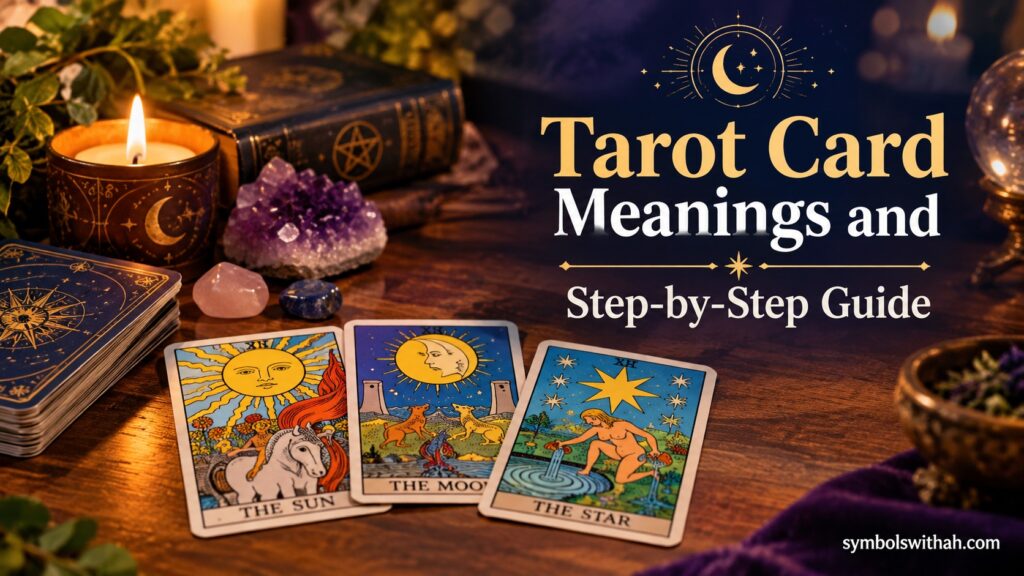

Tarot has fascinated people for centuries because its pictures turn abstract ideas into visible symbols. Tarot Card Meanings and Step-by-Step Guide helps you understand those symbols without memorizing a confusing list of definitions.
Today, tarot is used in the United States for spiritual reflection, personal journaling, creative exploration, and divination. Its imagery can explore themes such as love, choices, ambition, grief, change, identity, and personal growth.
However, tarot didn’t begin as a fortune-telling system. The earliest known tarot cards appeared in northern Italy during the 1440s and 1450s. They were created for a trick-taking card game, while their association with divination and occult practice developed much later.
Understanding that history makes the cards easier to appreciate. Their meanings aren’t simply isolated keywords. Each card combines imagery, number, suit, position, and surrounding cards into a larger visual language.
Read More: White Aura Meaning: Spiritual and Symbolism Significance
Quick Answer
Tarot Card Meanings and Step-by-Step Guide refers to a practical system for understanding the 78-card tarot deck and interpreting cards within a reading. The 22 Major Arcana often represent major themes and turning points, while the 56 Minor Arcana explore everyday experiences through four suits: Wands, Cups, Swords, and Pentacles.
TL;DR
• Tarot contains 78 cards divided into Major and Minor Arcana.
• The Major Arcana focuses on major life themes and archetypal experiences.
• Wands generally explore action, creativity, ambition, and personal drive.
• Cups focus on emotions, relationships, intuition, and connection.
• Swords often represent thoughts, communication, conflict, and decisions.
• Pentacles connect with work, resources, health, home, and material life.
What Is Tarot and What Do the Cards Represent?
Tarot is a deck of illustrated cards arranged into a structured symbolic system. Modern decks usually contain 78 cards, although individual artistic traditions can differ.
The deck has two major divisions. The first is the Major Arcana, containing 22 numbered or named archetypal cards. The second is the Minor Arcana, containing 56 cards divided among four suits.
The Major Arcana
The Major Arcana includes cards such as The Fool, The Magician, The Empress, Death, The Tower, and The World.
These cards often address larger themes rather than small daily details.
They can symbolize:
• Major transitions and personal turning points.
• Questions of identity, purpose, and direction.
• Challenges that create significant emotional or spiritual growth.
• Repeating patterns that demand greater awareness.
The familiar idea of The Fool’s Journey connects the Major Arcana into a symbolic progression. The Fool begins with openness and moves through experiences involving power, relationships, hardship, reflection, transformation, and completion.
The Minor Arcana
The Minor Arcana contains four suits:
| Suit | Common Symbolic Focus | Element Often Associated |
| Wands | Creativity, action, ambition, willpower | Fire |
| Cups | Emotions, relationships, intuition | Water |
| Swords | Thought, communication, conflict, truth | Air |
| Pentacles | Work, money, home, body, stability | Earth |
These associations are common within modern tarot systems, especially those influenced by the Rider-Waite-Smith tradition.
History of Tarot and Its Symbolic Evolution
Tarot’s history is more surprising than many modern explanations suggest. The cards were not originally created as an ancient Egyptian spiritual system.
Tarot’s Italian Origins
The earliest documented tarot references date to the 1440s and 1450s in northern Italy. Early decks were connected to a trick-taking game and included ordinary suits alongside additional trump cards.
Some surviving early decks were luxurious objects. The Metropolitan Museum of Art notes that the Visconti tarot tradition included elaborately hand-painted cards, sometimes enhanced with gold.
When Tarot Became Associated With Divination
The connection between tarot and fortune-telling developed much later.
According to the Metropolitan Museum of Art, the strong association between tarot, divination, and occultism became established during the 19th century. That means the original game and modern mystical interpretations belong to different historical periods.
This distinction matters because many popular internet explanations incorrectly present tarot as an unchanged ancient divination practice.
The Rider-Waite-Smith Influence
The Smith-Waite deck, illustrated by Pamela Colman Smith and published in 1909, became enormously influential in modern tarot. Its detailed scenes helped readers connect visual imagery with symbolic meanings.
That visual storytelling still shapes many tarot decks used today.
Tarot Card Meanings: The 22 Major Arcana
The Major Arcana is often treated as the heart of a tarot reading. Each card presents a different archetypal theme.
Major Arcana Meaning Chart
| Card | Core Meaning | Reversed Theme |
| The Fool | New beginnings, freedom, innocence | Recklessness, poor judgment |
| The Magician | Skill, willpower, creation | Manipulation, wasted ability |
| The High Priestess | Intuition, mystery, inner knowledge | Blocked intuition, secrecy |
| The Empress | Nurturing, fertility, abundance | Dependence, creative blockage |
| The Emperor | Structure, authority, stability | Rigidity, control |
| The Hierophant | Tradition, teaching, values | Rebellion, unconventional thinking |
| The Lovers | Union, choice, values | Disharmony, difficult choices |
| The Chariot | Direction, determination, control | Lack of direction, aggression |
| Strength | Courage, compassion, inner power | Self-doubt, insecurity |
| The Hermit | Reflection, solitude, wisdom | Isolation, withdrawal |
| Wheel of Fortune | Change, cycles, turning points | Resistance, instability |
| Justice | Truth, fairness, accountability | Imbalance, avoidance |
| The Hanged Man | Pause, surrender, new perspective | Stagnation, resistance |
| Death | Transformation, endings, renewal | Resistance to change |
| Temperance | Balance, patience, moderation | Excess, imbalance |
| The Devil | Attachment, temptation, material fixation | Release, awareness |
| The Tower | Upheaval, revelation, sudden change | Delayed disruption, resistance |
| The Star | Hope, renewal, inspiration | Discouragement, lost faith |
| The Moon | Uncertainty, dreams, hidden fears | Confusion clearing, avoidance |
| The Sun | Joy, clarity, vitality, success | Temporary doubt, reduced clarity |
| Judgement | Awakening, reflection, renewal | Self-doubt, refusal to learn |
| The World | Completion, achievement, wholeness | Lack of closure, incompletion |
These interpretations are best treated as symbolic starting points, not fixed predictions. Modern tarot guides commonly give both upright and reversed keywords, but readers often refine them through the question and surrounding cards.
Why Major Arcana Cards Feel So Powerful
A Major Arcana card can signal a theme that reaches beyond one isolated event.
For example, Death does not normally mean literal death. In contemporary tarot interpretation, it commonly symbolizes endings, transition, transformation, and the opening of a new phase.
Likewise, The Tower often represents disruption or a sudden revelation. Its imagery can point toward something that breaks an existing structure.
These interpretations show why tarot symbolism works through metaphor.
Tarot Minor Arcana Meanings and the Four Suits
The Minor Arcana brings tarot closer to everyday life. Its cards often address relationships, work, decisions, emotions, communication, and practical circumstances.
Wands: Fire, Action, and Creativity
Wands are commonly associated with fire.
They can represent:
• Personal ambition and motivation.
• Creative projects and inspiration.
• Courage, initiative, and movement.
• Passion, competition, and leadership.
In a reading about career, several Wands may suggest that action matters more than passive waiting.
Cups: Water, Emotion, and Relationships
Cups are commonly connected with water and emotional life.
They can explore:
• Romantic and family relationships.
• Emotional fulfillment and vulnerability.
• Intuition and imagination.
• Friendship, empathy, and social connection.
A strong presence of Cups can shift a reading toward emotional rather than practical concerns.
Swords: Air, Thought, and Conflict
Swords are associated with intellectual and communicative themes.
They can represent:
• Reasoning and difficult decisions.
• Communication and truth.
• Conflict and tension.
• Mental pressure or competing ideas.
Because swords can protect or harm, their symbolism often contains a built-in tension between clarity and conflict.
Pentacles: Earth, Work, and Material Life
Pentacles are commonly linked with earth and tangible life.
They often concern:
• Career and financial circumstances.
• Home and physical security.
• Health and the body.
• Long-term stability and practical goals.
A Pentacles-heavy reading may therefore draw attention toward what can be built, maintained, or physically experienced.
Understanding Tarot Numbers and Court Cards
You don’t need to memorize every card immediately. Numbers and court cards provide another useful layer.
Number Meanings in the Minor Arcana
The numbers can provide a broad narrative structure.
A simple modern framework is:
| Number | Common Theme |
| Ace | Potential, beginning, opportunity |
| Two | Balance, partnership, choice |
| Three | Growth, expression, development |
| Four | Stability, structure, foundation |
| Five | Tension, change, challenge |
| Six | Adjustment, harmony, movement |
| Seven | Assessment, testing, strategy |
| Eight | Progress, discipline, movement |
| Nine | Maturity, culmination, reflection |
| Ten | Completion, consequence, transition |
The exact interpretation can change by suit.
For example, the Two of Cups concerns connection, while the Two of Swords can concern indecision.
The number supplies a framework, while the suit supplies the subject.
Court Cards
The four court ranks are generally:
- Page
- Knight
- Queen
- King
They can represent people, personality patterns, stages of development, or ways of approaching a situation.
A Page may suggest learning or early exploration.
A Knight often emphasizes movement or pursuit.
A Queen can highlight inward mastery and mature expression.
A King commonly represents outward authority and developed command.
However, these are interpretive conventions rather than universal rules.
What Do Tarot Cards Mean in the United States?
Tarot has developed a distinctive cultural presence in the United States.
American readers may encounter tarot in metaphysical stores, private readings, social media communities, creative spaces, bookstores, wellness settings, and personal spiritual practices.
Tarot and American Spiritual Culture
In the United States, tarot is used across a broad spectrum.
Some people approach it as divination. Others use it as a reflective practice, creative exercise, or symbolic storytelling system.
That diversity is important because not every tarot reader believes the cards predict fixed future events.
For some practitioners, the cards provide prompts for reflection. Others view them through spiritual, mystical, religious, or intuitive frameworks.
Tarot in American Popular Culture
Tarot imagery has also moved beyond dedicated spiritual communities.
Its visual language appears in:
• Jewelry, posters, clothing, and home decor.
• Tattoos featuring cards such as The Moon or The Sun.
• Social media readings and card-pull videos.
• Fiction, music, television, and contemporary art.
• Journaling and personal reflection practices.
As tarot became visually recognizable, individual cards developed cultural associations beyond formal readings.
Spiritual and Cross-Cultural Meanings of Tarot
Tarot’s modern spiritual interpretations draw from several later traditions. These should not be confused with the original Renaissance card game.
Esoteric Correspondences
Over time, some occult traditions connected tarot with astrology, numerology, elemental systems, Kabbalah, and ceremonial magic.
These connections can be meaningful within particular schools of tarot practice.
However, they aren’t part of the documented origins of the original Italian game.
Tarot as an Archetypal Language
Some contemporary readers interpret tarot through archetypes.
An archetype is a recurring human pattern, such as:
- The seeker
- The ruler
- The caregiver
- The rebel
- The teacher
- The outsider
- The transformed self
This approach allows readers to explore universal human experiences without requiring every card to represent a literal supernatural event.
Emotional and Psychological Associations of Tarot
Tarot’s images can evoke strong emotional responses because they portray recognizable human situations.
A card showing isolation may remind someone of solitude. A card depicting celebration can evoke belonging or relief.
Why Images Matter
Visual symbolism often works faster than abstract explanation.
The High Priestess, for example, uses imagery associated with mystery and inward knowledge in many modern decks.
The Magician often presents tools, gestures, and visual contrasts associated with ability and focused action.
These images give readers something concrete to contemplate.
Tarot and Personal Reflection
A tarot card can function like a question.
Instead of asking:
“What will definitely happen?”
a reflective reader might ask:
“What does this image make me notice about my current situation?”
That shift can turn a reading into a structured form of self-examination.
It also explains why tarot can remain meaningful even for people who don’t view it as supernatural prediction.
Upright and Reversed Tarot Card Meanings
Many tarot readers distinguish between upright and reversed cards.
An upright card appears normally. A reversed card appears upside down from the reader’s perspective.
What Does a Reversed Card Mean?
A reversed card doesn’t automatically mean something negative.
Depending on the reader, it can indicate:
• An internal version of the card’s theme.
• A blocked or delayed expression.
• Excessive or insufficient energy.
• A hidden aspect of the situation.
• A lesson that needs closer attention.
For example, an upright Strength card may emphasize courage. A reversed Strength card can suggest insecurity or difficulty accessing inner confidence. Modern tarot references commonly use this type of contrast.
Do You Have to Use Reversals?
No.
Beginners can read exclusively with upright cards. This creates a simpler system and allows them to learn the basic imagery first.
Reversals can be introduced later when the reader feels comfortable with the deck.
How to Read Tarot Cards Step by Step
Learning tarot becomes easier when you treat a reading as a sequence rather than a memory test.
Choose Your Question
Start with a clear question.
Instead of:
“What is going to happen?”
try:
“What should I understand about this situation?”
Open-ended questions give the imagery more room to communicate.
Prepare the Deck
Shuffle the cards in whatever way feels comfortable.
Some readers cut the deck. Others simply shuffle and draw.
There isn’t one universally required method.
Choose a Simple Spread
Beginners can start with three cards.
A useful structure is:
Card One: Situation
Card Two: Challenge
Card Three: Guidance
This creates a simple narrative without overwhelming a new reader.
Examine the First Impression
Before looking up a textbook meaning, study the picture.
Ask:
- What catches your eye first?
- What emotion does the image create?
- Where are the figures looking?
- What symbols appear repeatedly?
- Does the scene feel active or still?
The visual details can provide useful interpretive clues.
Combine the Card With Its Position
A card doesn’t have exactly the same role in every spread.
For example, The Hermit in a challenge position can emphasize isolation or withdrawal.
The same card in a guidance position might suggest reflection and deliberate solitude.
The position changes the card’s function.
Connect the Cards Into a Story
Don’t interpret three cards as three unrelated definitions.
Instead, ask how they interact.
A reading might move from:
uncertainty → decision → action
or:
emotional tension → reflection → renewal
That narrative approach is central to learning tarot fluently.
A Beginner Three-Card Tarot Reading Example
Imagine someone asks:
“What should I understand about my current career direction?”
Suppose the cards are:
The Hermit → Two of Pentacles → The Chariot
The Hermit
The Hermit can represent reflection, solitude, and searching for insight.
In this position, it could suggest stepping back before making a major career decision.
Two of Pentacles
The Two of Pentacles is often associated with balancing priorities and adapting to change.
The card could highlight competing responsibilities or multiple options.
The Chariot
The Chariot represents direction, determination, and controlled movement.
As a final card, it can symbolically emphasize choosing a direction and moving forward with purpose.
Reading the Three Cards Together
Rather than treating the cards as predictions, you can read the sequence as a symbolic story:
Reflect carefully → balance competing demands → choose a direction.
That is often more useful than memorizing three disconnected keywords.
Common Tarot Misunderstandings and Controversies
Tarot has accumulated many myths because its imagery is mysterious and its history is complicated.
Tarot Did Not Begin in Ancient Egypt
There is no solid historical basis for the claim that tarot originated in ancient Egypt.
The earliest documented tarot evidence points to 15th-century Italy.
Ancient Egyptian imagery later became part of some occult interpretations, but that doesn’t establish Egyptian origins for tarot itself.
The Death Card Doesn’t Mean Literal Death
The Death card is one of the most misunderstood cards.
In many modern systems, it symbolizes ending, transformation, transition, and renewal.
Its imagery can be dramatic because transformation itself can feel disruptive.
Tarot Isn’t One Fixed Tradition
Different decks can interpret the same archetype differently.
The Marseille tradition, Rider-Waite-Smith tradition, Thoth tradition, and modern independent decks may use different imagery and interpretive frameworks.
The symbolism can therefore shift with the deck.
Tarot and Religion
Some religious communities view divination differently, ranging from acceptance to concern or rejection.
A respectful discussion should recognize that these positions vary among traditions and individuals.
Tarot can also be studied historically as art and cultural material without requiring a spiritual belief.
How Tarot Meanings Have Changed Over Time
Tarot has undergone several major shifts.
From Game to Divination
The first major shift occurred when a card game gradually became connected with divination and esoteric interpretation.
The historical evidence places the original game in Renaissance Italy, while the stronger occult association developed centuries later.
From Fortune-Telling to Reflection
Modern readers have expanded tarot beyond straightforward fortune-telling.
Today, some use it as:
- A spiritual practice
- A journaling prompt
- A creative exercise
- A meditation tool
- A storytelling framework
- A form of personal reflection
This broader use has helped tarot remain culturally flexible.
Modern Decks Continue Reinterpreting the Cards
Contemporary artists increasingly redesign traditional imagery.
The Metropolitan Museum of Art notes that modern artists have challenged traditional gender and hierarchical representations within tarot imagery.
As a result, tarot continues to change while retaining recognizable archetypal structures.
Tarot Cards in Tattoos, Fashion, Decor, and Social Media
Tarot imagery has become visually recognizable enough to function independently of readings.
Tarot Tattoos
Popular tattoo subjects include:
- The Moon
- The Sun
- The Star
- The Lovers
- Death
- The High Priestess
- The Magician
- The Fool
A person might choose a card because of its traditional meaning, personal experience, visual beauty, or symbolic connection.
Tarot Home Decor
Tarot-inspired artwork can add a mystical or vintage atmosphere to a room.
Common decorative choices include card prints, celestial motifs, moon imagery, stars, botanical illustrations, and symbolic line art.
Tarot on Social Media
Social media has made card pulls highly visible.
Short videos may present one card and explain a symbolic theme. Longer creators may demonstrate complete spreads or compare different decks.
However, social media explanations often simplify complex traditions. A single keyword shouldn’t be treated as the complete meaning of a card.
How to Remember Tarot Card Meanings
Memorizing 78 cards can feel intimidating.
Fortunately, you don’t need to learn every definition at once.
Learn the Major Arcana First
Start with the 22 Major Arcana cards.
Think of them as a sequence of human experiences rather than isolated vocabulary words.
Learn the Four Suits
Remember the broad themes:
Wands = action
Cups = emotion
Swords = thought
Pentacles = material life
This framework gives you a foundation for understanding the Minor Arcana.
Use Numbers as a Second Layer
Once the suits become familiar, add the number meanings.
For example:
Two + Cups = partnership and emotional connection
Two + Swords = mental conflict or difficult choice
Eight + Pentacles = disciplined work and skill development
The combination becomes easier to remember than a completely separate definition.
Study Through Images
Look at the card before reading its keywords.
Ask what the image suggests.
Then compare your impression with an established interpretation.
Over time, this develops a personal symbolic vocabulary.
Frequently Asked Questions About Tarot Card Meanings
What do the tarot cards mean?
Tarot cards represent a broad range of symbolic themes, including beginnings, choices, emotions, conflict, transformation, authority, hope, and completion. Their interpretation depends on the deck, question, position, and surrounding cards.
How many cards are in a tarot deck?
A standard modern tarot deck contains 78 cards. It typically has 22 Major Arcana cards and 56 Minor Arcana cards divided into four suits.
What are the four tarot suits?
The four common suits are Wands, Cups, Swords, and Pentacles. They are often associated with action, emotion, thought, and material life respectively.
What does the Death tarot card mean?
The Death card usually symbolizes transformation, endings, transition, and renewal. It doesn’t automatically represent literal death.
Are reversed tarot cards always negative?
No. Reversed cards can represent blocked energy, internal experiences, delays, excess, or an alternative expression of the upright theme. Some readers don’t use reversals at all.
Did tarot originate in ancient Egypt?
Historical evidence does not support that origin story. The earliest documented tarot references come from 15th-century Italy, where the cards were used in games before their later association with divination.
Can beginners read tarot cards?
Yes. Beginners can start with a simple three-card spread and learn the Major Arcana first. Understanding imagery, suits, numbers, and card positions gradually makes the system easier to interpret.
Conclusion
Tarot combines visual symbolism, archetypal storytelling, historical traditions, and personal interpretation. Its documented beginnings lie in Renaissance Italy, while its divinatory and occult associations developed centuries later.
The most useful way to approach Tarot Card Meanings and Step-by-Step Guide is to see the deck as a symbolic language. The Major Arcana explores larger themes, while the Minor Arcana brings those themes into everyday experiences involving emotions, decisions, work, relationships, and personal action.
You don’t need to memorize all 78 cards immediately. Start with the Major Arcana, learn the four suits, add number patterns, and then practice simple spreads. With time, the cards become less like a list of definitions and more like a visual vocabulary for exploring life’s questions.