
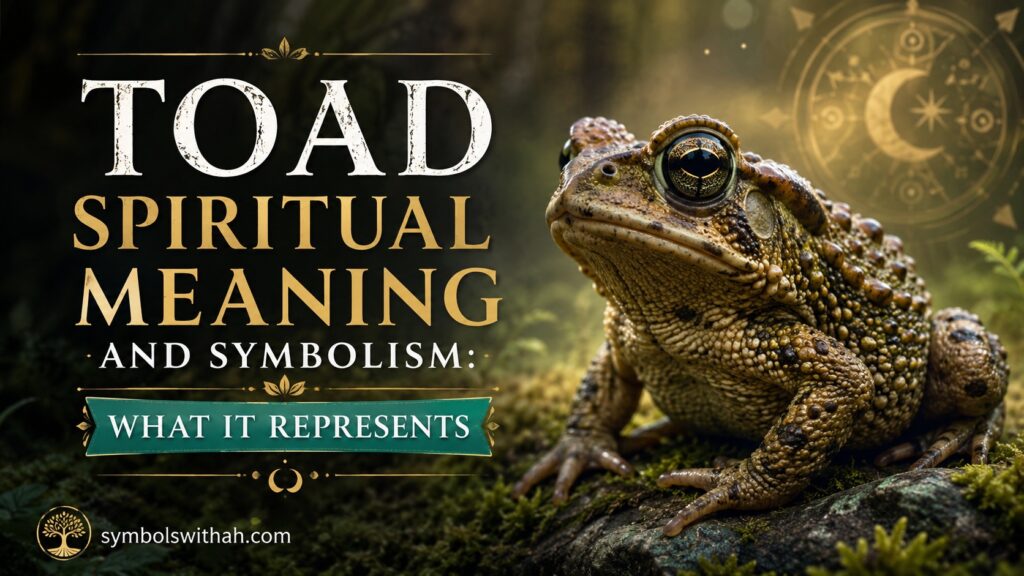

The Toad Spiritual Meaning and Symbolism often centers on transformation, resilience, grounding, fertility, protection, and hidden potential. Its unusual appearance and life between land and water have made the toad a memorable symbol across many traditions.
In the United States, people often encounter toads in gardens, yards, woods, and after summer rain. Therefore, seeing one can feel especially meaningful when it appears during a personal period of change.
At the same time, symbolism isn’t the same as a fixed spiritual rule. A toad can simply be a wild animal responding to moisture, shelter, insects, or seasonal changes. In symbolic traditions, however, its appearance has inspired many deeper interpretations.
Read More: Seeing 2 Rabbits: Spiritual Meaning and Symbolism
Quick Answer
Toad Spiritual Meaning and Symbolism in the USA commonly points to grounded transformation, resilience, protection, patience, and hidden good fortune. More broadly, toads can represent fertility, renewal, mystery, adaptability, and the ability to thrive through difficult conditions.
TL;DR
- Toads often symbolize transformation, resilience, patience, and renewal.
- In American culture, they connect strongly with rain, gardens, and nature.
- Ancient Egyptian imagery linked amphibians with regeneration and fertility.
- Chinese traditions feature the three-legged toad as a prosperity symbol.
- European folklore sometimes connected toads with magic and witchcraft.
- Today, toads can represent embracing what looks unusual or overlooked.
What Does a Toad Symbolize?
The toad’s symbolism comes partly from its physical nature. Its rough skin, earthy colors, nocturnal habits, and ability to live around water all shape how people interpret it.
For American readers, the toad can therefore symbolize something practical and grounded. It doesn’t always represent dramatic change. Instead, it often suggests surviving, adapting, and growing quietly.
The Main Symbolic Meanings
The most common associations include:
- Transformation: Growing through major changes and different life stages.
- Resilience: Surviving difficult surroundings through patience and adaptation.
- Grounding: Staying connected to the earth and practical reality.
- Renewal: Beginning again after an emotionally difficult period.
- Protection: Maintaining boundaries against unwanted influences.
- Fertility: Representing reproduction, abundance, and new life.
- Luck: Appearing as a symbol of unexpected opportunity or prosperity.
- Mystery: Connecting with nighttime, hidden places, and the unknown.
These meanings aren’t equally important in every culture. Instead, they developed from different observations, stories, religious traditions, and folk beliefs.
Why the Toad Feels Different From the Frog
People often treat frogs and toads as identical symbols. However, their cultural images can feel quite different.
Frogs are frequently pictured as watery, energetic, colorful, and playful. Toads appear more terrestrial, quiet, rough, and mysterious.
That distinction matters symbolically. The frog can suggest movement and emotional flow, while the toad often suggests patience, endurance, and earth-centered change.
Scientifically, “frog” and “toad” aren’t always strict opposites. Both belong to the order Anura, and common names don’t perfectly match biological classification.
Toad Symbolism in Nature and Appearance
Before looking at mythology, it’s useful to understand why the animal itself inspires symbolism. Its physical traits naturally create powerful metaphors.
In the United States, American toads commonly live in terrestrial environments while still depending on water for reproduction. The National Park Service notes that American toads prefer drier habitats than frogs but still need water for eggs and moist skin. (National Park Service)
Earthy Colors and Rough Skin
Brown, gray, olive, and muted green are common visual associations with toads. These colors connect the animal with soil, leaves, bark, shadows, and woodland environments.
Its bumpy skin also contributes to its symbolism. What some people find unattractive can become a symbol of authenticity.
The message can be simple: not everything valuable needs to look beautiful on the surface.
Nighttime Behavior
Many people notice toads after sunset. Their nocturnal habits give them a natural connection with darkness and hidden places.
Symbolically, this can represent:
- Inner reflection
- Hidden knowledge
- Intuition
- The subconscious
- Quiet observation
- Facing uncomfortable truths
Therefore, a toad can become a symbol of discovering value in places people usually overlook.
Historical Roots of Toad Symbolism
Toad symbolism has no single beginning. Instead, amphibians developed different meanings in separate societies.
Some of the strongest ancient associations came from the relationship between amphibians, water, fertility, and seasonal renewal.
Ancient Egypt and Regeneration
Ancient Egyptian culture provides especially strong evidence for amphibian symbolism. Frog and toad imagery appeared in amulets and religious objects.
The British Museum preserves Egyptian frog and toad amulets from different periods. One example represents the frog goddess Heket, while another Ptolemaic figure is specifically described as a frog or toad amulet associated with regeneration and fertility. (British Museum)
This connection makes sense within the Egyptian environment. Amphibians appeared in large numbers around the Nile’s seasonal waters.
Consequently, their appearance could be connected with life returning after flooding and environmental change.
Water, Birth, and Renewal
Amphibians undergo dramatic life changes. Eggs develop into tadpoles before becoming adults.
That process naturally lends itself to symbolic ideas about birth and renewal. It also helps explain why amphibian imagery became associated with fertility and regeneration.
However, it’s important not to treat every ancient frog or toad image as having exactly the same meaning. Historical symbolism changed according to period, object, location, and religious context.
European Folklore and the Toad
European folklore developed a more complicated image.
Toads sometimes represented hidden treasures, magical substances, protection, or mysterious powers. At other times, they became associated with poison, witchcraft, ugliness, or evil.
One famous medieval belief involved the so-called “toad-stone.” These objects were believed to possess protective powers, although they were actually fossilized fish teeth.
This mixture of fear and fascination helped create the familiar fairy-tale image of the magical toad.
Toad Spiritual Meaning in the USA
In the United States, the toad has a particularly earthy and familiar presence. It appears in suburban gardens, rural landscapes, parks, forests, and desert environments.
USGS resources describe frogs and toads as highly visible wildlife across the country. Their calls, movements, and appearances are part of everyday outdoor experiences for many Americans. (USGS Publications)
Rain and Seasonal Change
Americans often notice toads after rain.
This isn’t necessarily mystical. Rain creates moisture, increases insect activity, and can trigger breeding behavior in some species.
Still, the timing gives the toad an obvious symbolic connection with renewal.
A toad appearing after a storm can therefore become a metaphor for life returning after difficulty.
Gardens and the Home
Toads also appear around American homes.
They may live near gardens, porches, wood piles, rocks, and other sheltered areas. Their presence can therefore symbolize a relationship with nature close to home.
For a modern reader, this can suggest:
- Creating a calmer home environment
- Respecting natural cycles
- Protecting personal boundaries
- Finding value in simple surroundings
- Paying attention to overlooked details
The practical explanation remains important. A toad near your home usually means its habitat provides suitable moisture, shelter, and food.
A Symbol of American Resilience
The United States has a strong cultural admiration for resilience. Toad symbolism fits that theme naturally.
Toads aren’t usually portrayed as glamorous animals. Yet they survive in many environments and continue their life cycles despite predators, weather, and habitat pressures.
USGS research also shows that American toads and other amphibians depend on particular landscape conditions. Wetlands, grasslands, and connected habitats can be important for their survival. (USGS Publications)
Symbolically, that makes the toad a fitting image for persistence without perfection.
Toad Symbolism Across Cultures
Toad meanings vary considerably around the world. Some traditions emphasize fertility and renewal, while others focus on prosperity, magic, rain, or mystery.
These differences show why animal symbolism should always be understood within its cultural setting.
Chinese Three-Legged Toad
One of the best-known positive toad symbols comes from Chinese tradition.
The three-legged toad, often connected with Liu Hai, became associated with prosperity and good fortune. The Metropolitan Museum of Art describes a fourteenth-century three-legged toad as an auspicious symbol of prosperity and success. (The Metropolitan Museum of Art)
The British Museum likewise describes Liu Hai as a popular Chinese god of wealth associated with the three-legged toad and Chinese coins. (British Museum)
So, when Americans encounter a three-legged toad statue in a home or business, the intended meaning may be prosperity rather than general animal symbolism.
Japan and Daoist Imagery
The three-legged toad also traveled through East Asian artistic traditions.
The Smithsonian documents Japanese representations of Gama Sennin, a figure derived from the Chinese Liu Hai tradition. He is commonly shown with his three-legged toad companion. (Smithsonian Institution)
This demonstrates how symbols can cross borders while changing context.
Indigenous Traditions
Some modern sources make broad statements about “Native American toad symbolism.” Such claims should be treated carefully.
There isn’t one universal Indigenous interpretation. Hundreds of distinct Native nations have their own traditions, languages, stories, and relationships with animals.
Therefore, it’s better to say that particular Indigenous traditions may associate amphibians with rain, water, environmental cycles, or other meanings. These ideas shouldn’t be presented as a single belief shared by all Native peoples.
Toad Symbolism and Spiritual Transformation
Transformation is perhaps the most popular modern spiritual interpretation of the toad.
The idea comes naturally from amphibian development. A tiny aquatic stage eventually becomes a terrestrial adult with a completely different body and lifestyle.
Growing Through Change
The toad can represent change that happens gradually.
Instead of demanding an instant breakthrough, its symbolism encourages patience. Growth may happen quietly before anyone else notices it.
This interpretation can resonate with people beginning a new career, ending an old chapter, moving somewhere new, or changing their priorities.
From Discomfort to Growth
The toad also carries an unusual lesson about appearance.
Its rough skin and unusual shape may initially create discomfort. Yet those same qualities help distinguish it from more delicate-looking animals.
Symbolically, this can represent accepting parts of yourself that don’t fit conventional expectations.
The deeper message is not that discomfort is always good. Rather, something unfamiliar or unattractive can still hold value.
Toad Symbolism, Protection, and Resilience
Toads can also represent protection.
Their skin contains defensive substances, and their appearance can help them blend into their surroundings. These natural traits have encouraged symbolic interpretations involving boundaries and self-preservation.
Protection Without Aggression
A toad doesn’t symbolize protection through dominance.
Instead, it suggests quiet defense. Stay close to the ground, avoid unnecessary conflict, and protect what matters.
For some people, this becomes a useful metaphor for emotional boundaries.
Resilience and Patience
Toads also move differently from animals associated with speed.
Their slower, grounded movement creates an image of persistence rather than urgency.
Symbolically, the lesson becomes:
You don’t have to move quickly to move forward.
That idea can be especially meaningful during periods when progress feels slow.
Toads, Luck, Wealth, and Abundance
Toads have sometimes been connected with luck and prosperity.
This association is especially strong in East Asian symbolism, where the three-legged toad became a recognized prosperity image. Historical Chinese artworks show the creature in association with wealth, success, and auspicious fortune. (The Metropolitan Museum of Art)
In modern American spirituality, the meaning is often broadened.
Common Interpretations of Toad Luck
| Context | Meaning in the USA | Common Associations | Notes |
| Toad in a garden | Growth and natural abundance | Rain, soil, renewal | Often grounded in nature |
| Toad after rain | Fresh beginnings | Cleansing, change | Seasonal symbolism is common |
| Three-legged toad | Prosperity | Wealth, opportunity | Strong East Asian connection |
| Toad tattoo | Resilience and transformation | Growth, individuality | Meaning depends on design |
| Toad dream | Inner change | Hidden feelings, adaptation | Dream meanings are personal |
However, seeing an ordinary American toad shouldn’t automatically be treated as a promise of money.
The prosperity interpretation is strongest when the image deliberately uses traditional three-legged toad imagery.
Emotional and Psychological Meaning of the Toad
Symbolism often works because animals trigger emotional associations.
Toads can produce very different reactions. Some people feel affection, while others feel discomfort or fear.
The Unconventional Self
Because toads don’t fit traditional ideas of beauty, they can symbolize individuality.
A person attracted to toad imagery may appreciate:
- Authenticity over appearance
- Quiet strength over attention
- Nature over artificial perfection
- Patience over constant urgency
- Hidden value over obvious status
This doesn’t mean every toad tattoo or image carries these meanings. Personal symbolism always matters.
Shadow Symbolism
The toad’s nighttime activity and unusual appearance can also connect it with the psychological idea of the “shadow.”
In simple terms, shadow symbolism concerns parts of ourselves that we may avoid or hide.
The toad can therefore represent facing something uncomfortable without immediately rejecting it.
That might include an old fear, an unwanted habit, or an aspect of identity that deserves greater understanding.
What Does Seeing a Toad Mean Spiritually?
For people who interpret animal encounters symbolically, seeing a toad can feel significant.
However, there is no universal spiritual message attached to every sighting. Context matters more than the animal alone.
Seeing a Toad Outside
A toad outside may symbolize grounding, patience, and natural renewal.
If the encounter happens after rain, the symbolism may feel even stronger. Rain and amphibian activity naturally create an image of cleansing and fresh beginnings.
A Toad Crossing Your Path
Some spiritual interpretations view a crossing toad as a reminder to pause.
Rather than treating it as a prediction, you can use it as a reflective prompt:
What needs patience before I take my next step?
That approach keeps the symbolism personal without presenting it as a guaranteed supernatural message.
Seeing a Toad Repeatedly
Repeated sightings can feel meaningful, especially during major life changes.
Symbolically, repetition may encourage you to revisit themes such as resilience, grounding, or adaptation.
At the same time, repeated sightings may have a simple environmental explanation. Your yard may provide exactly what local toads need.
Toads in Dreams and Personal Symbolism
Dream interpretations involving toads vary widely.
A dream toad can represent something hidden, uncomfortable, resilient, or transforming. The emotional feeling of the dream often matters more than the animal itself.
If the Toad Looks Healthy
A healthy toad may symbolize strength and adaptation.
You might connect it with an area of life that is quietly becoming stronger.
If the Toad Looks Threatening
A threatening toad may reflect discomfort rather than danger.
It could symbolize something you find difficult to face. However, dream symbolism isn’t a diagnostic tool and shouldn’t be treated as a prediction.
If You Feel Calm Around the Toad
A peaceful encounter may suggest acceptance.
The dream could reflect your growing comfort with uncertainty, change, or parts of yourself you previously avoided.
Toad Tattoos, Art, and Modern Usage
Toad imagery has found a new life in contemporary American culture.
Artists can use the animal in very different styles. A realistic toad can emphasize nature, while a mystical version can highlight magic and transformation.
Popular Toad Tattoo Meanings
Common personal interpretations include:
- Transformation after hardship
- Connection with nature
- Quiet resilience
- Individuality
- Luck and prosperity
- Mystery and magic
- Acceptance of imperfection
A three-legged toad tattoo carries a more specific cultural reference. It can point toward Chinese prosperity symbolism rather than generic toad imagery.
Home Decor
Toad figures can also appear in gardens, nature-themed interiors, and spiritual spaces.
Garden statues often emphasize earthiness and connection with wildlife. Three-legged toad figures, however, may intentionally represent prosperity.
Therefore, the visual details matter.
Social Media and Pop Culture
Modern internet culture has also softened the traditional image of the toad.
Instead of always portraying the creature as ugly or sinister, contemporary art often makes toads cute, funny, wise, mysterious, or magical.
This shift gives the animal a broader emotional range.
Toads, Witchcraft, and Misunderstandings
The connection between toads and witchcraft has deep roots in European folklore. Yet modern discussions sometimes exaggerate or simplify this history.
Why Toads Became Associated With Magic
Their nighttime activity, unusual appearance, defensive secretions, and mysterious habitats made them natural folklore characters.
European stories sometimes placed toads alongside witches, potions, charms, and supernatural events.
That doesn’t mean the toad itself universally represents evil.
Instead, it reflects a particular strand of European folklore that influenced later literature and popular culture.
The “Warts From Toads” Myth
The familiar belief that touching a toad causes warts is false.
Toad skin bumps aren’t the same thing as human warts. The myth likely became popular because the animal’s appearance seemed to match the idea.
This is a good example of how physical appearance can shape folklore.
Don’t Confuse Symbolism With Biology
A toad can symbolize poison or protection in a story without being dangerous in the way folklore suggests.
Similarly, a spiritual interpretation doesn’t change the animal’s actual ecological behavior.
Keeping those categories separate creates a more accurate understanding of symbolism.
How Toad Symbolism Has Changed Over Time
The toad’s image has never been completely positive or negative.
Its meaning has shifted depending on cultural context.
In ancient Egypt, amphibian imagery could emphasize regeneration and fertility. In medieval European folklore, toads could represent both protective treasures and frightening magic. In Chinese symbolism, the three-legged toad became strongly associated with prosperity. (British Museum)
Today, American audiences often combine these older meanings with modern ideas about resilience and personal transformation.
From Ugly to Meaningful
Older Western stories frequently emphasized the toad’s ugliness.
Modern symbolism often reverses that idea.
Instead of asking whether the toad is attractive, people may ask what its unusual qualities can teach them.
That shift reflects a wider cultural interest in authenticity and embracing imperfection.
From Omen to Reflection
Older folklore sometimes treated animal appearances as omens.
Modern spiritual readers are more likely to use the encounter as a reflective prompt.
Instead of asking, “What will happen?” they may ask, “What does this moment make me think about?”
That is a meaningful change in how symbolism functions.
FAQs
1. What does a toad symbolize spiritually?
A toad commonly symbolizes transformation, resilience, grounding, patience, and renewal. Depending on the tradition, it can also represent fertility, protection, mystery, or prosperity.
2. Is seeing a toad a good omen?
Many symbolic traditions interpret toads positively, especially as signs of renewal, resilience, or good fortune. However, there is no universal rule that a toad sighting predicts good or bad events.
3. What does it mean when you see a toad?
Symbolically, seeing a toad can encourage patience, grounding, or acceptance of change. The setting and your personal feelings about the encounter can shape its meaning.
4. What is the difference between frog and toad symbolism?
Frogs are often associated with water, movement, emotional flow, and transformation. Toads tend to emphasize earth, patience, resilience, protection, and hidden strength.
5. Do toads represent wealth?
They can, particularly through the Chinese three-legged toad tradition. The three-legged toad is an established symbol of prosperity and success in Chinese art and folklore. (The Metropolitan Museum of Art)
6. Are toads connected to witchcraft?
Toads became associated with witchcraft in parts of European folklore. Today, that association is mostly a cultural and literary symbol rather than a universal meaning.
Conclusion
The Toad Spiritual Meaning and Symbolism brings together transformation, resilience, grounding, renewal, protection, and hidden potential. Its rough appearance and quiet behavior make it a powerful reminder that value isn’t always obvious.
In the United States, the toad also has a practical connection with gardens, rain, changing seasons, and local wildlife. Across other traditions, it can carry meanings involving fertility, prosperity, magic, or regeneration.
Ultimately, a toad doesn’t need to predict your future to be meaningful. Its symbolism can simply invite you to slow down, notice what’s changing, and appreciate the strength found in unexpected places