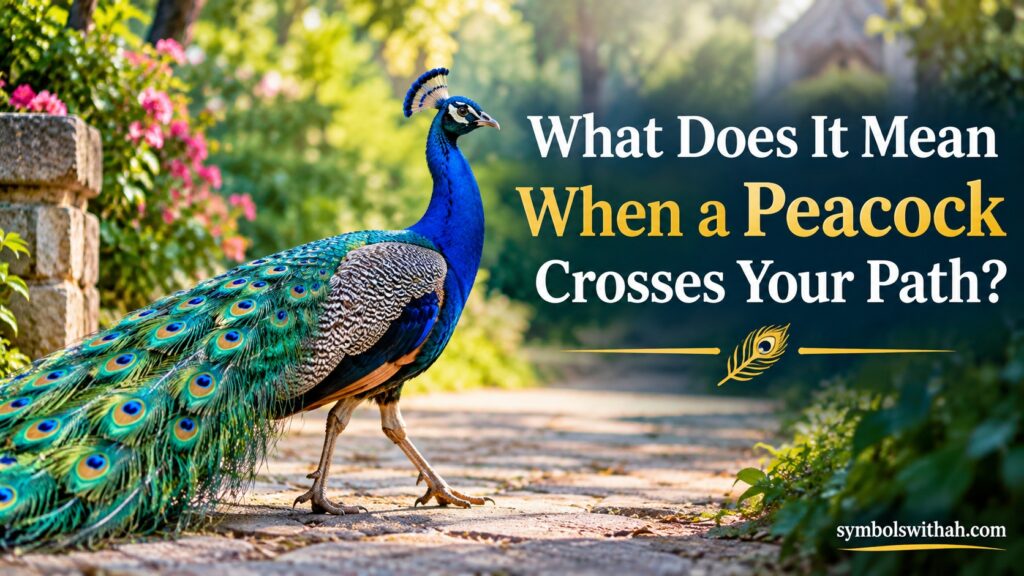

A peacock is difficult to ignore. Its brilliant feathers, graceful movement, and eye-like patterns make even an ordinary encounter feel memorable. For many people, What Does It Mean When a Peacock Crosses Your Path? becomes a meaningful question after seeing this striking bird unexpectedly.
In the United States, peacocks are often associated with beauty, confidence, individuality, and bold self-expression. Yet their symbolism reaches much further back. Ancient Mediterranean cultures, South Asian traditions, Christian art, and royal imagery all gave the bird different meanings.
However, a peacock crossing your path doesn’t have one universal message. The meaning depends on your culture, beliefs, emotions, and the circumstances surrounding the encounter. Sometimes it can simply be a beautiful wildlife moment. Other times, people use it as a prompt for personal reflection.
Quick Answer
What Does It Mean When a Peacock Crosses Your Path? In modern American symbolism, it often represents confidence, beauty, individuality, awareness, and transformation. Spiritually, some people interpret the encounter as encouragement to express yourself, recognize your worth, or become more aware of a new stage in life.
Read More: EVB Meaning in Text: What Does EVB Mean in Chat?
TL;DR
- Peacocks often symbolize beauty, confidence, individuality, and renewal.
- Their colorful eyespots can represent awareness and watchfulness.
- Ancient cultures connected peacocks with royalty, divinity, and immortality.
- Christian art often used peacocks as symbols of eternal life.
- Modern Americans often associate peacocks with bold self-expression.
- A path-crossing encounter has personal meaning rather than one fixed message.
What Does a Peacock Symbolize?
A peacock symbolizes several ideas at once. Its extraordinary appearance naturally connects it with beauty, display, confidence, and distinction.
At the same time, the bird carries an interesting contrast. Its dramatic tail can symbolize healthy self-expression, but it can also represent vanity or excessive pride.
Core Peacock Meanings
Today, common symbolic associations include:
- Beauty and visual brilliance
- Confidence and self-expression
- Individuality and uniqueness
- Renewal and transformation
- Awareness and watchfulness
- Pride and personal identity
The Smithsonian’s National Museum of Asian Art notes that peacocks can represent power, strength, confidence, and divinity in different cultural settings.
Why the Tail Matters
The male peacock spreads its enormous train during courtship. The feathers create a shimmering fan filled with blue, green, bronze, and eye-like markings.
Because the display is so dramatic, people naturally connect the bird with visibility and confidence. In symbolic language, the peacock often asks us to consider how comfortably we show our own qualities.
What Does It Mean Spiritually When a Peacock Crosses Your Path?
A peacock crossing your path can be interpreted as an invitation to notice something. Rather than treating the bird as proof of a supernatural message, many spiritual interpretations use the encounter as a metaphor.
The moment may encourage greater awareness of your direction, identity, or personal growth.
A Reminder to Be Seen
Peacocks don’t hide their most distinctive feature. Their symbolism can therefore encourage authentic self-expression.
A spiritual interpretation may suggest:
- Let your natural talents become more visible.
- Stop shrinking yourself to please others.
- Express your creativity without unnecessary fear.
- Recognize qualities you once overlooked.
- Allow confidence to replace excessive self-doubt.
This interpretation is especially common in modern spiritual writing.
A Call to Awareness
The feather’s eye-like markings add another layer. They can suggest observation, insight, and paying attention.
Therefore, a peacock encounter may become a personal reminder to look beyond the obvious. Something you’ve overlooked might deserve closer attention.
What Does It Mean When a Peacock Crosses Your Path Unexpectedly?
The unusual timing can make a peacock encounter feel especially powerful. A bird appearing directly in your path interrupts your normal routine.
For a moment, you stop and look. That pause itself can become part of the symbolism.
The Meaning of an Unexpected Encounter
Some people interpret unexpected animal encounters as synchronicities. This means an event feels personally meaningful because it occurs alongside an important thought or experience.
For example, someone considering a career change might encounter a peacock while reflecting on confidence. The bird doesn’t objectively answer the decision. Still, the encounter may inspire useful reflection.
Consider the Circumstances
Ask yourself what was happening before you noticed the bird.
Your interpretation may become clearer when you consider:
- What you were thinking about
- How you felt during the encounter
- Where the peacock appeared
- What the bird was doing
- Why the moment stayed in your memory
The context often matters more than a fixed symbolic dictionary.
Ancient Origins of Peacock Symbolism
Peacock symbolism has remarkably old roots. The bird originated in South Asia and later became an exotic import into the ancient Mediterranean world.
Research on the peacock’s arrival in Greece and Rome shows that its symbolism developed through contact with Persian, Greek, Roman, Jewish, and Christian traditions.
The Peacock in Ancient Greece
Greek culture connected the peacock with Hera, the goddess associated with marriage and sovereignty.
One famous myth explains the bird’s eye-like feathers through Argus Panoptes. Argus was a watchman with many eyes. After his death, Hera was said to preserve his eyes in the peacock’s tail.
That story helped connect the bird with:
- Watchfulness
- Protection
- Royal authority
- Vigilance
- Divine association
The eye patterns therefore became more than decorative features in symbolic art.
From Exotic Bird to Sacred Image
The peacock was initially unusual in Greece. Its rarity and expense also contributed to associations with wealth and luxury.
Over time, however, its symbolism became more complex. Ideas about death, renewal, immortality, and divine protection became attached to the bird in different settings.
Peacock Symbolism in Ancient India and South Asia
South Asia provides some of the deepest cultural connections to the peacock. The Indian peafowl has appeared in art, literature, textiles, religious imagery, and royal settings for centuries.
Government cultural material from India’s Handlooms Development Commissioner notes peacock imagery in art from the Indus Valley period through Buddhist, Gupta, Mughal, and later traditions.
Beauty, Love, and Divinity
In South Asian traditions, the peacock can represent beauty, love, courtship, and divine presence.
Peacock imagery also appears in connection with several religious figures. For example, Krishna is commonly portrayed wearing a peacock feather, while peacock symbolism appears in traditions connected with Kartikeya or Murugan.
These meanings are not identical across every South Asian tradition. Instead, each should be understood within its own religious and artistic context.
Why the Peacock’s Rain Connection Matters
In parts of South Asia, peacock behavior has long been associated with the arrival of rain and the monsoon season.
That relationship can strengthen symbolic ideas of:
- Renewal
- Fertility
- Celebration
- Seasonal change
- Life returning after dryness
The bird’s beauty therefore becomes connected with nature’s cycles as well as personal transformation.
What Does a Peacock Symbolize in Christianity?
Peacock imagery also became important in early Christian art. Its symbolism developed partly from ancient beliefs about the bird and its feathers.
Early Christian artists used the peacock to represent ideas connected with immortality, resurrection, and eternal life.
The Peacock and Eternal Life
Ancient writers believed the peacock’s flesh resisted decay. Although that belief was not scientifically accurate, it influenced later symbolism.
The bird also molts and grows new feathers. This seasonal renewal made it a useful image for resurrection.
As a result, peacock imagery appeared in Christian catacombs, mosaics, tombs, and religious artwork.
The Feather’s “Eyes”
The eye-like markings on the tail also developed Christian interpretations.
Some Christian artistic traditions connected these markings with divine sight or God’s awareness. However, this should be understood as iconographic symbolism rather than a universal Christian doctrine.
The same visual feature can therefore carry different meanings across cultures.
What Does a Peacock Mean in the United States?
In contemporary America, peacocks are usually encountered outside formal religious symbolism. They’re seen in gardens, estates, parks, private collections, artwork, fashion, and decorative design.
As a result, American interpretations often focus on identity and appearance.
Confidence and Individuality
A peacock can symbolize someone who isn’t afraid to stand out.
Modern American associations commonly include:
- Personal confidence
- Creative expression
- Individual style
- Beauty and elegance
- Social visibility
- Self-acceptance
The bird’s dramatic appearance fits a culture that often celebrates personal expression.
Beauty With a Warning
American symbolism also preserves the older association with vanity.
The phrase “proud as a peacock” can describe someone who appears overly pleased with themselves. Therefore, the bird can represent either confidence or excessive pride.
That distinction is important.
Healthy confidence says, “I value who I am.” Vanity can suggest, “I need everyone to admire me.”
Peacock Symbolism at a Glance
| Context | Meaning in the USA | Common Association | Important Note |
| Crossing your path | Awareness and confidence | Personal reflection | Meaning depends on context |
| Peacock feathers | Beauty and individuality | Fashion and decor | Can carry different cultural meanings |
| Peacock tattoo | Transformation and identity | Self-expression | Personal symbolism varies |
| Christian artwork | Eternal life | Resurrection and renewal | Historical religious context matters |
| Home decor | Elegance and color | Luxury and nature | Usually decorative rather than religious |
| Excessive display | Vanity or pride | Attention-seeking | Context determines interpretation |
What Does a Peacock Crossing Your Path Mean in Love?
A peacock can have a strong connection with attraction because its elaborate tail is part of courtship behavior.
Therefore, people sometimes interpret a peacock encounter as a reminder about attraction, confidence, or romantic self-expression.
Romantic Symbolism
In a relationship context, the peacock may suggest:
- Attraction and admiration
- Confidence in your appearance
- Expressing affection openly
- Celebrating individuality within love
- Recognizing your personal worth
However, the bird doesn’t predict a relationship outcome. Instead, its symbolism can encourage reflection on how you express yourself.
Confidence in Relationships
Sometimes the most useful interpretation is simple: don’t disappear inside a relationship.
The peacock’s symbolism can remind you to maintain your identity while connecting with another person. Confidence and affection can coexist without demanding constant attention.
What Does a Peacock Feather Symbolize?
Peacock feathers have their own symbolic history. Their colors and eye-like patterns make them especially powerful visual objects.
The feather can represent beauty, protection, awareness, renewal, and individuality.
The Meaning of the “Eyes”
The circular markings resemble eyes. In some traditions, they became associated with watchfulness and perception.
A feather may therefore symbolize:
- Seeing a situation more clearly
- Staying aware of hidden details
- Protecting personal boundaries
- Developing greater self-knowledge
- Looking beyond appearances
Still, the same feather can have very different meanings depending on cultural context.
Beauty and Identity
Today, peacock feathers are common in jewelry, artwork, tattoos, clothing, and interior design.
Their vivid colors make them popular among people who want a symbol of individuality. A feather can say something visually before words are spoken.
What Does a Peacock Symbolize Psychologically?
Animal symbolism often works because people recognize parts of themselves in animals.
The peacock can reflect the tension between wanting to be seen and fearing judgment.
Confidence Versus Approval
A peacock’s display is visually bold. Symbolically, that can represent the desire to express yourself without hiding.
However, it can also raise a useful question: Are you expressing yourself for personal fulfillment or outside approval?
This distinction gives the symbol emotional depth.
Emotional Associations
A peacock may evoke feelings such as:
- Pride in personal progress
- Desire for recognition
- Creative excitement
- Social confidence
- Beauty and pleasure
- Concern about judgment
The meaning can change with the person’s emotional state.
Someone feeling invisible may see the bird as encouragement. Someone struggling with excessive pride may see it as a reminder to remain grounded.
Peacock Symbolism in Tattoos, Fashion, and Decor
Peacock imagery remains popular because it combines natural beauty with strong symbolism.
The design can be subtle or dramatic. A single feather creates a different message than a fully displayed bird.
Peacock Tattoos
A peacock tattoo can symbolize personal transformation, confidence, creativity, or individuality.
Design choices can change the emphasis:
- A spread tail emphasizes confidence and visibility.
- A single feather highlights beauty and awareness.
- A flying peacock can suggest freedom.
- Floral elements can emphasize beauty and renewal.
- Geometric designs can create a modern identity symbol.
The personal story behind the tattoo usually matters more than a generic definition.
Home Decor and Fashion
Peacock patterns often appear in textiles, paintings, jewelry, accessories, and decorative objects.
Their rich colors can communicate elegance and luxury. However, some designs use the bird simply because its appearance is visually striking.
Not every peacock decoration has spiritual meaning.
Is Seeing a Peacock a Sign of Good Luck?
Some spiritual traditions and modern interpretations treat the peacock as a positive symbol.
Its associations with beauty, renewal, abundance, and confidence can make an encounter feel fortunate.
Why People Call It Lucky
The idea of good fortune often comes from the bird’s broader symbolism.
A peacock can represent:
- New opportunities
- Personal growth
- Confidence after uncertainty
- Creative success
- Positive transformation
However, seeing a peacock doesn’t guarantee that something fortunate will happen.
It can instead become a symbolic reminder to notice opportunities already around you.
What Does a Peacock Mean When It Appears Repeatedly?
Repeated encounters can feel especially meaningful. Seeing a peacock several times may encourage you to consider why the image keeps catching your attention.
A Symbol of Repeated Reflection
You might ask whether the same theme keeps appearing in your life.
Perhaps you’re being reminded to:
- Express yourself more honestly.
- Stop comparing yourself with others.
- Recognize your recent growth.
- Protect your personal boundaries.
- Balance confidence with humility.
At the same time, repeated sightings can have ordinary explanations. If peacocks live nearby, you’re naturally more likely to see them.
Symbolic meaning doesn’t require ignoring practical explanations.
Misunderstandings About Peacock Symbolism
Peacock symbolism becomes confusing when one cultural interpretation is treated as universal.
The bird has accumulated meanings from many different historical settings. Beauty in one tradition may represent immortality in another.
One Bird, Many Meanings
A peacock can symbolize:
- Royal power in one setting
- Immortality in another
- Divine connection elsewhere
- Vanity in moral artwork
- Individuality in modern American culture
None of these automatically cancels the others.
Instead, symbolism works through context.
Avoid Treating Spiritual Interpretations as Facts
A peacock crossing your path may feel meaningful. Yet there is no universal rule proving that the encounter carries a supernatural message.
A balanced interpretation allows both possibilities. The bird can have natural causes and personal symbolic meaning at the same time.
How Peacock Symbolism Has Changed Over Time
Peacock symbolism has moved through several major stages. Its earliest meanings cannot simply be copied into modern life.
In ancient South Asia, the bird developed rich artistic and religious associations. In Greece and Rome, it became connected with royalty, mythology, and ideas surrounding death and immortality. Early Christian art then adapted some existing symbolism to express eternal life and resurrection.
Today, Americans often encounter the peacock through personal style, nature imagery, gardens, tattoos, art, and home decor.
From Divinity to Individuality
The biggest modern shift is perhaps the move toward personal identity.
Older religious artwork often used the peacock to communicate collective beliefs. Modern individuals may use the bird to communicate something about themselves.
The symbol has therefore moved from sacred imagery toward personal expression without losing its older associations completely.
How to Interpret a Peacock Crossing Your Path
If a peacock appears unexpectedly, you don’t need to force a single answer.
Instead, consider what the encounter brings to mind. Your reaction may reveal more about its personal meaning than any symbolic dictionary.
Questions to Ask Yourself
Consider these questions:
- What was I thinking about before I saw the peacock?
- Did the encounter make me feel peaceful, excited, or curious?
- Am I entering a period of personal change?
- Do I need more confidence in some area?
- Am I seeking recognition from others?
- Could I express my identity more honestly?
These questions turn an ordinary encounter into a moment of reflection.
Let the Context Guide You
A peacock standing calmly in a garden creates a different feeling from one running across a busy street.
Likewise, seeing a peacock during a major life transition may feel different from seeing one during a normal afternoon.
Symbolism becomes strongest when it connects naturally with your experience.
FAQs
What does it mean spiritually when a peacock crosses your path?
A peacock crossing your path is often interpreted as a symbol of confidence, awareness, beauty, and transformation. Some people also view it as encouragement to express their authentic identity.
Is seeing a peacock a good sign?
Many modern spiritual interpretations view peacocks positively. They can represent renewal, confidence, beauty, opportunity, and personal growth, although an encounter doesn’t guarantee a particular outcome.
What does a peacock symbolize in love?
Peacocks can symbolize attraction, admiration, confidence, and romantic self-expression. Their courtship display also makes them natural symbols of beauty and attraction.
What does a peacock feather symbolize?
A peacock feather can symbolize beauty, awareness, protection, renewal, and individuality. Its meaning varies significantly between cultures and personal traditions.
What does a peacock symbolize in Christianity?
In Christian art, peacocks became associated with immortality, resurrection, and eternal life. These meanings developed through ancient beliefs and later Christian artistic traditions.
What does it mean if I keep seeing peacocks?
Repeated sightings may feel like a personal reminder about confidence, visibility, or transformation. However, repeated encounters can also have ordinary explanations, especially where peacocks are common.
Conclusion
So, What Does It Mean When a Peacock Crosses Your Path? There isn’t one universal answer. The bird can symbolize beauty, confidence, awareness, individuality, renewal, and transformation, while its dramatic display can also represent pride or vanity.
Its history makes the symbolism even richer. Ancient Mediterranean traditions connected the bird with divine watchfulness and immortality, while South Asian traditions developed their own sacred and cultural meanings. Christian artists later used the peacock as an image of eternal life.
For a modern American reader, a peacock encounter can simply be a beautiful moment in nature. Yet if it makes you pause, reflect, or think differently about yourself, that personal meaning can be worth exploring. Sometimes the most useful symbol isn’t one that predicts the future. It’s one that helps you notice the present.