
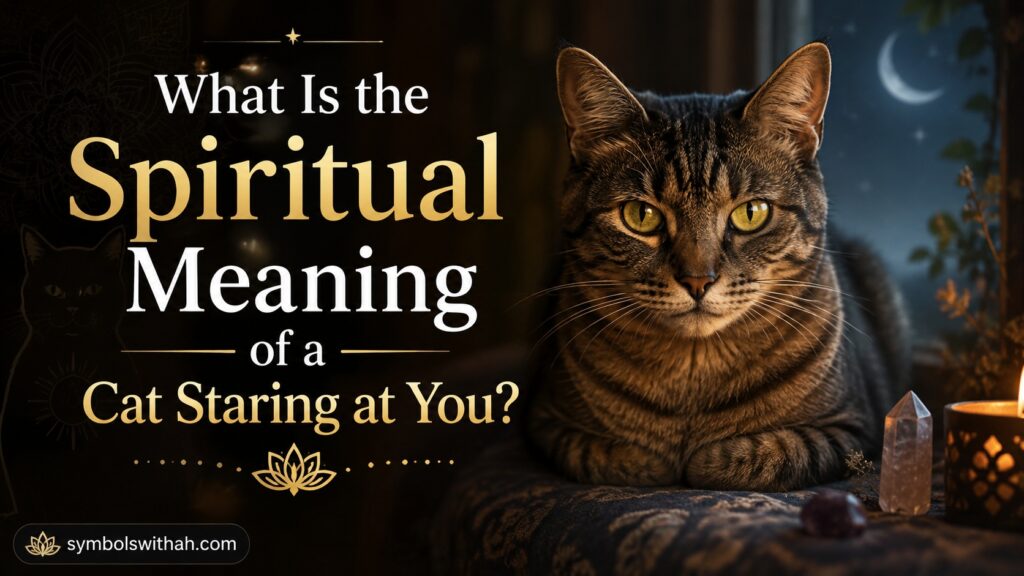

If you’ve ever wondered, What Is the Spiritual Meaning of a Cat Staring at You?, you’re not alone. A cat’s steady gaze can feel unusually intense, especially when it happens during a quiet moment.
In everyday life, a cat may simply be watching you because it wants food, attention, play, or reassurance. However, people have also given cats deeper symbolic meanings for thousands of years. Their quiet movements, nighttime activity, independence, and watchful eyes have made them powerful symbols across cultures.
In the United States today, a staring cat can represent intuition, awareness, affection, independence, or protection. For spiritually minded people, the moment may also become an invitation to slow down and notice what’s happening within.
Read More: Dead Flies in House: Spiritual Meaning and Magical Meanings
Quick Answer
What Is the Spiritual Meaning of a Cat Staring at You? It’s commonly interpreted as a symbol of intuition, awareness, protection, affection, or a need to pay closer attention. In the USA, these meanings often blend modern pet companionship with older ideas about cats as mysterious and watchful animals.
TL;DR
- A staring cat can symbolize intuition and heightened awareness.
- Many people interpret the gaze as a sign of protection or companionship.
- Ancient Egypt connected cats with protection, prosperity, and divine power.
- American culture gives cats both comforting and mysterious associations.
- A soft gaze may symbolize affection, trust, and emotional connection.
- Spiritual interpretations are personal rather than proven supernatural messages.
What Does a Cat Staring at You Symbolize?
A cat’s stare is often interpreted through the situation surrounding it. The cat’s posture, eye expression, behavior, and your own feelings can all influence the meaning.
For example, a relaxed cat staring at you may suggest comfort and connection. A tense cat with flattened ears communicates something very different.
Common spiritual interpretations
People commonly connect a cat’s focused gaze with:
- Intuition and inner awareness
- Protection and watchfulness
- Affection and emotional connection
- Independence and personal boundaries
- Mystery and the unseen
- A reminder to slow down and observe
These interpretations aren’t universal rules. Instead, they come from symbolism, folklore, personal spirituality, and the long relationship between humans and cats.
The meaning depends on the moment
Consider what was happening immediately before the stare.
If you were making an important decision, you might interpret the cat as a reminder to trust your instincts. If you were feeling lonely, the same moment might feel like companionship.
That personal context matters because symbolism often works through association rather than fixed definitions.
Why Do Cats Have Such Strong Spiritual Symbolism?
Cats naturally invite symbolic thinking because their behavior can seem mysterious. They move quietly, sleep for long periods, become active at unusual hours, and observe their surroundings carefully.
Their eyes also contribute to this image. A cat can remain perfectly still while watching something for several minutes.
The watcher archetype
In symbolic language, a watcher observes without immediately acting. Therefore, the cat’s gaze can represent patience, awareness, and careful attention.
This makes the cat different from symbols associated with loudness or force. Its power is often portrayed as quiet and controlled.
Mystery and independence
Cats also symbolize independence because they often appear self-directed. They can show affection while maintaining strong personal boundaries.
For modern readers, that combination can represent a healthy balance between connection and autonomy.
Ancient Egyptian Cat Symbolism
Few ancient traditions shaped feline symbolism more strongly than ancient Egypt. Cats were associated with protection, prosperity, and divine qualities, especially through the goddess Bastet.
The Metropolitan Museum of Art notes that Bastet was represented in feline form and associated with protection and prosperity. Cat figures from the Late Period and Ptolemaic Period also show the animal in an alert, upright posture. (The Metropolitan Museum of Art)
Bastet and the protective cat
Bastet’s symbolism changed over time, but her feline form became strongly associated with protective and nurturing qualities.
The Rosicrucian Egyptian Museum describes Bastet as a goddess connected with protection, pleasure, and good health. Her feline imagery also carried an important watchful quality. (Egyptian Museum)
That history helps explain why a staring cat can still feel protective to modern observers.
The cat as a guardian
Ancient Egyptian feline imagery often emphasized alertness. A seated cat could appear calm while remaining ready to respond.
Symbolically, that creates a powerful combination:
- Calmness without passivity
- Gentleness without weakness
- Awareness without panic
- Protection without aggression
These qualities remain easy for modern people to recognize in cats.
Cat Symbolism in the United States
American culture has developed a complicated relationship with feline symbolism. Cats can represent comfort, independence, mystery, humor, companionship, and even supernatural themes.
Today, most Americans encounter cats primarily as household companions. Yet older folklore still influences movies, decorations, Halloween imagery, and popular spiritual discussions.
The modern American cat
In American homes, cats often symbolize companionship without constant dependence. Their independent nature can feel especially meaningful to people who value privacy and personal freedom.
A cat staring calmly from across the room may therefore feel less like a supernatural event and more like a quiet moment of connection.
Halloween and mystery
Black cats have also become strongly associated with Halloween in the United States. Their connection with witchcraft and bad luck developed from European folklore rather than from an inherent quality of black-coated cats. (HISTORY)
This creates an interesting contrast. The same animal can symbolize protection and affection in one context, but mystery or fear in another.
What Does a Cat Staring at You Mean Spiritually?
Spiritual interpretations usually focus on what the cat’s attention seems to represent. Rather than treating one meaning as universal, it helps to consider several possibilities.
1. A reminder to trust your intuition
Cats are often associated with instinct. Their alertness and sensitivity make them natural symbols for paying attention to subtle feelings.
A staring cat may therefore become a personal reminder to listen to your instincts before making a choice.
2. A symbol of protection
Because cats have historically been associated with guardianship, their gaze can represent watchfulness.
Some spiritual traditions interpret the moment as a comforting symbol of being observed or protected. This is a spiritual interpretation, not proof that a cat can detect supernatural forces.
3. A call to become more observant
Cats rarely rush into every situation. They watch first.
Consequently, their stare can symbolize a simple lesson: observe before reacting.
4. Emotional companionship
A cat’s gaze can also feel reassuring during difficult periods. For some people, the animal becomes a symbol of steady presence.
The meaning may be especially strong when the cat sits quietly nearby without demanding anything.
What Does It Mean When a Cat Stares at You and Blinks?
A cat that looks at you and slowly blinks is commonly associated with comfort and trust. Animal behavior experts describe staring as one possible form of feline communication, with context and body language helping distinguish affection from requests or discomfort. (PetMD)
The symbolic meaning of the slow blink
In spiritual symbolism, the slow blink can represent:
- Trust developing quietly
- Emotional safety
- Mutual affection
- Calm communication
- Acceptance without pressure
A slow blink also fits the broader symbolic personality of the cat. It suggests communication without dramatic action.
Why context still matters
However, spiritual interpretation shouldn’t replace observation of normal feline behavior.
A cat may stare because it wants food, attention, play, or access to something. Cats also watch people because they are naturally curious and responsive to movement. (PetMD)
What Does a Cat Staring at You Mean at Night?
Nighttime can make a cat’s stare feel especially mysterious. Dim lighting naturally creates a stronger emotional response, particularly when the animal appears silently from across a room.
The spiritual interpretation
Spiritually, nighttime is often associated with reflection, dreams, intuition, and the unknown. Therefore, a cat staring at you at night may be interpreted symbolically as a reminder to notice your inner world.
Some people see it as a sign to pause and reflect on thoughts they’ve been avoiding.
The ordinary explanation
Cats can also be active and attentive during nighttime hours. They may be watching because they hear movement, expect food, want attention, or are simply awake while you’re sleeping. (The Spruce Pets)
So, a nighttime stare doesn’t automatically carry a supernatural meaning.
Cat Staring at You: Meaning by Context
The same behavior can feel very different depending on the circumstances. For a USA audience, this distinction helps separate cultural symbolism from everyday pet behavior.
| Context | Meaning in the USA | Common Association | Notes |
| Relaxed cat | Affection or curiosity | Companionship | Look for relaxed body language |
| Slow blinking | Trust and comfort | Emotional bond | Often seen as friendly communication |
| Cat staring at night | Mystery or awareness | Intuition | Normal feline nighttime activity can explain it |
| Black cat staring | Mystery or protection | Halloween folklore | Meanings vary widely by tradition |
| Stray cat watching you | Curiosity or caution | Unexpected encounter | The cat may simply be assessing safety |
The important point is that symbolism works alongside context. A relaxed gaze generally feels very different from a defensive stare.
Cross-Cultural and Spiritual Cat Meanings
Cats have never had one universal symbolic meaning. Different societies have emphasized different aspects of the animal.
Japan and the beckoning cat
In Japan, the maneki-neko, or beckoning cat, is traditionally associated with good fortune and prosperity. These figures are commonly placed near entrances and businesses. (Japan Travel)
This tradition offers a useful contrast to American black-cat superstition. A feline figure can represent welcome and good fortune rather than danger.
Norse associations
In Norse mythology, cats are associated with the goddess Freyja in later literary traditions and modern retellings. This has helped connect cats with themes such as femininity, independence, beauty, and mystery.
However, modern spiritual interpretations should not automatically be treated as exact descriptions of ancient Norse belief. Historical evidence is more complex than many modern summaries suggest.
A broader spiritual pattern
Across different traditions, feline symbolism often returns to a few recurring ideas:
- Protection
- Independence
- Mystery
- Fertility and abundance
- Sensitivity
- Watchfulness
- Grace
The details change, but the cat’s unusual combination of softness and power remains important.
The Psychological Meaning of a Cat’s Gaze
Symbolism can also reveal something about the person interpreting the moment. When an animal stares at us, we naturally wonder what it is noticing.
That curiosity can turn the moment into a form of self-reflection.
Why the gaze feels meaningful
Humans are highly responsive to eye contact. A direct gaze can create a feeling of connection, attention, or tension.
Because cats can remain quiet while staring, their gaze may feel more mysterious than a human interaction.
What you might associate with it
Depending on your emotional state, the stare may remind you of:
- A need for reassurance
- A desire for companionship
- A decision requiring careful thought
- A need for stronger boundaries
- A wish to trust yourself more
In this sense, the spiritual meaning may come partly from what the moment brings to your attention.
Cat Staring at You as a Sign of Protection
Protection is one of the most popular spiritual interpretations of feline behavior. This association has deep historical roots, especially in Egyptian symbolism.
A cat’s ability to remain alert while appearing relaxed makes it an appealing guardian symbol.
The quiet guardian
Unlike a traditional warrior symbol, the cat doesn’t need to look aggressive. Its power comes from awareness.
Therefore, a staring cat can represent the idea that protection sometimes means noticing problems early rather than fighting them later.
Protection and personal boundaries
The cat can also symbolize emotional boundaries. Cats often decide when they want closeness and when they want space.
For modern readers, that can become a useful metaphor for respecting your own limits.
Cat Staring at You as a Sign of Intuition
Intuition is another common spiritual interpretation. Cats are often portrayed as creatures that notice things humans overlook.
Their sharp senses and careful movements naturally support this symbolism.
Look before you leap
If a cat suddenly captures your attention, you might use the moment as a reminder to observe your surroundings.
That doesn’t mean the cat has delivered a supernatural prediction. Instead, the experience can encourage mindful attention.
A symbolic question to ask yourself
When the stare feels unusually meaningful, ask:
What am I noticing right now that I normally ignore?
That question keeps the experience personal without requiring a supernatural explanation.
Black Cats, Fear, and Spiritual Misunderstandings
One of the biggest problems with feline symbolism is the assumption that every spiritual meaning is positive or negative.
Black cats are a clear example. In parts of Western folklore, they became associated with witches, bad luck, and supernatural danger. These ideas developed through historical religious and folk traditions rather than through anything inherently threatening about black cats. (HISTORY)
Why the misunderstanding persists
Halloween imagery continues to use black cats as shorthand for mystery and fright. The Smithsonian’s National Museum of American History has documented black-cat imagery as part of American Halloween traditions. (National Museum of American History)
At the same time, other cultures have viewed black cats positively. Historical and modern traditions in places such as Japan and Scotland have associated them with good fortune or prosperity. (HISTORY)
Symbolism isn’t destiny
A cat’s coat color doesn’t determine its spiritual character.
Likewise, a staring cat isn’t automatically a warning, omen, or supernatural messenger. Symbolism is most useful when treated as a way to explore meaning rather than as certainty.
How Cat Symbolism Has Changed Over Time
Cat symbolism has shifted dramatically. Ancient societies could view cats as sacred or protective, while later European traditions sometimes connected them with witchcraft and danger.
Today, American culture contains pieces of both histories.
From sacred animal to household companion
Ancient Egyptian imagery connected cats with divine qualities and protection. Later folklore gave them darker associations, particularly in medieval and early modern Europe.
Modern American culture has largely softened those extremes. Cats are now commonly associated with companionship, humor, independence, internet culture, and home life.
From superstition to self-expression
Today, cat symbolism appears in tattoos, artwork, clothing, jewelry, home decor, social media, and spiritual practices.
A person may choose a cat image to represent independence. Another may choose it for intuition, protection, mystery, or simply affection for cats.
The symbol remains flexible because the cat itself can embody several seemingly opposite qualities.
Cat Symbolism in Tattoos, Decor, and Social Media
Cats have become highly adaptable symbols in modern American culture. Their recognizable shape makes them easy to use visually, while their long history gives them deeper associations.
Tattoos
A cat tattoo may represent:
- Independence and self-reliance
- A beloved companion
- Intuition and mystery
- Protection and resilience
- A connection with feminine symbolism
- Memories of a specific animal
The details often change the message. A sleeping cat can feel peaceful, while a wide-eyed cat can emphasize awareness.
Home decor
Cat imagery can make a room feel playful, cozy, mysterious, or elegant.
Moon-and-cat designs often emphasize nighttime symbolism. Meanwhile, minimalist cat silhouettes tend to focus more on affection and simplicity.
Social media
Online, cats often combine serious symbolism with humor. A mysterious stare may be described as psychic awareness in one post and a demand for dinner in the next.
That contrast reflects modern cat culture well: people can enjoy the symbolism without taking every interpretation literally.
Is a Cat Staring at You a Bad Spiritual Sign?
Usually, there’s no reason to treat a cat’s stare as automatically negative. Spiritual traditions differ, and everyday feline behavior provides many ordinary explanations.
A cat may stare because it’s curious, hungry, affectionate, alert, playful, or uncertain. Body language provides important context. (PetMD)
When the stare feels uncomfortable
If the cat has an arched back, flattened ears, defensive posture, or other signs of fear or aggression, give it space.
Likewise, a sudden major behavior change can have ordinary causes that deserve attention. Spiritual symbolism should never prevent responsible care for an animal.
A balanced interpretation
A helpful approach is to hold two ideas at once:
The cat may simply be behaving like a cat.
At the same time, you can personally use the moment as a reminder of intuition, awareness, affection, or protection.
FAQs
1. What does it mean when a cat stares at you?
A cat may stare because it wants food, attention, play, or simply because it’s observing you. Spiritually, people may interpret the gaze as intuition, protection, affection, or awareness.
2. Is a cat staring at you a spiritual sign?
Some spiritual traditions and modern interpretations treat feline behavior as symbolic. However, there’s no universal rule proving that a stare is a supernatural message.
3. What does it mean when a cat stares at you and blinks?
A relaxed stare followed by slow blinking is commonly associated with comfort and trust. Symbolically, people may interpret it as affection or emotional connection.
4. What does it mean if a cat stares at you at night?
Spiritually, nighttime staring can symbolize intuition, mystery, or self-reflection. Practically, cats can also be alert at night and may simply be watching their surroundings.
5. Does a black cat staring at you mean bad luck?
Not necessarily. Black cats have been linked with bad luck in some Western folklore, while other cultures have associated them with prosperity or good fortune.
6. Can cats sense spiritual energy?
Many spiritual beliefs suggest that cats are unusually sensitive to unseen energies. However, this is a spiritual belief rather than an established scientific fact.
Conclusion
The spiritual meaning of a cat staring at you often centers on intuition, awareness, protection, affection, and independence. These themes make sense within both modern American culture and the much older history of feline symbolism.
At the same time, the simplest explanation may be the correct one. Your cat could be hungry, curious, affectionate, playful, or simply watching what you’re doing.
Still, a quiet stare can become meaningful if it makes you pause. Whether you view it spiritually or symbolically, let the moment encourage greater awareness of yourself, your surroundings, and the connections you value.