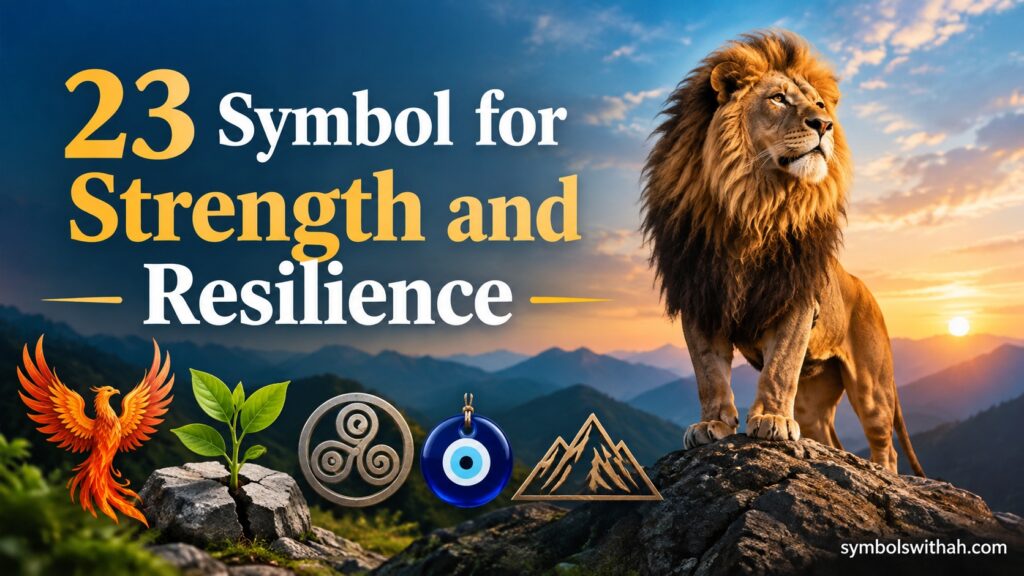

Strength doesn’t always look like a clenched fist or a roaring animal. Sometimes it looks like a tree standing through another winter, a mountain refusing to move, or a flower rising from murky water. 23 Symbol for Strength and Resilience brings together these different visual languages of endurance, courage, recovery, and inner power.
In the United States, strength symbols appear everywhere. You can find them in tattoos, military imagery, sports culture, memorial art, jewelry, national emblems, home decor, and social media posts. However, their meanings aren’t always identical.
A lion may suggest leadership, while an anchor can express steadiness. A phoenix points toward renewal, while bamboo offers a quieter lesson about flexibility. Looking at those differences makes symbolism far more interesting.
Read More: Are Deer a Sign of Angels? Spiritual Meaning
Quick Answer
The 23 Symbol for Strength and Resilience concept includes animals, plants, objects, and natural forms associated with courage, endurance, recovery, protection, and perseverance. In the USA, the bald eagle, oak tree, lion, mountain, anchor, and phoenix are especially recognizable examples, although each carries a different cultural history.
TL;DR
• Strength can mean courage, endurance, protection, or inner stability.
• Resilience focuses more strongly on recovery after hardship.
• The phoenix represents renewal after destruction.
• Oak trees suggest endurance, stability, and rootedness.
• The bald eagle carries powerful American associations with freedom.
• Modern tattoos often turn these meanings into personal stories.
What Makes a Symbol Represent Strength and Resilience?
Before exploring individual symbols, it’s useful to separate strength from resilience. The two ideas overlap, but they aren’t identical.
Strength can describe physical power, courage, stability, authority, or emotional endurance. Resilience focuses more specifically on adapting, recovering, and continuing after difficulty.
That distinction changes which symbol feels appropriate.
Strength, Power, Courage, and Resilience
These related qualities have different shades of meaning:
| Quality | Main Idea | Examples |
| Strength | Ability to withstand or endure | Oak, bear, mountain |
| Power | Force, authority, or influence | Lion, dragon, bull |
| Courage | Facing fear or difficulty | Lion, eagle, shield |
| Resilience | Recovering and continuing | Phoenix, bamboo, lotus |
| Perseverance | Continuing toward a goal | Mountain, koi, arrow |
| Protection | Defending yourself or others | Shield, bear, anchor |
| Stability | Remaining grounded | Oak, anchor, mountain |
This is why there isn’t one universal symbol for strength. Different images describe different kinds of human endurance.
Why Nature Produces So Many Strength Symbols
Nature provides powerful visual evidence of survival.
A tree grows slowly through seasons. Bamboo bends during storms. Mountains withstand erosion for enormous periods. Waves repeatedly strike shorelines without permanently stopping.
These natural patterns give abstract qualities a visible form.
1. Phoenix: Renewal After Destruction
Few resilience symbols are as recognizable as the phoenix. Its story centers on destruction followed by renewal, making it especially relevant to people rebuilding after major life changes.
The ancient Egyptian Bennu bird is connected with creation and renewal. The Metropolitan Museum of Art notes that Greek writers later associated this Egyptian bird with the phoenix tradition. (The Metropolitan Museum of Art)
What the Phoenix Represents
The phoenix commonly suggests:
• Rebirth after a difficult period.
• Renewal following destruction or loss.
• Transformation through major change.
• The courage to begin again.
In modern American culture, the phoenix frequently appears in tattoos and personal artwork. Someone may choose it after leaving behind an old chapter and starting another.
Phoenix Versus Resilience
There’s a subtle distinction worth noting. The phoenix is primarily a renewal and rebirth symbol.
It doesn’t simply show something surviving unchanged. Instead, its traditional story involves destruction followed by a new beginning.
2. Oak Tree: Endurance and Deep Roots
The oak represents a quieter kind of strength. It doesn’t need dramatic imagery because its power comes from longevity, roots, and steady growth.
Across European traditions, oak trees acquired associations with sacred landscapes, strength, and authority. Today, Americans often encounter oak symbolism through landscapes, family imagery, environmental art, and personal tattoos.
Why the Oak Feels Strong
An oak’s symbolism comes naturally from its physical characteristics:
• Deep roots suggest stability.
• Large branches suggest protection.
• Long growth suggests patience.
• Seasonal survival suggests endurance.
• New leaves suggest renewal.
For someone who wants a strength symbol without aggressive imagery, the oak can be particularly fitting.
3. Lion: Courage, Leadership, and Power
The lion has represented power and authority across many historical cultures. Its physical presence made it an intuitive image for courage and leadership.
Ancient Egyptian, Greek, Roman, European, and later heraldic traditions all used lion imagery in different ways. However, the exact meaning changed with each cultural setting.
Modern Meaning of the Lion
In the United States, lions commonly appear in sports imagery, family symbolism, tattoos, jewelry, and decorative art.
The lion can communicate:
• Courage under pressure.
• Leadership and confidence.
• Protective strength.
• Determination.
• Personal authority.
A lion therefore suits someone emphasizing bold strength rather than quiet endurance.
4. Bald Eagle: American Strength and Freedom
The bald eagle carries a particularly strong meaning in the United States. It became the national symbol adopted by the Continental Congress in 1782.
American institutions have repeatedly used the eagle to represent freedom, liberty, and national identity. Smithsonian collections document its longstanding patriotic role in American visual culture. (National Museum of American History)
What the Eagle Means in America
The eagle can suggest:
• Freedom and independence.
• National identity.
• Courage and vigilance.
• Authority and leadership.
• Rising above difficulty.
Unlike some strength symbols, the American eagle has a clear civic dimension.
That makes it especially meaningful when strength is connected with freedom, independence, or national identity.
5. Bear: Physical Strength and Protection
The bear communicates a more grounded form of strength. Its size, physical power, and protective behavior have made it a recurring symbol across many societies.
In modern American culture, bear imagery can appear in wildlife art, outdoor culture, sports identities, tattoos, and personal symbolism.
Bear Symbolism
The bear can represent:
• Physical strength.
• Protection of family.
• Courage during danger.
• Independence.
• Fierce determination.
However, interpretations vary considerably among Indigenous nations and other cultures. There isn’t one universal Indigenous meaning for the bear.
6. Wolf: Resilience, Loyalty, and Independence
The wolf carries a fascinating tension between independence and social connection.
Wolves live in social groups, yet they also symbolize wilderness and self-reliance in popular American imagination. This combination makes the wolf useful for expressing strength without suggesting isolation.
Wolf as a Strength Symbol
Modern interpretations often connect the wolf with:
• Loyalty to a close group.
• Independence and self-direction.
• Instinct and adaptability.
• Endurance in difficult environments.
• Protective relationships.
Wolf symbolism should still be treated carefully because meanings differ widely among cultures and Indigenous communities.
7. Mountain: Perseverance Through Difficulty
A mountain represents strength through steadiness rather than force.
It doesn’t chase, attack, or dominate. It simply remains while weather, seasons, and time move around it.
Why Mountains Symbolize Resilience
A mountain works especially well as a metaphor for long-term challenges.
Climbing one involves:
• Patience.
• Repeated effort.
• Physical and mental endurance.
• Accepting slow progress.
• Continuing despite obstacles.
In American culture, mountain imagery also connects with wilderness, exploration, national parks, adventure, and personal challenge.
8. Lotus Flower: Growth Through Difficult Conditions
The lotus offers one of the clearest examples of resilience through transformation.
Its roots grow in muddy water, while the flower emerges above the surface. This natural pattern helped give the lotus deep symbolic importance in Indian religious art.
The Metropolitan Museum of Art describes the lotus as a major Indian symbol associated with spiritual perfection and rising from muddy water toward the light. (The Metropolitan Museum of Art)
Lotus Meaning
The lotus can suggest:
• Spiritual growth.
• Transformation.
• Purity amid difficult surroundings.
• Inner strength.
• Renewal and awakening.
Buddhist art also uses the lotus extensively. A first-century BCE example from Bharhut connects lotus imagery with Buddhist enlightenment. (The Metropolitan Museum of Art)
9. Bamboo: Flexible Strength
Bamboo teaches a different lesson about strength. Instead of standing rigidly against every force, it bends.
That quality has made bamboo an enduring metaphor for adaptability and resilience, particularly within East Asian artistic and philosophical traditions.
What Bamboo Symbolizes
Bamboo commonly suggests:
• Flexibility during adversity.
• Patience and steady growth.
• Adaptability.
• Endurance.
• Strength without rigidity.
This makes bamboo particularly useful for people who define strength as knowing when to bend without breaking.
10. Anchor: Stability and Hope
The anchor carries an obvious physical meaning: it keeps a vessel from drifting.
That simple function turned it into a powerful metaphor for stability, grounding, and hope.
The Smithsonian notes that an anchor appearing with the American eagle on an early American fire hat represented hope and safety. (National Museum of American History)
Modern Anchor Symbolism
Today, an anchor may represent:
• Emotional stability.
• Staying grounded during change.
• Hope during uncertainty.
• Loyalty and commitment.
• A dependable foundation.
Anchor tattoos are especially common among people who want a compact symbol with a straightforward message.
11. Shield: Protection and Defensive Strength
The shield represents strength through protection rather than domination.
Historically, shields served a practical defensive purpose. Their symbolic meaning naturally developed around safety, defense, courage, and guardianship.
Shield Symbolism Today
A shield can represent:
• Protecting loved ones.
• Defending personal boundaries.
• Courage during conflict.
• Safety and security.
• Emotional resilience.
The shield can therefore express a type of strength that focuses on preserving what matters.
12. Dragon: Mythic Power and Protection
Dragons are among the world’s most varied mythological creatures.
In European traditions, dragons have often been portrayed as dangerous creatures or formidable opponents. In Chinese traditions, dragon imagery developed very different associations with power, authority, rain, and auspicious forces.
Why Dragons Remain Popular
Modern American culture borrows from both traditions, especially through fantasy literature, film, games, tattoos, and artwork.
A dragon may therefore symbolize:
• Power and authority.
• Protection.
• Transformation.
• Courage.
• Mythic strength.
The exact meaning depends heavily on the dragon’s cultural and artistic context.
13. Arrow: Moving Forward
An arrow is a remarkably simple strength symbol.
Its direction gives it immediate meaning. When pointed forward, it naturally suggests movement, purpose, progress, and determination.
Arrow Symbolism
An arrow can represent:
• Moving beyond the past.
• Direction and purpose.
• Determination.
• Forward progress.
• Focus on a goal.
Modern minimalist tattoos often use arrows because their shape remains recognizable even after considerable simplification.
14. Sun: Vitality and Renewal
The sun is one of humanity’s most enduring natural symbols.
Its daily appearance, warmth, and relationship with plant growth made it important within many ancient religious and cultural systems.
Sun as Strength
The sun can symbolize:
• Vitality and life.
• Renewal after darkness.
• Energy and confidence.
• Hope.
• Continuity and endurance.
In modern American design, sun imagery appears in tattoos, jewelry, clothing, home decor, and spiritual artwork.
15. Wave: Adaptability and Persistence
A wave demonstrates movement rather than rigidity.
It repeatedly changes shape, meets resistance, retreats, and returns. That cycle provides a useful metaphor for resilience.
Wave Symbolism
A wave can express:
• Adaptability.
• Emotional strength.
• Persistence.
• Freedom.
• Acceptance of change.
For someone who wants a less conventional resilience symbol, the wave can carry a beautifully understated message.
16. Horse: Stamina and Perseverance
Horses have played important roles in transportation, agriculture, warfare, sport, and American history.
Their strength is therefore both physical and cultural.
Horse Symbolism in America
In the American imagination, horses can evoke:
• Freedom.
• Stamina.
• Independence.
• Endurance.
• Movement and determination.
Western culture has particularly strengthened the horse’s association with independence and open landscapes.
17. Butterfly: Transformation and Personal Growth
The butterfly represents strength through change.
Its life cycle offers a natural visual metaphor for transformation from one stage into another.
Butterfly Symbolism
It can suggest:
• Personal transformation.
• Freedom after restriction.
• Growth through change.
• New beginnings.
• Emotional renewal.
Butterfly imagery is especially common in contemporary tattoos because it can carry deeply personal meanings without looking overtly aggressive.
18. Koi Fish: Perseverance and Determination
Koi imagery is strongly associated with Japanese cultural traditions and later became widely recognized internationally.
The fish is often connected with perseverance, especially through stories and artistic traditions emphasizing movement against strong currents.
Koi as a Resilience Symbol
The koi can represent:
• Persistence despite obstacles.
• Determination toward a goal.
• Courage during difficult periods.
• Transformation.
• Steady forward movement.
However, koi symbolism shouldn’t be reduced to a single universal meaning. Japanese artistic traditions contain richer layers than modern tattoo interpretations often suggest.
19. Celtic Knot: Continuity and Connection
Celtic knotwork is recognized for its interlaced lines and repeating patterns.
Modern audiences often interpret these designs through ideas of continuity, connection, eternity, and endurance.
What the Knot Can Represent
The repeating structure can suggest:
• Continuity through time.
• Enduring relationships.
• Interconnection.
• Cycles and persistence.
• Strength through unity.
However, not every modern “Celtic” knot has one ancient documented meaning. Some interpretations have been created or expanded in modern popular culture.
20. Fire: Transformation and Survival
Fire has a double nature.
It can destroy, but it can also provide heat, light, cooking, protection, and transformation. That tension gives fire unusually rich symbolism.
Fire as a Strength Symbol
Fire can suggest:
• Passion and determination.
• Transformation through hardship.
• Energy and vitality.
• Destruction followed by renewal.
• Inner drive.
In contemporary tattoos and artwork, flames often represent intense motivation or the decision to keep moving.
21. Feather: Freedom and Spiritual Resilience
Feathers carry different meanings across cultures, making context especially important.
In American popular symbolism, feathers may suggest freedom, flight, communication, spirituality, or connection with nature.
Feather Symbolism
A feather may represent:
• Freedom and independence.
• Lightness after hardship.
• Spiritual reflection.
• Connection with nature.
• Personal remembrance.
However, specific feather traditions can have deep meanings within particular Indigenous nations. Using them as generic “Native American” decoration can erase those distinctions.
22. Compass: Direction and Inner Guidance
A compass doesn’t make the journey easier. It helps a traveler know which way to go.
That makes it an effective symbol for resilience during uncertain periods.
Compass Meaning
A compass can represent:
• Direction during uncertainty.
• Personal values.
• Staying focused.
• Finding your way after change.
• Independence and exploration.
In the United States, compass imagery naturally connects with travel, exploration, wilderness, navigation, and adventure.
23. Tree of Life: Growth, Roots, and Continuity
The Tree of Life brings together several ideas found throughout strength symbolism.
Its roots reach downward, while its branches reach outward and upward. That structure makes it a natural image of connection between past, present, and future.
Tree of Life Symbolism
It can represent:
• Deep roots and personal history.
• Family and ancestry.
• Growth through changing seasons.
• Connection between generations.
• Endurance and renewal.
Tree symbolism appears in many cultures and religious traditions. However, the specific meaning of a Tree of Life image depends heavily on its cultural setting.
What Do These 23 Strength Symbols Mean in the USA?
American culture gives certain symbols additional layers because national history, popular media, sports, outdoor culture, and personal storytelling shape how people see them.
Common American Associations
| Symbol | Common U.S. Association | Main Strength Theme |
| Bald eagle | Freedom and national identity | Courage |
| Oak tree | Endurance and rootedness | Stability |
| Lion | Leadership and confidence | Courage |
| Phoenix | Personal recovery | Renewal |
| Mountain | Adventure and challenge | Perseverance |
| Anchor | Grounding and hope | Stability |
| Bear | Wilderness and protection | Physical strength |
| Horse | Western heritage and freedom | Stamina |
| Shield | Defense and safety | Protection |
| Butterfly | Personal transformation | Growth |
The bald eagle is especially distinctive because its American meaning has an official historical foundation. It was adopted as the national symbol in 1782 and became deeply woven into American patriotic imagery. (National Museum of American History)
What Do Strength Symbols Mean Across Cultures?
Strength symbolism becomes more interesting when you look beyond American interpretations.
No symbol has exactly the same meaning everywhere. A lotus, dragon, eagle, or lion can carry very different associations depending on its cultural setting.
Eastern Traditions
The lotus provides an excellent example. In Hindu and Buddhist art, it has long carried important spiritual meanings connected with purity, enlightenment, divinity, and transformation. (Metropolitan Museum of Art Resources)
Chinese lotus imagery later developed additional associations, including prosperity and good fortune in decorative traditions. (The Metropolitan Museum of Art)
European Traditions
Oak symbolism has deep roots in European history and mythology. Lions also became important in medieval heraldry, where they could communicate courage, authority, and lineage.
However, modern interpretations shouldn’t automatically be projected backward onto every historical example.
Ancient Mediterranean and Egyptian Traditions
The phoenix tradition has connections with the Egyptian Bennu bird and later Greek interpretations. The historical development matters because the modern “rising from the ashes” idea is not simply an unchanged belief from one ancient culture. (The Metropolitan Museum of Art)
Why Do People Choose Strength Symbols for Tattoos?
A tattoo can turn an abstract value into a permanent visual reminder.
Modern tattoo culture frequently uses lions, eagles, bears, oak trees, phoenixes, dragons, butterflies, and lotus flowers to express courage, resilience, transformation, or personal triumph. (Greatist)
Matching the Symbol to the Story
Instead of choosing a symbol simply because it looks powerful, consider the message.
For resilience: phoenix, oak, lotus, bamboo.
For courage: lion, eagle, bear, shield.
For perseverance: mountain, koi, arrow, horse.
For stability: anchor, oak, mountain.
For transformation: butterfly, phoenix, lotus, fire.
This approach creates a more precise connection between image and personal meaning.
How Strength Symbols Appear in Modern American Culture
These symbols have moved far beyond ancient myths and historical emblems.
Today, they’re found in tattoos, jewelry, clothing, wall art, memorial pieces, social media graphics, sports imagery, and personal logos.
Common Modern Uses
• Tattoos: Personal stories of survival, courage, or transformation.
• Jewelry: Small reminders of family, stability, or personal values.
• Home decor: Mountains, trees, suns, and animals can create themes of endurance.
• Memorial art: Symbols can honor people, relationships, or difficult chapters.
• Social media: Phoenixes and butterflies often accompany messages about personal change.
• Fashion: Animal and natural motifs can communicate identity and attitude.
The same symbol can therefore move from ancient mythology into a modern personal narrative.
Emotional and Psychological Associations of Strength Symbols
Symbols work because humans attach meaning to visible patterns.
Seeing an oak doesn’t literally make someone stronger. Instead, the image can act as a mental cue, reminding the viewer of endurance, patience, or stability.
Different Symbols Can Trigger Different Feelings
A roaring lion may feel energizing and assertive. An anchor can feel calming. A mountain may create a sense of determination, while a lotus can evoke peaceful transformation.
These emotional associations are personal rather than universal.
Strength Doesn’t Always Mean Aggression
Modern strength symbolism increasingly includes quieter forms of resilience.
A person may prefer bamboo because they value flexibility. Another may choose an oak because they value patience. Someone else may choose a lotus because their strength comes from personal growth.
That broader understanding helps separate strength from dominance.
Misunderstandings and Controversies Around Strength Symbols
Symbols can become complicated when modern interpretations flatten their histories.
A design may look simple while carrying religious, cultural, political, or Indigenous associations that aren’t obvious to outsiders.
Cultural Context Matters
Feathers, knots, lotus flowers, dragons, and other symbols have specific histories in different traditions.
Using a symbol doesn’t automatically reproduce its original meaning. However, learning about its history can prevent careless or inaccurate interpretations.
Symbols Can Also Change Meaning
A symbol used for courage in one setting might communicate something entirely different elsewhere.
The same eagle, lion, fire, or shield can carry different meanings depending on surrounding imagery, text, organization, or historical context.
Avoid Universal Claims
Statements such as “this symbol always means strength” are usually too broad.
A more accurate approach is:
“This symbol is commonly associated with strength in this context.”
That small distinction makes symbolism more historically responsible.
How Strength Symbolism Has Changed Over Time
The meaning of strength has never remained fixed.
Ancient societies often emphasized divine authority, warfare, fertility, protection, or natural power. Medieval heraldry frequently connected animals with status, lineage, and courage.
Modern Americans often interpret the same imagery through more personal themes.
From Public Power to Personal Resilience
A lion once displayed on a royal emblem might now appear on a tattoo representing personal courage.
An anchor once used primarily for ships can now represent emotional stability.
A phoenix from ancient literary traditions can now symbolize surviving a difficult life chapter.
This shift is important because it shows how symbolism remains alive by changing with the people who use it.
Choosing a Symbol for Your Own Strength
The best symbol depends on the type of strength you want to express.
If Your Strength Is About Survival
Consider:
• Phoenix for renewal after destruction.
• Oak for enduring long-term hardship.
• Lotus for growth through adversity.
• Bamboo for flexible resilience.
If Your Strength Is About Courage
Consider:
• Lion for boldness and leadership.
• Eagle for freedom and courage.
• Bear for physical power and protection.
• Shield for defensive strength.
If Your Strength Is About Stability
Consider:
• Anchor for grounding.
• Oak for rooted endurance.
• Mountain for steadiness.
• Tree of Life for continuity.
If Your Strength Is About Moving Forward
Consider:
• Arrow for direction.
• Compass for guidance.
• Mountain for perseverance.
• Horse for movement and stamina.
The key is to choose the story behind the symbol, not simply its appearance.
FAQs About Symbols for Strength and Resilience
1. What is the strongest symbol of strength?
There is no single universal symbol of strength. The lion often represents courage and leadership, while the oak emphasizes endurance and the phoenix emphasizes renewal.
2. What symbolizes strength and resilience?
The phoenix, oak tree, mountain, lotus, bamboo, and anchor are commonly used for strength and resilience. Each emphasizes a different form of endurance or recovery.
3. What symbolizes inner strength?
The lotus, oak tree, mountain, bamboo, and anchor can all express inner strength. They emphasize growth, stability, patience, flexibility, and grounding.
4. What animal represents strength?
Lions, bears, eagles, wolves, horses, and dragons can represent different forms of strength. Their meanings vary according to culture and context.
5. What symbolizes overcoming hardship?
The phoenix is strongly associated with renewal after destruction. Mountains, oak trees, lotus flowers, and bamboo offer quieter images of perseverance and adaptation.
6. What is a good tattoo symbol for strength?
A phoenix can represent recovery, while an oak can represent endurance. A mountain suggests perseverance, and a lotus can represent transformation and inner growth.
7. What symbolizes strength without aggression?
The oak, lotus, bamboo, mountain, anchor, wave, and Tree of Life can communicate strength without emphasizing dominance. Their meanings center more on endurance, growth, stability, and adaptation.
Conclusion
Strength has many forms. It can roar like a lion, rise like a phoenix, stand like an oak, bend like bamboo, or remain steady like a mountain.
The 23 Symbol for Strength and Resilience examples show that visual symbols can express far more than physical power. They can represent courage, recovery, perseverance, protection, freedom, stability, transformation, and the quiet decision to continue.
For American readers, symbols such as the bald eagle carry distinctive national meaning, while the phoenix, oak, anchor, lotus, mountain, and butterfly often work as more personal expressions. Their histories also reach far beyond modern trends, connecting contemporary imagery with ancient stories, religious art, nature, and human experience. (National Museum of American History)
A meaningful strength symbol doesn’t need to look fierce. Sometimes the most enduring image is the one that quietly says, “I bent, I changed, and I kept growing.”