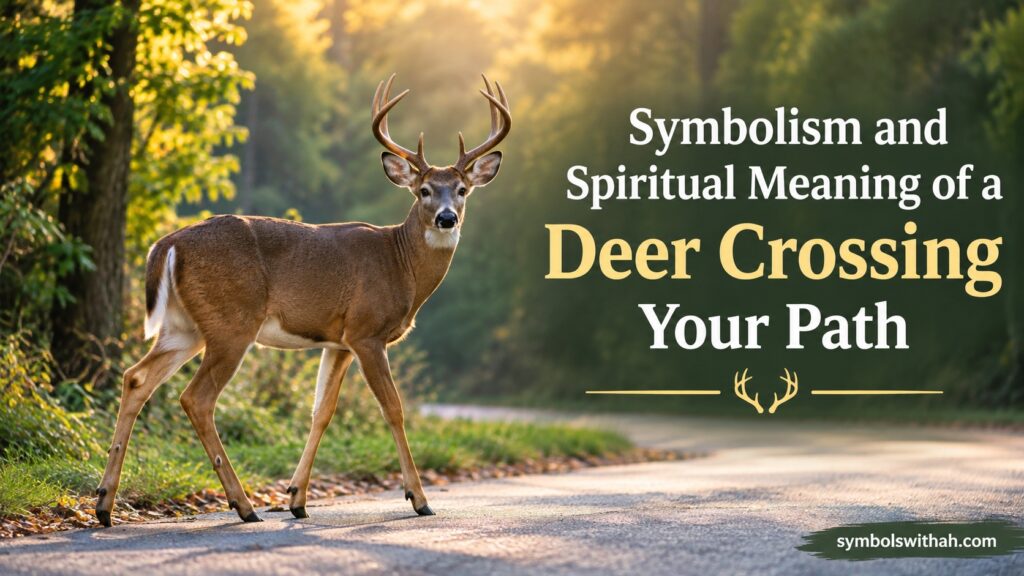

A deer can appear for only a few seconds, yet the encounter may stay with you all day. The symbolism and spiritual meaning of a deer crossing your path often centers on gentleness, intuition, awareness, and transition. For many people, the moment feels meaningful because the animal suddenly interrupts an ordinary routine.
In the United States, deer are part of everyday life as well as wilderness imagery. They appear in forests, suburban neighborhoods, parks, roadsides, artwork, tattoos, holiday decorations, and wildlife photography. Because of that familiarity, a deer sighting can feel both ordinary and strangely memorable.
However, symbolism and biology are not the same thing. A deer crossing a road may simply be moving between feeding or shelter areas. Still, people have attached meaning to deer encounters for centuries, and those interpretations remain popular today. Modern spiritual traditions often treat the encounter as an invitation to slow down, notice subtle signals, and respond with calm rather than force.
Read More: Are Deer a Sign of Angels? Spiritual Meaning
Quick Answer
The symbolism and spiritual meaning of a deer crossing your path is commonly associated with gentleness, intuition, awareness, protection, and life transitions. In the United States, the encounter also carries strong connections to nature, wilderness, and respect for wildlife. Broader traditions add themes of sacred nature, spiritual longing, guidance, and renewal. These are symbolic interpretations, not proof that an animal encounter carries a supernatural message.
TL;DR
- Deer commonly symbolize gentleness, sensitivity, intuition, and quiet strength.
- A crossing can represent movement, transition, or a new direction.
- American culture strongly connects deer with forests, wilderness, and nature.
- Ancient traditions often associated deer with sacred landscapes and spiritual figures.
- A sudden encounter can encourage reflection without requiring a supernatural explanation.
- On roads, the practical meaning matters too because deer collisions are common.
What Does a Deer Crossing Your Path Symbolize?
A deer crossing your path often feels significant because it creates a sudden pause. One moment, you are moving through your routine. The next, your attention is completely captured by a quiet animal.
Spiritually, many modern interpretations connect that interruption with awareness and gentleness. The deer does not represent strength through domination. Instead, its symbolic power comes from sensitivity, alertness, grace, and the ability to move quickly when necessary.
The Core Symbolism of a Deer
The most common symbolic associations include:
• Gentleness: Choosing softness without becoming powerless.
• Intuition: Paying attention to subtle feelings and surroundings.
• Awareness: Noticing what deserves your attention before reacting.
• Transition: Moving from one stage of life into another.
• Protection: Staying alert without living in constant fear.
• Renewal: Beginning again after a difficult or uncertain period.
These meanings are interpretive rather than universal rules. A person’s culture, beliefs, circumstances, and personal associations can change how the encounter feels.
Historical Roots of Deer Symbolism
Long before modern spiritual blogs and social media, humans were already assigning symbolic meaning to deer. Their speed, antlers, seasonal behavior, and connection with forests made them particularly striking animals.
Across ancient Europe and the Mediterranean, deer appeared in mythology and religious imagery. In Greek mythology, deer were closely associated with Artemis, the goddess of the hunt and wild places. The famous Ceryneian Hind, with its extraordinary golden features, was sacred to Artemis in the story of Heracles.
Deer in Celtic Traditions
Celtic traditions provide another important historical layer. Antlered figures and deer appear in archaeological and artistic evidence from ancient Celtic regions.
The figure commonly called Cernunnos is particularly important. The name is securely attested on a first-century CE monument from Paris, while the broader group of antlered figures associated with him remains a subject of scholarly debate. Deer and other wild animals frequently appear within this artistic tradition.
Later Celtic folklore also developed stories in which deer could mark boundaries between ordinary life and mysterious woodland realms. These stories helped reinforce the image of the deer as a creature connected with the wild, transformation, and hidden places.
Deer and the Natural World
Ancient symbolism often grew from direct observation.
Deer are cautious animals with strong senses and remarkable agility. Their seasonal movements and antler growth also make them visually associated with cycles of change. Consequently, themes such as renewal, vigilance, and transformation developed naturally around the animal.
Deer Symbolism in the United States
In America, deer symbolism has a particularly strong connection with landscape and wilderness. White-tailed deer are familiar across much of the country, including rural areas, forests, suburbs, and developed regions.
That familiarity creates an interesting symbolic tension. Deer can represent untouched wilderness while also appearing surprisingly close to human homes.
Deer and the American Wilderness
American art and popular culture often use deer to evoke:
• Forests and mountain landscapes.
• Quietness and solitude.
• Wildlife conservation.
• Rural life and outdoor recreation.
• Seasonal change and natural beauty.
• A peaceful relationship with the outdoors.
The deer therefore occupies a distinctive place in American imagination. It can represent wilderness without feeling completely foreign or distant.
Deer and American Road Culture
There is also a very practical side to deer encounters in America.
The Federal Highway Administration states that the United States experiences more than one million wildlife-vehicle collisions annually, creating substantial safety, economic, and ecological costs. Congress established the Wildlife Crossings Program through the Infrastructure Investment and Jobs Act of 2021 to help reduce these conflicts and improve habitat connectivity.
That reality gives a deer crossing a road two simultaneous meanings. Symbolically, someone may experience it as a reflective moment. Practically, it is a reminder that wildlife movement intersects with modern transportation.
Spiritual Meaning of Seeing a Deer
For people who approach animal encounters spiritually, seeing a deer often represents a gentle interruption.
Rather than interpreting the animal as predicting a specific event, many contemporary traditions treat the sighting as an opportunity for reflection. The question becomes less “What will happen?” and more “What deserves my attention right now?”
A Message of Gentleness
Deer symbolism frequently emphasizes softness.
That does not necessarily mean passivity. A deer can be gentle while remaining extremely alert and capable of rapid movement.
The symbolic lesson can therefore be summarized as softness with awareness.
A Reminder to Trust Your Senses
Deer survive by noticing changes in their environment.
Because of that behavior, modern spiritual interpretations often associate them with intuition. Seeing one may prompt someone to reconsider whether they have ignored a feeling, overlooked a detail, or rushed through an important decision.
A Call to Slow Down
A sudden deer encounter can interrupt an otherwise hurried day.
That interruption itself can become meaningful. It creates a small pocket of stillness where attention shifts away from screens, schedules, and worries.
What Does a Deer Crossing Your Path Mean Spiritually?
A crossing is different from simply seeing a deer standing nearby. Symbolically, movement adds another layer to the encounter.
The animal is going somewhere. It enters your field of attention, crosses your route, and continues onward.
Crossing as a Symbol of Transition
A deer moving from one side to another naturally lends itself to ideas about transition.
It may represent:
• Leaving an old situation behind.
• Entering an unfamiliar stage of life.
• Adjusting to changing circumstances.
• Moving forward without unnecessary force.
• Remaining alert during uncertain periods.
These interpretations are especially common in modern spiritual writing about deer encounters. Contemporary sources repeatedly connect the crossing with gentleness, awareness, intuition, and transition.
A Threshold Between Two Experiences
There is also a broader symbolic idea at work.
Paths, doors, bridges, rivers, and crossroads often represent boundaries in mythology and storytelling. A deer crossing such a boundary can therefore become a vivid metaphor for change.
Still, the metaphor belongs to human interpretation. It does not establish that the deer intentionally arrived to deliver a supernatural message.
Deer Symbolism Across Cultures
Deer symbolism is not limited to the United States. Different cultures have developed their own traditions, although similar themes sometimes appear independently.
European Traditions
European folklore frequently connects deer with forests, hunting, nobility, mystery, and transformation.
In Celtic-related traditions, deer can appear alongside supernatural or otherworldly themes. However, these traditions vary considerably across regions and historical periods.
Greek Tradition
The Greek association with Artemis is especially well documented. Deer were among the animals sacred to the goddess, and the Ceryneian Hind became part of the Heracles cycle.
This association links deer with wild landscapes, hunting, sacred nature, and divine protection.
Biblical Symbolism
The Bible uses deer imagery in a different way.
Psalm 42 famously compares a deer’s thirst for water with spiritual longing. This imagery helped establish the deer as a symbol of yearning, dependence, and the search for spiritual nourishment within Jewish and Christian traditions.
The image is powerful because it connects a basic physical need with an inward spiritual desire.
Indigenous North American Traditions
Deer hold important meanings within numerous Indigenous nations, but there is no single Native American interpretation.
Different nations have distinct languages, histories, ceremonies, stories, and relationships with deer. Broad internet claims that assign one universal “Native American deer meaning” flatten those differences.
A respectful approach recognizes diversity rather than treating Indigenous cultures as one symbolic system.
What Does a Deer Mean in American Spirituality?
Modern American spirituality often blends nature appreciation with personal reflection.
This does not necessarily belong to one organized religion. Instead, people may draw symbolic meaning from encounters with animals, weather, landscapes, dreams, or repeated experiences.
Nature as a Reflective Space
For many Americans, nature provides a setting for quiet reflection.
A deer encountered during a hike can therefore become connected with feelings of peace, solitude, or renewal. The symbolism develops partly from the environment itself.
Spirituality Without a Fixed Doctrine
Contemporary spiritual interpretations often remain personal.
One person may see a deer as a reminder to remain compassionate. Another may connect it with a loved one, a major life transition, or a need to slow down.
Neither interpretation needs to be treated as a universal rule.
Emotional and Psychological Meaning of a Deer Encounter
A deer encounter can produce a surprisingly strong emotional response.
That reaction often begins with the animal’s appearance and behavior. Deer are visually striking, quiet, and difficult to ignore when they suddenly emerge nearby.
Why the Encounter Can Feel Powerful
Several factors can make the experience memorable:
• The encounter interrupts an ordinary routine.
• The animal may appear unexpectedly close.
• Its movement can feel graceful and unusual.
• The surrounding environment may be unusually quiet.
• The experience can occur during an emotionally important period.
Psychologically, humans naturally search for patterns and meaning. A meaningful life event can make an otherwise ordinary encounter feel especially resonant.
That does not make the experience meaningless. It simply means personal symbolism can develop through attention, memory, and emotion.
Vulnerability and Quiet Strength
The deer also offers an interesting emotional metaphor.
It appears vulnerable because it is not an aggressive predator. Yet it survives through alertness, speed, adaptability, and sensory awareness.
That combination can symbolize quiet strength.
What Different Deer Encounters May Symbolize
Not every deer encounter looks the same. The details can influence the symbolic interpretation people give it.
A Deer Staring at You
A deer that pauses and looks toward you can feel especially intense.
Symbolically, people often connect this moment with awareness and attention. The animal’s stillness may encourage you to become more observant of your own circumstances.
Biologically, however, the deer may simply be assessing a potential threat. Both interpretations can coexist without confusing symbolism with animal behavior.
A Deer Running Across Your Path
A rapidly moving deer may symbolize urgency or sudden change in modern spiritual interpretations.
However, running is also normal defensive behavior. The animal may be responding to traffic, people, predators, dogs, or another disturbance.
Multiple Deer Crossing
Several deer can naturally suggest themes of community, family, and connection.
This interpretation is particularly common when the group includes adults and young deer. The symbolism reflects the visible social relationship rather than a fixed spiritual code.
Deer Crossing Your Path at Night
A nighttime encounter can feel mysterious because visibility is reduced and deer become harder to anticipate.
Symbolically, darkness is often associated with uncertainty, the unknown, and hidden aspects of life. A deer appearing in that setting may therefore be interpreted as a reminder to remain calm while navigating uncertainty.
The Practical Meaning Matters Too
There is an important real-world reason to take nighttime deer encounters seriously.
Deer activity often overlaps with periods when visibility is lower, and wildlife-vehicle collisions are a significant American road-safety issue. Wildlife crossings, fencing, and underpasses are increasingly used to reduce these conflicts. The Pew Charitable Trusts reported in January 2026 that properly designed wildlife crossings can reduce wildlife-vehicle crashes by more than 90% in suitable settings.
So, if a deer appears beside a road, symbolism should never replace attention to the actual environment.
Deer Symbolism in Tattoos, Art, and Home Decor
Deer imagery remains popular because it combines natural beauty with flexible symbolism.
A person can use a deer image to represent wilderness, family, independence, gentleness, spirituality, or personal transformation.
Deer Tattoos
Common symbolic approaches include:
• Antlers: Growth, strength, renewal, or maturity.
• Doe: Gentleness, nurturing, sensitivity, or grace.
• Fawn: Innocence, youth, tenderness, or new beginnings.
• Forest deer: Nature, freedom, solitude, or belonging.
• Geometric deer: Modern identity blended with natural symbolism.
Antlers are particularly interesting because they naturally shed and regrow. That biological cycle makes them an obvious metaphor for renewal and change.
Deer in Home Decor
Deer imagery often appears in American homes through:
- Woodland artwork
- Cabin-style decor
- Nature photography
- Holiday ornaments
- Rustic furniture accents
- Seasonal decorations
The meaning can range from simple appreciation of wildlife to a deeper connection with family, place, or nature.
Deer Symbolism in Holidays and Popular Culture
Deer imagery is deeply woven into American seasonal culture.
During winter holidays, deer and reindeer appear in decorations, children’s stories, ornaments, greeting cards, and displays. This imagery often emphasizes innocence, wonder, winter landscapes, and family traditions.
However, the symbolic deer is broader than holiday imagery.
Wildlife photography, children’s literature, conservation campaigns, outdoor recreation, and nature-themed media have all helped maintain the animal’s gentle public image.
That cultural familiarity makes deer symbolism especially accessible to American audiences.
Misunderstandings and Misuse of Deer Symbolism
Animal symbolism can become distorted when broad claims are repeated without historical context.
One common problem is presenting one spiritual interpretation as an ancient universal truth. Deer symbolism has never been completely uniform across cultures.
Common Misunderstandings
• Every deer sighting does not have a supernatural explanation.
• Indigenous traditions should not be treated as one belief system.
• Ancient symbolism and modern spirituality are not identical.
• A symbolic interpretation does not predict a specific future event.
• Animal behavior should not automatically be treated as a spiritual message.
Another issue is the tendency to attach precise meanings to details that lack strong historical support.
For example, modern websites sometimes assign fixed meanings to seeing exactly two, three, or four deer. Such interpretations can be meaningful as contemporary spiritual reflection, but they should not automatically be presented as ancient or universal traditions.
How Deer Symbolism Has Changed Over Time
The meaning of deer has shifted as human relationships with nature changed.
In ancient societies, deer could be sacred, hunted, feared, admired, or associated with powerful mythological figures. Later European traditions added layers of folklore, nobility, woodland mystery, and religious imagery.
In modern America, deer have become simultaneously wild animals, suburban neighbors, hunting animals, conservation subjects, artistic symbols, and spiritual metaphors.
That layered identity explains why a single deer encounter can mean different things to different people.
From Sacred Animal to Modern Symbol
The broad shift can be understood like this:
| Historical Context | Common Deer Association |
| Ancient mythology | Sacred nature, divine figures, hunting |
| Celtic and European folklore | Forests, mystery, transformation |
| Biblical imagery | Spiritual longing and dependence |
| American wilderness culture | Nature, wildlife, freedom |
| Modern spirituality | Intuition, gentleness, transition |
| Contemporary art | Identity, beauty, renewal |
The meanings overlap rather than replacing one another completely.
How to Reflect on a Deer Crossing Your Path
If an encounter feels personally significant, reflection can be more useful than searching for one rigid interpretation.
Start with the circumstances surrounding the moment.
Ask Yourself a Few Questions
• What was happening in your life immediately before the encounter?
• What emotion did you feel when you noticed the deer?
• Were you facing a decision or transition?
• Did the deer appear calm, alert, frightened, or curious?
• What quality of the animal stood out most strongly?
These questions turn symbolism into personal reflection rather than fortune-telling.
Let the Symbol Stay Flexible
A deer does not need to mean only one thing.
It can represent gentleness in one situation and transition in another. For someone else, it may simply be a beautiful reminder of the natural world.
That flexibility is part of what keeps animal symbolism meaningful across generations.
Frequently Asked Questions About Deer Crossing Your Path
What does it mean when a deer crosses your path?
A deer crossing your path is commonly interpreted as a symbol of gentleness, intuition, awareness, and transition. In modern spiritual traditions, the encounter may encourage a calmer and more observant approach to life.
Is seeing a deer a good spiritual sign?
Many contemporary spiritual interpretations view deer positively because they associate the animal with peace, sensitivity, intuition, and renewal. However, there is no universal spiritual rule stating that every deer sighting is either good or bad.
What does a deer symbolize in the Bible?
Deer imagery in the Bible can represent spiritual longing and deep desire for nourishment. Psalm 42 uses the image of a deer longing for flowing water as a comparison for the soul’s longing for God.
What does a deer crossing your path mean in Native American traditions?
There is no single Native American meaning because Indigenous nations have distinct traditions and histories. Some traditions hold deer in important cultural or spiritual roles, but broad claims about one universal interpretation should be treated cautiously.
What does it mean when a deer stares at you?
Symbolically, a deer staring at you is often associated with awareness, intuition, and paying closer attention. In ordinary animal behavior, the deer may simply be assessing whether you pose a threat.
What does a deer symbolize spiritually?
Modern spiritual interpretations commonly connect deer with gentleness, intuition, sensitivity, quiet strength, renewal, and guidance. Different cultures and individuals may emphasize different qualities.
Conclusion
A deer crossing your path can be an ordinary wildlife encounter and a meaningful personal moment at the same time. Its symbolism has grown from centuries of human observation, mythology, religious imagery, folklore, and modern relationships with nature.
The symbolism and spiritual meaning of a deer crossing your path often centers on gentleness, awareness, intuition, transition, and quiet strength. In the United States, those themes are reinforced by the country’s deep connection with forests, wildlife, outdoor culture, and conservation.
Ultimately, the most useful interpretation may be the one that encourages thoughtful attention without turning symbolism into certainty. A deer can remind you to slow down, notice what surrounds you, and move through change with both sensitivity and awareness.