
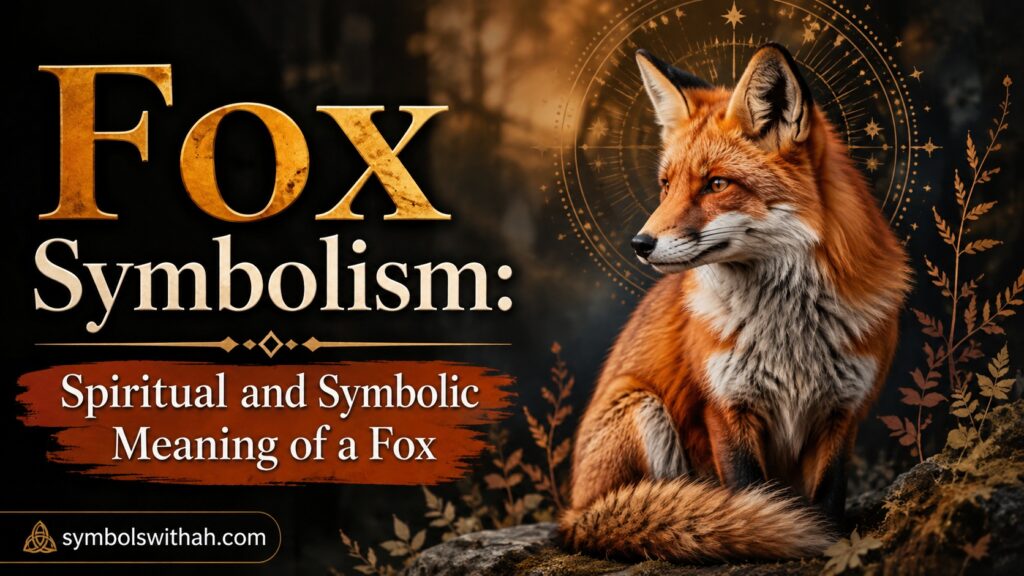

A fox has always seemed like an animal with a secret. It watches carefully, moves quietly, and disappears before you fully understand what happened. That combination helps explain why Fox Symbolism: Spiritual and Symbolic Meaning of a Fox remains popular in American culture.
In the United States, the fox often represents cleverness, adaptability, independence, and resourcefulness. However, its meaning isn’t always positive. Older stories also connect foxes with trickery, deception, temptation, and mischief.
Today, fox imagery appears in tattoos, artwork, clothing, home decor, children’s stories, social media, and spiritual discussions. Its meaning depends heavily on context.
A realistic fox in a forest can suggest connection with nature. A cartoon fox may represent playfulness. Meanwhile, a nine-tailed fox can point toward East Asian mythology and transformation.
Read More: Fairy Rings in Grass Spiritual Meaning and Symbolism
Quick Answer
Fox symbolism: spiritual and symbolic meaning of a fox in the United States usually centers on cleverness, adaptability, independence, awareness, and survival through intelligence rather than force. In broader traditions, foxes can also symbolize trickery, transformation, spiritual guidance, mystery, or protection.
TL;DR
- Foxes commonly symbolize cleverness, adaptability, and independence.
- European folklore often portrays the fox as a clever trickster.
- American culture connects foxes with intelligence and resourcefulness.
- Some spiritual traditions view foxes as guides or messengers.
- Fox tattoos often express independence, resilience, or transformation.
- A fox’s meaning changes according to culture and context.
What Does a Fox Symbolize?
The fox has a flexible symbolic identity because its real behavior is so distinctive. It is alert, adaptable, cautious, and capable of living near humans while remaining difficult to observe.
For American readers, these qualities often create a positive image of someone who thinks before acting. The fox succeeds through awareness rather than physical dominance.
Cleverness and Strategy
The most familiar fox meaning is cleverness.
Expressions such as “sly as a fox” reflect a long tradition of portraying the animal as intelligent and strategic. In stories, fox characters often survive by noticing opportunities that stronger animals miss.
This doesn’t always mean dishonesty. In modern usage, cleverness can suggest creative problem-solving, quick thinking, and emotional awareness.
Adaptability and Survival
Foxes live in forests, farmland, mountains, deserts, and increasingly developed areas. The National Park Service notes their remarkable adaptability and ability to thrive in environments ranging from wilderness to suburban neighborhoods. (National Park Service)
Symbolically, that makes the fox a natural image of resilience.
It suggests finding another route when the original plan fails. It also represents staying flexible when circumstances change.
Independence and Awareness
Foxes are often portrayed as solitary and watchful. Their behavior encourages associations with self-reliance, observation, and careful timing.
Therefore, a fox symbol can represent someone who doesn’t need constant attention or approval.
How Does Fox Symbolism Appear?
The way a fox looks can change the feeling of its symbolism. Artists, tattoo designers, storytellers, and decorators often use posture, color, and surroundings to shape the message.
For example, a curled fox may suggest comfort and quietness. An alert fox with raised ears can communicate awareness and readiness.
Common Visual Features
- Red-orange fur: warmth, vitality, passion, and natural energy.
- White fur: mystery, purity, winter, or spiritual imagery.
- Black fur: secrecy, independence, and the unknown.
- Raised tail: confidence, movement, or alertness.
- Curled posture: rest, protection, comfort, or peaceful solitude.
- Sharp gaze: awareness, intelligence, and careful observation.
These associations aren’t universal rules. Instead, they come from artistic convention and personal interpretation.
Why the Fox’s Shape Matters
The fox has a narrow face, pointed ears, bright eyes, and a large tail. Those features create an image that looks both delicate and alert.
Because of that, fox imagery can feel elegant without appearing weak.
What Is the Historical Meaning of the Fox?
Fox symbolism has deep roots in European, Asian, Middle Eastern, and North American storytelling. However, these traditions developed independently, so they shouldn’t be treated as one single belief system.
In many older stories, the fox became a character who could succeed through intelligence. That role probably grew partly from observing the animal’s behavior.
Aesop and Ancient Storytelling
Foxes appear in ancient Greek fables associated with Aesop. These stories often used animals to explore human behavior, including pride, greed, cleverness, and poor judgment.
The famous “sour grapes” story is one example. The fox cannot reach the grapes, so it dismisses them as undesirable.
That story helped reinforce the fox as an intelligent but imperfect character.
Medieval Reynard the Fox
During medieval Europe, the fox became even more prominent through the Reynard tradition.
The Reynard stories developed from earlier animal tales and circulated widely in French, Dutch, German, and related literary traditions. Reynard is clever, manipulative, entertaining, and frequently able to outwit stronger animals. (Wikisource)
This tradition strongly influenced the Western image of the fox as a trickster.
The Fox as a Trickster
A trickster isn’t necessarily a purely evil character.
In folklore, tricksters can expose foolishness, challenge authority, create disorder, or teach lessons through unexpected behavior. The fox therefore became a symbol of intelligence operating outside conventional rules.
That duality still shapes modern fox symbolism.
What Does the Fox Mean in American Culture?
The American meaning of the fox is especially interesting because the animal has both native and introduced histories in the United States.
Today, Americans may encounter foxes in rural landscapes, suburbs, parks, and even areas close to cities.
The Red Fox in the United States
The National Park Service explains that red foxes were historically native to boreal and mountain regions of North America. European red foxes were later introduced for hunting, especially along the East Coast during the 1800s. (National Park Service)
That history adds an important layer to American symbolism.
The fox isn’t simply an ancient European symbol transplanted unchanged into America. Its modern American identity developed through wildlife, settlement, hunting culture, folklore, literature, and changing relationships with nature.
Modern American Associations
In the United States, the fox commonly suggests:
- Intelligence without relying on physical strength.
- Adaptability in changing environments.
- Independence and personal resourcefulness.
- Awareness of opportunities and potential risks.
- A playful but unpredictable personality.
- Connection with forests, wildlife, and the natural world.
American media also helped soften the fox’s older reputation as a purely deceptive animal.
Today, fox characters can be villains, heroes, comic figures, clever companions, or symbols of individuality.
What Is the Spiritual Meaning of a Fox?
Spiritual interpretations of foxes are personal and vary between traditions. There isn’t one universal spiritual meaning that applies to every person or culture.
Still, modern spiritual discussions frequently associate the fox with awareness, intuition, adaptability, and navigating uncertain situations.
Seeing a Fox Spiritually
Some people interpret an unexpected fox encounter as a prompt to become more observant.
Rather than treating the encounter as proof of a supernatural message, it can be viewed as an opportunity for personal reflection.
You might ask:
- What situation requires more patience right now?
- Am I overlooking something important?
- Would flexibility help me solve a current problem?
- Am I reacting too quickly?
- Where could greater awareness improve my choices?
These questions keep spiritual interpretation reflective rather than absolute.
Fox as a Guide
Modern spiritual writing sometimes describes the fox as a guide through uncertain circumstances.
That idea fits the animal’s traditional reputation. A fox moves through complicated environments while remaining cautious and responsive.
As a symbol, it can therefore encourage quiet observation before decisive action.
What Does the Fox Mean in Native American Traditions?
There is no single “Native American fox meaning.” Hundreds of Indigenous nations have distinct histories, languages, stories, and spiritual traditions.
That diversity matters when discussing animal symbolism in the United States.
Smithsonian collections document fox-related stories and traditions among communities including the Meskwaki, Sauk, Shawnee, and others. These records demonstrate that fox stories existed in specific cultural contexts rather than one universal Indigenous system. (Smithsonian Collections)
A Lakota Example
The Aktá Lakota Museum and Cultural Center describes the fox, or šunğíla, as a medicine animal associated with knowledge of herbs, quick escape, dangerous travel, and protection around the home community. It also describes the Kit Fox Society’s role in maintaining order and harmony. (Aktá Lakota Museum & Cultural Center)
This example shows why simple definitions can be misleading.
In one context, a fox may be linked with cleverness. In another, it can carry more specific cultural responsibilities.
Why Cultural Context Matters
Modern spiritual websites sometimes combine traditions from unrelated Indigenous nations.
That can erase important differences. A respectful approach is to identify the specific nation or tradition whenever historical claims are being made.
What Does the Fox Mean in Japanese and East Asian Traditions?
Fox symbolism becomes especially rich in East Asian folklore.
Japanese kitsune traditions include fox spirits associated with transformation, intelligence, mystery, and supernatural abilities. However, kitsune stories vary widely and shouldn’t be reduced to a simple “good” or “evil” meaning.
Foxes and Inari in Japan
In Japanese religious traditions, foxes are strongly associated with Inari.
The Metropolitan Museum of Art describes foxes as messengers of Inari and notes their connection with rice and agricultural prosperity. Its discussion of Hiroshige’s 1857 print also shows foxes participating in imagery surrounding the Ōji Inari shrine. (The Metropolitan Museum of Art)
The British Museum likewise identifies the fox as a messenger of Inari and notes symbolic objects such as a key connected with a rice storehouse. (British Museum)
This meaning differs significantly from the Western image of the dishonest fox.
Kitsune and Transformation
Kitsune stories often emphasize shape-shifting and changing appearances.
Because of this, fox imagery can symbolize:
- Transformation and changing identity.
- Mystery and hidden knowledge.
- Intelligence beyond ordinary expectations.
- The boundary between familiar and unfamiliar.
- Protection or mischief, depending on the story.
This is one reason fox imagery appears so frequently in contemporary art and fantasy.
What Does a Fox Symbolize Psychologically?
Symbolism often works because animals become mirrors for human traits.
The fox can represent a personality that values observation, flexibility, independence, and strategic thinking.
Intelligence Without Dominance
The fox isn’t normally imagined as the strongest animal in the forest.
Instead, it survives through timing, awareness, speed, and flexibility. Psychologically, that can appeal to people who value intelligence over confrontation.
The Shadow Side
Every powerful symbol has a darker side.
The fox can also represent:
- Manipulation.
- Suspicion.
- Secrecy.
- Opportunism.
- Emotional distance.
- Deception.
These meanings don’t make the fox inherently negative. They show the symbol’s dual nature.
Someone might choose fox imagery because they have learned to recognize manipulation. Another person may choose it because they identify with independence.
Fox Symbolism in Dreams and Personal Encounters
Dream interpretations aren’t fixed formulas. A fox appearing in a dream can mean different things depending on the dreamer’s emotions and experiences.
For one person, it may represent cleverness. For another, it may reflect distrust or uncertainty.
Common Symbolic Interpretations
| Context | Possible Meaning in the USA | Common Association | Important Note |
| Fox crossing your path | Awareness and adaptability | Paying attention | Personal interpretation varies |
| Fox watching you | Observation or caution | Intuition | Not a universal omen |
| Friendly fox | Curiosity and confidence | Openness | Emotional tone matters |
| Aggressive fox | Distrust or conflict | Hidden tension | Could reflect personal fears |
| Fox in a dream | Strategy or uncertainty | Problem-solving | Dream meaning isn’t universal |
The strongest clue is often your emotional response.
If the fox made you feel peaceful, its meaning may differ from an encounter that caused fear.
What Does a Fox Tattoo Symbolize?
Fox tattoos have become a popular form of personal symbolism because the animal carries many layers.
A tattoo can represent intelligence, independence, resilience, transformation, or simply an appreciation for the animal.
Popular Fox Tattoo Meanings
- Clever fox: intelligence and strategic thinking.
- Sleeping fox: peace, self-protection, and comfort.
- Running fox: freedom, movement, and independence.
- Geometric fox: logic, balance, and modern identity.
- Nine-tailed fox: transformation and East Asian mythology.
- Fox with flowers: beauty, growth, and natural harmony.
The design can change the message considerably.
A realistic American red fox may emphasize wildlife. A stylized kitsune can carry a much more specific cultural reference.
Choosing a Cultural Design Carefully
If a tattoo uses Japanese, Korean, or Indigenous imagery, understanding its source tradition is important.
That doesn’t mean people can’t appreciate art from other cultures. Instead, context helps prevent a meaningful symbol from becoming a vague decorative image.
Fox Symbolism in Home Decor, Fashion, and Media
Fox imagery has become common in modern American design.
Its warm colors work especially well with woodland, autumn, rustic, and nature-inspired styles.
Modern Uses
A fox may appear on:
- Children’s clothing and storybooks.
- Woodland-themed nursery decorations.
- Autumn and winter home decor.
- Jewelry and small personal accessories.
- Nature-inspired artwork.
- Fantasy and folklore illustrations.
- Social media avatars and digital artwork.
In these settings, the fox often feels charming rather than threatening.
Why the Fox Works So Well Today
The fox combines several traits modern audiences find appealing.
It’s intelligent but playful. It’s independent but visually attractive. It’s wild without feeling completely unfamiliar.
That balance makes the fox unusually adaptable as a modern symbol.
What Are the Negative Meanings of a Fox?
The fox has never been exclusively positive.
In many Western traditions, its cleverness could become deceit. A person described as “foxy” or “sly” might be admired for intelligence or criticized for manipulation.
Deception and Suspicion
The negative fox represents someone who hides motives or uses intelligence unfairly.
This interpretation appears in older fables and continues in modern language.
However, it’s important not to confuse a symbolic stereotype with actual animal behavior. Real foxes aren’t morally deceptive. They are wild animals responding to their environment.
Gendered Meanings
The word “foxy” has also developed sexualized meanings in American English.
That usage is separate from many historical animal traditions. Modern audiences may therefore read fox imagery differently depending on age, context, and cultural background.
How Has Fox Symbolism Changed Over Time?
Fox symbolism has moved through several broad stages.
Ancient fables emphasized intelligence and moral lessons. Medieval European stories expanded the fox into a famous trickster figure. Later American culture added wildlife, independence, adaptability, and personal identity.
Meanwhile, Japanese traditions preserved a different set of associations involving Inari and fox messengers.
From Trickster to Survivor
One of the biggest modern shifts is the move from deception toward adaptability.
Today, calling someone “clever like a fox” can be a compliment. The emphasis is often on solving problems rather than cheating others.
From Folklore to Identity
Fox symbolism has also become more personal.
People now use fox imagery to express individuality, resilience, creativity, and independence. Tattoos and social media make it easy to turn an old folklore character into a personal emblem.
FAQs
1. What does a fox symbolize spiritually?
A fox can symbolize awareness, adaptability, intuition, cleverness, and navigating uncertainty. Spiritual interpretations vary, so the meaning depends on the person’s beliefs and circumstances.
2. Is seeing a fox a good omen?
Some people consider fox sightings positive signs connected with awareness or adaptability. However, there is no universal rule that a fox sighting must be good or bad.
3. What does a fox symbolize in Native American culture?
There isn’t one Native American interpretation. Different Indigenous nations have their own fox stories and traditions, with meanings that can include medicine, knowledge, protection, cleverness, or other roles.
4. What does a fox tattoo mean?
A fox tattoo commonly represents cleverness, independence, adaptability, resilience, or transformation. The design can also reference a specific cultural tradition.
5. What does a fox symbolize in Japanese culture?
Foxes are strongly associated with Inari in Japanese religious traditions and are viewed as messengers. Kitsune folklore also connects foxes with transformation, intelligence, mystery, and supernatural abilities.
6. Is a fox a symbol of deception?
Yes, deception is one traditional fox association, especially in Western folklore. However, modern symbolism also emphasizes positive qualities such as intelligence, adaptability, and resourcefulness.
Conclusion
The fox is one of the most flexible animal symbols in human storytelling. It can represent cleverness, independence, adaptability, mystery, transformation, or deception depending on the tradition and setting.
In the United States, Fox Symbolism: Spiritual and Symbolic Meaning of a Fox increasingly leans toward intelligence, resilience, self-reliance, and the ability to adapt without unnecessary force. Yet its older trickster identity remains an important part of the picture.
Perhaps that’s what makes the fox so enduring. It reminds us that strength doesn’t always have to be loud. Sometimes, the wiser path is to observe carefully, stay flexible, and move when the moment is right.