
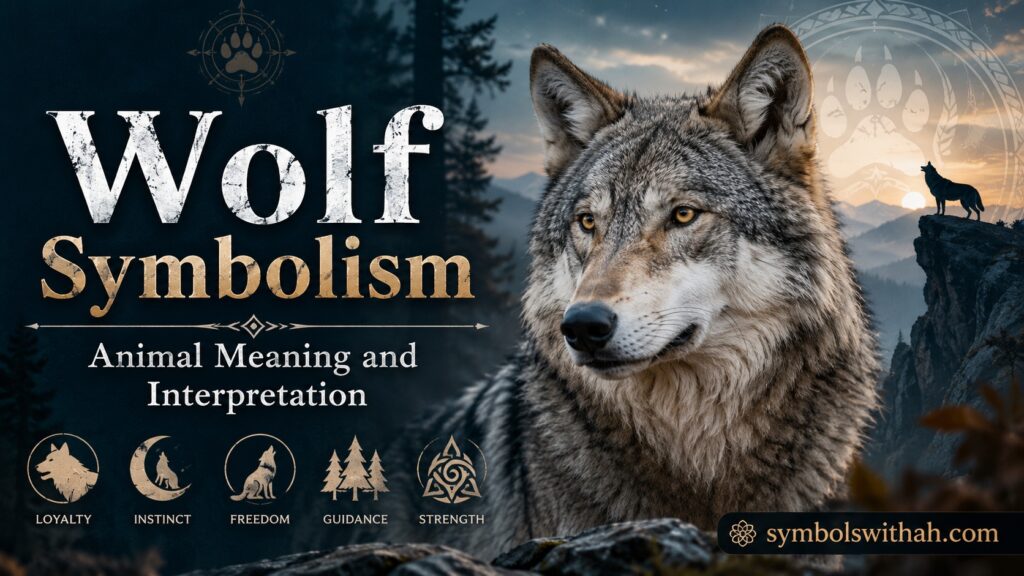

Wolf symbolism, animal meaning, and interpretation can point to several ideas at once. In the United States, the wolf often represents strength, freedom, loyalty, instinct, and a deep connection with nature.
Yet the wolf has never carried only one meaning. Across history, people have viewed wolves as protectors, predators, companions, threats, teachers, and symbols of survival.
That contrast makes the wolf especially interesting. Its meaning can change depending on the story, culture, artwork, or personal experience surrounding it.
For Americans today, the wolf also carries a powerful environmental history. Once nearly eliminated from much of the country, wolves have become symbols of wilderness recovery and conservation.
Read More: Fairy Rings in Grass Spiritual Meaning and Symbolism
Quick Answer
Wolf symbolism, animal meaning, and interpretation in the USA commonly center on strength, independence, loyalty, instinct, family, and wilderness. More broadly, wolves can symbolize protection, transformation, spiritual guidance, and the balance between individuality and community.
TL;DR
- Wolves often symbolize strength, loyalty, freedom, and instinct.
- American history connects wolves with wilderness and conservation.
- Native traditions contain diverse wolf meanings that vary by nation.
- Ancient myths often portray wolves as protectors or dangerous forces.
- Wolf imagery commonly represents independence and belonging today.
What Does a Wolf Symbolize?
The wolf is one of the most recognizable animal symbols in human culture. Its appearance naturally creates strong associations with power, alertness, and survival.
However, symbolism isn’t determined by appearance alone. A howling wolf can suggest communication, while a wolf with its pack may suggest family and loyalty.
Core Wolf Meanings
Common modern associations include:
- Strength and physical endurance
- Loyalty and family bonds
- Independence and personal freedom
- Instinct and intuition
- Protection and courage
- Wilderness and natural balance
The important point is that these meanings can coexist. A wolf can symbolize independence while still emphasizing the importance of community.
That combination is one reason wolf imagery remains popular in American culture.
Wolf Symbolism in the United States
In America, the wolf carries an unusually complicated history. It has represented both a feared predator and a treasured symbol of wilderness.
Wolves once occupied much of North America. However, settlement, livestock conflicts, hunting, habitat changes, and organized predator-control programs caused their numbers to collapse across much of the contiguous United States. (U.S. Fish and Wildlife Service)
By the middle of the 20th century, wolves had disappeared from most of their former range. Later conservation efforts changed how many Americans viewed the animal.
From Threat to Wilderness Symbol
The wolf’s American image gradually shifted from danger toward ecological importance.
Today, wolves can represent:
- Untamed American wilderness
- Protection of natural ecosystems
- Resilience after persecution
- The return of native wildlife
- Respect for ecological balance
- A connection with remote landscapes
Yellowstone became especially important to this changing image. Wolves were restored there in 1995, becoming part of one of America’s best-known wildlife recovery stories. (National Park Service)
The wolf therefore symbolizes more than wilderness. For many Americans, it also represents the idea that damaged natural systems can recover.
The Historical Roots of Wolf Symbolism
Humans have been fascinated by wolves for thousands of years. Their intelligence, social behavior, hunting ability, and close relationship to dogs made them powerful figures in traditional stories.
Archaeological evidence also shows wolves appearing in prehistoric European art. At Lascaux, for example, wolves appear among numerous animals represented by Paleolithic artists. (The Metropolitan Museum of Art)
Wolves in Ancient Rome
One of the best-known ancient wolf stories comes from Rome.
According to Roman tradition, the twins Romulus and Remus were abandoned and later nursed by a she-wolf. Romulus eventually became associated with the founding of Rome. (The Metropolitan Museum of Art)
Here, the wolf isn’t simply a predator. It becomes a figure of survival, nourishment, protection, and the beginning of a civilization.
Wolves in Northern European Myth
Northern European traditions also gave wolves powerful roles.
The Norse mythological wolf Fenrir represents an enormous destructive force. Unlike the nurturing Roman she-wolf, Fenrir represents danger, chaos, and a force that even divine beings struggle to control.
This contrast is important. There has never been one universal “wolf meaning.”
Instead, wolves have represented both protective and threatening forces.
Wolf Symbolism in Native American Traditions
Native American wolf traditions are diverse, so it’s important not to treat Indigenous peoples as having one shared belief system.
Different nations have their own languages, histories, ceremonies, and teachings. Therefore, a wolf’s meaning can differ considerably between communities.
The Wolf as a Relative
Some Anishinaabe traditions describe the wolf as a brother and companion to human beings. National Park Service materials discussing Isle Royale explain the cultural importance of Ma’iingan, the wolf, within Anishinaabe traditions. (Park Planning)
In this context, wolf symbolism can emphasize:
- Family and kinship
- Cooperation and shared responsibility
- Learning through observation
- Respect for the natural world
- Parallel paths between humans and animals
Other Indigenous communities have their own wolf stories and relationships with the animal.
For example, National Park Service materials note the cultural significance of wolves among Tlingit communities in Southeast Alaska, including their use as clan emblems in certain contexts. (National Park Service)
Why Generalizations Can Be Misleading
Modern internet culture sometimes reduces Indigenous wolf symbolism to simple phrases such as “wolf spirit animal.”
That can erase important differences between nations and traditions. A respectful approach recognizes that Indigenous teachings belong to specific cultural contexts rather than treating them as one universal system.
Wolf Symbolism and Spiritual Meaning
In modern spiritual writing, wolves are often interpreted as symbols of instinct and guidance.
Some people see the wolf as an image of trusting inner awareness. Others associate it with protection, courage, or moving through uncertain periods.
These interpretations are personal and shouldn’t be treated as universal religious rules.
Common Spiritual Associations
The wolf may represent:
- Trusting your instincts during uncertain situations
- Protecting people or values that matter
- Finding strength after difficult experiences
- Balancing independence with belonging
- Listening carefully before taking action
The spiritual wolf is therefore often less about aggression and more about awareness.
Its quiet movement, strong senses, and social bonds make it a natural symbol of alertness.
Wolf Symbolism and Family Loyalty
One of the most interesting features of wolf symbolism is the tension between independence and family.
Popular culture often focuses on the lone wolf. Yet real wolves are highly social animals that commonly live and cooperate within packs. National Park Service information describes wolf packs that can range from small groups to much larger family-based groups. (National Park Service)
The Pack Meaning
Because of this behavior, wolf imagery can symbolize:
- Loyalty to family
- Cooperation during difficult times
- Shared protection
- Social responsibility
- Strong bonds between individuals
The pack can therefore represent belonging without eliminating individuality.
That idea resonates strongly in American culture, where personal independence is often valued alongside family identity.
The Meaning of the Lone Wolf
The lone wolf has become one of the most popular modern interpretations.
It usually represents someone who chooses independence rather than following a crowd.
Independence and Individuality
A lone wolf image may suggest:
- Self-reliance
- Personal freedom
- Solitude
- Nonconformity
- Quiet confidence
- Emotional independence
However, the phrase can also be misunderstood.
A person who identifies with the lone wolf doesn’t necessarily reject relationships. Instead, the image often communicates a preference for independence or personal space.
In modern American culture, it can therefore function as an identity statement rather than a literal description of social behavior.
What a Howling Wolf Symbolizes
The wolf’s howl is one of its strongest symbolic features.
People often associate it with loneliness. Yet real wolf howling has several social functions, including communication between pack members and responses between groups. (National Park Service)
Communication and Connection
Symbolically, a howl can represent:
- Calling for connection
- Expressing emotion
- Finding one’s people
- Sending a warning
- Remembering someone absent
- Speaking without words
This gives wolf imagery a surprisingly emotional dimension.
A howling wolf beneath a moon can therefore symbolize solitude, but it can also symbolize belonging and communication across distance.
Wolf Colors and Their Symbolic Meanings
The color of a wolf image can change its emotional impression.
There isn’t a universal color code. Still, modern American art often uses color intentionally to emphasize particular qualities.
| Wolf Appearance | Common Meaning in the USA | Emotional Association | Typical Context |
| Gray wolf | Wilderness and resilience | Strength and realism | Nature art |
| White wolf | Purity and rarity | Mystery and calm | Spiritual imagery |
| Black wolf | Mystery and independence | Power and intensity | Tattoos and fantasy |
| Red wolf | Passion and individuality | Energy and courage | Symbolic artwork |
| Silver wolf | Wisdom and experience | Elegance and reflection | Jewelry and decor |
These interpretations are modern associations rather than fixed rules.
The surrounding setting also matters. A wolf under a full moon creates a very different impression from a wolf standing with pups.
Wolf Symbolism in Psychology and Emotions
Wolf imagery often appeals to people who want to express qualities that feel difficult to describe directly.
For example, someone may choose a wolf tattoo to represent resilience after a difficult chapter. Another person may choose a wolf because it reflects family loyalty.
What the Wolf Can Signal
Psychologically, wolf imagery can communicate:
- A desire for independence
- Strong protective instincts
- Confidence without constant attention
- Connection with nature
- A need for personal freedom
- Pride in family or community
However, symbolic interpretation shouldn’t be treated as a personality test.
A wolf tattoo doesn’t prove that someone is aggressive, solitary, or dominant. It simply gives the person a visual language for expressing certain ideas.
Wolf Symbolism in Tattoos, Art, and Decor
Wolf imagery remains highly popular in American tattoos and artwork.
Artists can portray the animal realistically or transform it into a highly stylized design. The choice of posture, expression, moon, forest, mountains, and other elements can completely change the message.
Common Modern Designs
Popular symbolic combinations include:
- Wolf and moon for mystery and instinct
- Wolf and mountains for freedom and endurance
- Wolf pack for family and loyalty
- Wolf and forest for wilderness connection
- Wolf eyes for awareness and intuition
- Wolf and geometric shapes for modern identity
In home decor, wolf images often create a rustic, outdoors-oriented atmosphere.
They can also evoke national parks, mountain landscapes, hunting traditions, wildlife conservation, or a general love of nature.
Wolves in American Media and Popular Culture
American entertainment has helped create many modern wolf meanings.
Films, television, fantasy stories, sports identities, video games, and novels frequently portray wolves as powerful, mysterious, loyal, or dangerous.
Werewolf stories add another layer. They use the wolf as a symbol of transformation and the struggle between human identity and animal instinct.
The Difference Between Fiction and Tradition
Popular media can sometimes borrow cultural stories without preserving their original meaning.
A notable example involves the Quileute people of Washington. The Smithsonian has documented how popular entertainment connected the Quileute with werewolf imagery, even though the traditional Quileute origin story concerns transformation between wolves and people rather than modern werewolf mythology. (Smithsonian Magazine)
This distinction matters because entertainment can reshape real cultural traditions for a broad audience.
Wolf Symbolism, Fear, and Controversy
The wolf’s positive modern image doesn’t erase its difficult history.
For centuries, people have feared wolves because they were predators. In the United States, conflicts with livestock and competition for game contributed to extensive persecution. (Congress.gov)
Why the Wolf Remains Controversial
Today, disagreements can involve:
- Livestock protection
- Hunting and trapping
- Wildlife management
- Conservation goals
- Federal protections
- Local economic concerns
The disagreement isn’t simply about whether wolves are “good” or “bad.”
Different communities can experience the same animal in very different ways. Ranchers, hunters, conservationists, Indigenous communities, wildlife researchers, and visitors may have different priorities.
That complexity is part of the wolf’s modern American symbolism.
The Wolf as a Symbol of Conservation
The American wolf story has also become a story about ecological recovery.
Wolves were nearly eliminated from most of the contiguous United States by the early 20th century. Conservation laws and recovery programs later helped restore populations in selected regions. (U.S. Fish and Wildlife Service)
Yellowstone became especially important after wolves were restored there in 1995.
Today, the wolf can symbolize a broader conservation lesson: removing one species can affect an entire ecosystem, while restoring it can create new ecological relationships.
That doesn’t mean wolf management is simple. It means the animal has become part of America’s larger conversation about living alongside wildlife.
How Wolf Meanings Have Changed Over Time
The wolf’s symbolic journey is unusually dramatic.
In ancient stories, it could be a mother, founder, guardian, monster, or divine companion. In medieval European stories, wolves were frequently associated with danger and the wild.
In America, fear became especially powerful during settlement and agricultural expansion. Later, conservation and environmental movements helped create a more positive public image.
From Predator to Cultural Symbol
The broad shift can be summarized this way:
Ancient world: survival, protection, danger, founding myths, supernatural power.
European folklore: wilderness, threat, cunning, violence, transformation.
Early American history: predator, livestock threat, wilderness obstacle.
20th century: endangered species, wilderness icon, conservation symbol.
Modern America: independence, loyalty, resilience, nature, identity, and ecological recovery.
The older meanings haven’t disappeared. Instead, new meanings have been layered over them.
What Does a Wolf Mean in a Dream or Personal Experience?
Dreams and personal encounters can carry highly individual meanings.
A wolf in a dream might represent strength, fear, independence, family, or an unresolved feeling. The emotional tone is usually more useful than a fixed dictionary definition.
Consider the Context
Ask yourself:
- Was the wolf calm, threatening, wounded, or protective?
- Was it alone or with a pack?
- Did you feel fear, admiration, peace, or curiosity?
- Was the wolf approaching you or moving away?
- What was happening in your life at the time?
For example, a peaceful wolf may feel like a symbol of confidence. A threatening wolf may reflect anxiety or a perceived challenge.
There isn’t one interpretation that applies to everyone.
FAQs
1. What does a wolf symbolize spiritually?
A wolf can symbolize instinct, protection, courage, loyalty, and personal strength. Spiritual interpretations vary widely, so context and personal beliefs matter.
2. What does a wolf symbolize in Native American culture?
There is no single Native American wolf meaning. Different nations have distinct traditions, and some connect wolves with kinship, teaching, clans, or relationships with the natural world. (Park Planning)
3. What does a lone wolf symbolize?
A lone wolf commonly represents independence, self-reliance, freedom, and nonconformity. It doesn’t necessarily mean rejecting family or relationships.
4. What does a howling wolf symbolize?
A howling wolf can symbolize communication, emotional expression, connection, or calling to others. Its meaning can shift depending on whether the image emphasizes loneliness or community.
5. What does a wolf symbolize in American culture?
In the USA, wolves commonly represent wilderness, strength, independence, loyalty, and resilience. Their conservation history has also made them symbols of ecological recovery.
6. What does a wolf tattoo mean?
A wolf tattoo can represent family loyalty, independence, courage, instinct, freedom, or connection with nature. The surrounding design often reveals which meaning the wearer intends.
Conclusion
The wolf has never had just one symbolic meaning. Across history, it has represented protection and danger, independence and family, wilderness and survival.
In the United States, wolf symbolism, animal meaning, and interpretation are especially shaped by the country’s complicated relationship with wilderness. The wolf’s near-disappearance and later recovery added a powerful modern meaning: resilience.
Ultimately, the wolf can remind us that strength doesn’t always mean standing alone. Sometimes it means knowing when to trust your instincts, when to protect your community, and when to find your place within something larger.