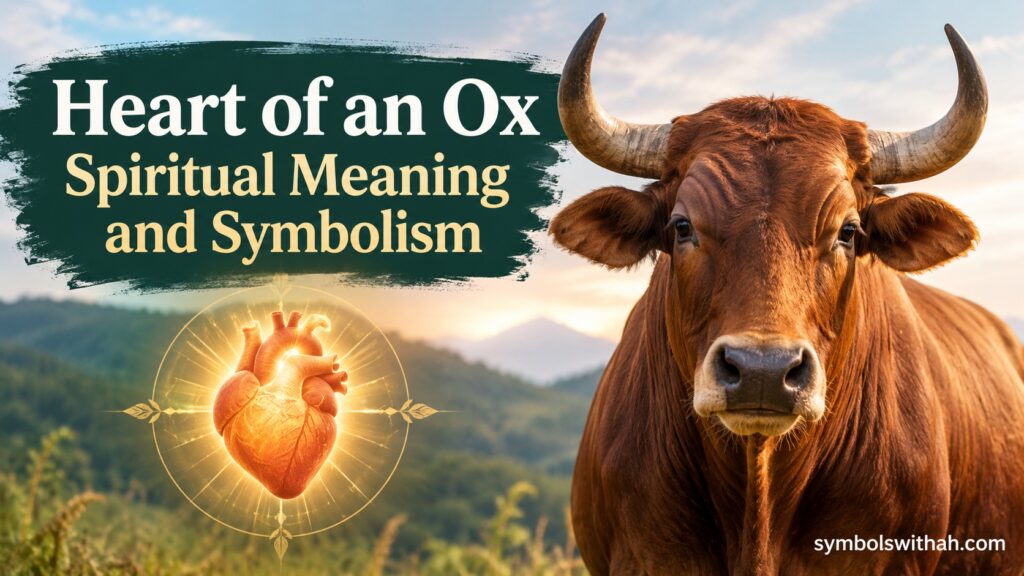

The heart of an ox spiritual meaning and symbolism centers on quiet strength, patience, endurance, loyalty, and purposeful work. Rather than representing sudden power, the ox suggests strength that develops through consistency and commitment.
For thousands of years, people depended on oxen to plow fields, move heavy loads, and support communities. That practical relationship shaped the animal’s symbolic meaning. Its strength became associated with patience, reliability, sacrifice, and service.
In the United States, the ox also connects with farming, pioneer history, rural traditions, and the idea of earning progress through hard work. Historical images of American farming often show ox teams pulling plows, wagons, and other heavy equipment.
At the same time, the phrase “heart of an ox” isn’t an ancient religious term with one fixed definition. Instead, it works mainly as a modern symbolic expression built from the long history of ox imagery.
Read More: Birds Flying Into Your House: Spiritual Meaning
Quick Answer
Heart of an Ox Spiritual Meaning and Symbolism usually represents inner strength, patience, resilience, loyalty, and the ability to carry burdens without giving up. In American culture, it can also suggest honest labor, determination, dependability, and grounded courage.
TL;DR
- The ox symbolizes strength that remains calm and controlled.
- Its heart represents courage, endurance, loyalty, and emotional steadiness.
- American symbolism connects oxen with farming and pioneer life.
- Ancient traditions linked oxen with agriculture, sacrifice, and fertility.
- Spiritual interpretations often emphasize patience and purposeful service.
- Modern designs use the ox to express resilience and grounded identity.
What Does the Heart of an Ox Represent?
The heart adds an important emotional layer to traditional ox symbolism. While the animal represents physical strength, the heart suggests the inner qualities behind that strength.
Strength Without Aggression
An ox can carry tremendous weight without appearing hurried or aggressive. Therefore, its symbolic strength often feels calm rather than threatening.
This distinction matters. The heart of an ox isn’t simply about being powerful. Instead, it suggests knowing how to use strength responsibly.
Patience and Persistence
An ox moves steadily toward its task. It doesn’t symbolize instant success or dramatic transformation.
For many people, this makes the symbol especially meaningful during long periods of effort. It can represent continuing forward when progress feels slow.
Loyalty and Dependability
Because people historically relied on oxen for essential work, the animal became associated with dependability.
Symbolically, a person with an “ox heart” may be seen as someone who keeps commitments and remains present during difficult periods.
How Does the Ox Look as a Symbol?
The visual appearance of an ox changes its symbolic message. Artists can emphasize strength, gentleness, labor, spirituality, or connection with the earth.
Common Visual Features
Traditional ox imagery often includes broad shoulders, large horns, lowered heads, strong legs, and heavy bodies.
A lowered head can suggest humility or concentration. Meanwhile, large horns may emphasize protection, power, and physical strength.
• Broad shoulders can suggest endurance and responsibility.
• A lowered head may symbolize humility and focused effort.
• Strong horns can represent protection and personal power.
• A yoke can symbolize duty, partnership, or shared burdens.
• Earthy colors reinforce stability and connection with nature.
The Meaning of the Heart
When artists add a heart to an ox image, the message becomes more personal.
The heart can represent compassion beneath strength. It can also suggest that resilience doesn’t require emotional hardness.
That combination creates a useful symbolic contrast: strong enough to endure, gentle enough to care.
Ancient Roots of Ox Symbolism
Ox symbolism reaches far beyond modern spiritual writing. Ancient farming societies depended heavily on cattle for food, transportation, plowing, and social wealth.
Agriculture and Fertility
Ancient artwork frequently connects oxen with agriculture. A sixth-century BCE Greek bronze at The Metropolitan Museum of Art depicts a man plowing with two yoked oxen and was likely connected with agricultural or fertility worship.
This relationship helped create a powerful symbolic pattern. The ox didn’t simply represent strength; it helped transform difficult soil into productive farmland.
Therefore, its symbolism became connected with:
• Fertility and agricultural abundance.
• Productive work and physical endurance.
• Cooperation between humans, animals, and land.
• Stability within farming communities.
Ancient Near Eastern Traditions
The ox and bull appear throughout ancient Near Eastern imagery. These animals could represent strength, fertility, royal power, or divine authority.
However, ox, bull, and cow symbolism shouldn’t always be treated as identical. Their meanings varied by culture, period, and religious context.
That distinction becomes important when interpreting modern spiritual claims. Ancient symbolism provides background, but it doesn’t prove that every modern interpretation existed thousands of years ago.
The Ox in Biblical and Christian Symbolism
The ox also became important in Christian art and biblical interpretation. One of its strongest associations is with sacrifice and service.
The Ox as a Symbol of Luke
In Christian iconography, a winged ox or calf represents Luke, one of the four Evangelists. This tradition draws on imagery from Ezekiel and later Christian interpretations.
Luke’s association with the ox became connected with sacrifice because his Gospel begins with a priestly sacrificial setting.
As a result, Christian ox imagery can suggest:
• Sacrifice for a meaningful purpose.
• Service rather than personal glory.
• Patience through demanding circumstances.
• Faithfulness to a calling or responsibility.
Why the Heart Matters
When the ox is combined with a heart, the Christian symbolism can take on a more emotional meaning.
Rather than focusing only on sacrifice, the image may suggest compassionate service. Still, this is an interpretation rather than a universal Christian doctrine.
What Does the Ox Mean in America?
In the United States, ox symbolism has a strong connection with work and settlement. Long before modern machinery transformed agriculture, oxen provided valuable pulling power.
Farming and Pioneer Life
American historical records show oxen working on farms and transporting goods. The Library of Congress preserves an 1868 image of men plowing a prairie with a team of oxen.
The Smithsonian also documents oxen pulling Red River carts across nineteenth-century frontier trade routes.
Because of this history, Americans may associate the ox with:
• Frontier determination and self-reliance.
• Rural labor and agricultural heritage.
• Patience during difficult journeys.
• Practical strength rather than showmanship.
• Building something slowly from limited resources.
The symbolism can feel especially familiar in American stories about homesteading, farming, westward expansion, and rural life.
The Modern American Meaning
Today, relatively few Americans depend on oxen for everyday work. Yet the symbolic image remains recognizable.
The ox can now represent a person who works steadily behind the scenes. In this sense, “heart of an ox” can describe someone whose strength comes from discipline rather than attention.
What Is the Spiritual Meaning of an Ox?
Spiritually, the ox often represents grounded energy and patient progress. Its symbolism encourages steady movement instead of impulsive action.
Inner Strength
An ox doesn’t need to appear dramatic to be powerful. Therefore, spiritual interpretations often use it as an image of quiet resilience.
Someone drawn to this symbol may interpret it as encouragement to remain stable during uncertainty.
Patience as Spiritual Growth
Spiritual growth is often described as gradual rather than instant. The ox fits this idea because its traditional role depended on repeated effort.
The message can be simple: keep doing meaningful work, even when results take time.
Service and Responsibility
The ox’s historical role also makes service an important theme. Its strength supported families and communities.
However, service shouldn’t automatically mean self-sacrifice without limits. A balanced interpretation recognizes both responsibility and personal boundaries.
What Does an Ox Symbolize in Different Cultures?
Ox symbolism changes across cultures, although several themes appear repeatedly. Strength, agriculture, discipline, and patience are especially common.
China and East Asia
The ox has a major place in Chinese tradition and the Chinese zodiac. It is commonly associated with diligence, reliability, patience, and responsibility.
Ox-herding imagery also became important in Chinese and Japanese Buddhist art. The ox can represent the mind being trained and gradually brought under control. The Met notes the connection between ox-herding imagery, agriculture, and Zen teachings.
India
Indian traditions contain several important bovine symbols. However, the meanings of a bull, cow, ox, and water buffalo aren’t always interchangeable.
Nandi, the bull associated with Shiva, is particularly important in Hindu traditions. Therefore, readers should avoid treating every South Asian bovine symbol as the same tradition.
Mediterranean Traditions
In ancient Mediterranean cultures, oxen were closely connected with agriculture. Plowing and fertility helped create associations between bovine strength and productive land.
These older themes later influenced European art and religious symbolism.
Heart of an Ox Meaning in American Culture
The heart-of-an-ox idea fits several values that Americans often connect with perseverance. It can represent someone who keeps working when circumstances become difficult.
| Context | Meaning in the USA | Common Associations | Notes |
| Farming | Endurance and practical strength | Fields, barns, livestock | Reflects agricultural heritage |
| Pioneer imagery | Perseverance | Wagons, trails, frontier life | Linked with historical settlement |
| Personal growth | Resilience | Discipline, patience | Usually metaphorical |
| Family life | Dependability | Loyalty, responsibility | Emphasizes emotional steadiness |
| Spiritual art | Gentle strength | Heart, earth, light | Modern interpretation varies |
Blue-Collar and Rural Associations
An ox can symbolize respect for work that doesn’t receive much attention. It represents the person who keeps showing up and carrying responsibility.
That meaning can resonate with working-class and rural imagery without belonging exclusively to either group.
Family and Relationships
A heart combined with an ox may also symbolize someone dependable in relationships.
The message becomes less about physical power and more about emotional reliability. It can suggest, “I will stay steady when life becomes difficult.”
Emotional and Psychological Meaning
The heart of an ox can also work as an emotional archetype. It brings together two ideas that people sometimes separate: strength and tenderness.
Emotional Resilience
An ox-heart image may appeal to people who have experienced hardship and learned to remain steady.
It doesn’t necessarily mean suppressing emotions. Instead, it can symbolize feeling deeply while continuing to function with purpose.
Grounded Personality
The symbol may also represent someone who values consistency over excitement.
Such a person might prefer dependable routines, long-term relationships, and practical decisions.
• Calmness during stressful situations.
• Commitment to long-term goals.
• Strong feelings paired with self-control.
• Loyalty toward family and close friends.
• Confidence that grows through experience.
The Shadow Side
Every symbol can have a less positive interpretation. The ox can sometimes represent carrying too much for too long.
Therefore, an “ox heart” doesn’t have to mean endless endurance. It can also remind someone to recognize when a burden has become unhealthy or unnecessary.
What Does It Mean to Dream of an Ox Heart?
Dream symbolism is personal, so an ox heart doesn’t have one universal interpretation. The surrounding dream details matter just as much as the animal itself.
A Strong Ox Heart
Seeing a healthy or powerful ox heart might symbolize endurance, courage, or emotional strength.
If the dream feels peaceful, the image may suggest stability. If it feels frightening, it could reflect pressure or responsibility.
A Damaged or Bleeding Heart
A damaged ox heart can symbolize emotional exhaustion, vulnerability, or the feeling of carrying too much.
However, dreams don’t provide fixed predictions. They often reflect personal memories, fears, expectations, or recent experiences.
Heart of an Ox Tattoos and Modern Symbolism
The ox works well as a tattoo because its meaning can be expressed through many visual styles.
Popular Design Ideas
A tattoo might show a realistic ox, an ox head, horns surrounding a heart, or a minimalist outline.
Some designs combine the ox with mountains, wheat, trees, stars, or agricultural tools. Each added element changes the emphasis.
• Ox and heart designs can represent resilient love.
• Ox and mountains can suggest endurance through hardship.
• Ox and wheat can emphasize harvest and abundance.
• Ox and earth imagery can suggest grounding and stability.
Why People Choose the Symbol
Someone may choose an ox tattoo after overcoming a difficult period. Another person may use it to honor family, farming roots, or a hardworking parent.
Because symbolism is personal, the same tattoo can carry very different stories.
Heart of an Ox in Home Decor and Art
Ox imagery can create a strong rustic or natural feeling in American homes. It often works especially well with farmhouse, Western, or traditional country-inspired decor.
Common Decorative Settings
You may see ox imagery on paintings, carved signs, textiles, pottery, or metal wall art.
A heart-centered ox design can soften the traditionally rugged appearance of the animal.
Symbolic Home Meaning
In a home, the image can represent stability and perseverance. It may also honor agricultural heritage or family traditions.
Because the symbol isn’t universally defined, its meaning usually comes from the owner’s personal story.
Misunderstandings and Controversies
Ox symbolism can become confusing when modern spiritual claims are presented as ancient facts.
The Phrase Isn’t a Universal Ancient Doctrine
There is no single worldwide tradition that defines “the heart of an ox” with one fixed spiritual meaning.
Many current interpretations combine older ox symbolism with modern ideas about emotional strength. That doesn’t make them meaningless, but it does make historical accuracy important.
Ox Versus Bull Symbolism
Another common mistake is treating every ox and bull image as identical.
A bull can symbolize fertility, aggression, sexuality, or raw power. An ox more often emphasizes labor, patience, service, and controlled strength.
The animals overlap historically, but their symbolic roles can differ.
Avoiding Cultural Overreach
Cross-cultural symbolism should also be handled carefully. A meaning found in Chinese, Christian, Indian, or Mediterranean traditions shouldn’t automatically be presented as universal.
Instead, it helps to say that a particular tradition associates the animal with a certain quality.
How Ox Symbolism Has Changed Over Time
The meaning of the ox has shifted as human life changed. Its original practical importance gradually became cultural and symbolic.
From Working Animal to Symbol
In ancient farming societies, the ox was a vital working animal. Its strength had immediate practical value.
Later, religious art transformed that practical identity into moral symbolism. The ox could represent sacrifice, service, patience, and endurance.
From Farm to Modern Culture
Industrial agriculture reduced the ox’s everyday role in the United States. Tractors and machines replaced much of the work once performed by animals.
Yet the image survived through historical art, Western imagery, museums, rural branding, tattoos, and decorative art.
Today, the ox often represents an ideal rather than a tool: steady strength that keeps moving forward.
What Can the Heart of an Ox Teach Us?
The strongest lesson is not simply “be tough.” The symbol offers a more balanced idea of strength.
Strength Can Be Quiet
An ox doesn’t need speed or aggression to demonstrate power. Its strength comes from persistence.
That makes it a useful symbol for people who make progress slowly but consistently.
Patience Has Value
Modern life often rewards speed. The ox represents a different approach.
It suggests that meaningful results can come from repeating small efforts over a long period.
Strength and Compassion Can Coexist
The heart changes the message of the ox. Instead of strength alone, it suggests strength guided by care.
That combination may be the most meaningful modern interpretation of the symbol.
FAQs
1. What does the heart of an ox symbolize?
The heart of an ox commonly symbolizes strength, patience, endurance, loyalty, and resilience. In spiritual interpretations, it can also represent grounded courage and purposeful service.
2. What does an ox symbolize spiritually?
An ox can symbolize steady progress, discipline, patience, service, and inner strength. Different traditions give the animal additional meanings, so interpretations vary by culture.
3. Is the ox a symbol of strength?
Yes. The ox has long been associated with physical strength because of its role in plowing and hauling heavy loads. Symbolically, that strength often appears as patience and endurance rather than aggression.
4. What does an ox symbolize in Christianity?
Christian art traditionally associates the ox or winged calf with Luke. The image connects with sacrifice because Luke’s Gospel begins with a priestly sacrificial setting.
5. What does an ox represent in Chinese culture?
The ox is associated with qualities such as diligence, responsibility, patience, and reliability. Ox-herding imagery also has an important place in Chinese and Japanese Buddhist art.
6. What does an ox heart tattoo mean?
An ox heart tattoo may symbolize resilience, loyal love, family strength, or perseverance. Its exact meaning depends on the person’s story and the other elements included in the design.
Conclusion
The Heart of an Ox Spiritual Meaning and Symbolism centers on a powerful but grounded idea: strength doesn’t always need to be loud. The ox represents patience, endurance, reliability, service, and steady progress.
In American culture, those qualities connect naturally with farming heritage, pioneer history, family responsibility, and respect for hard work. Across other traditions, the ox has also carried meanings involving agriculture, sacrifice, discipline, and spiritual development.
Ultimately, the symbol can be viewed as a reminder to develop strength without losing compassion. If the image speaks to you, consider which quality matters most right now: patience, courage, loyalty, or the willingness to keep moving forward.