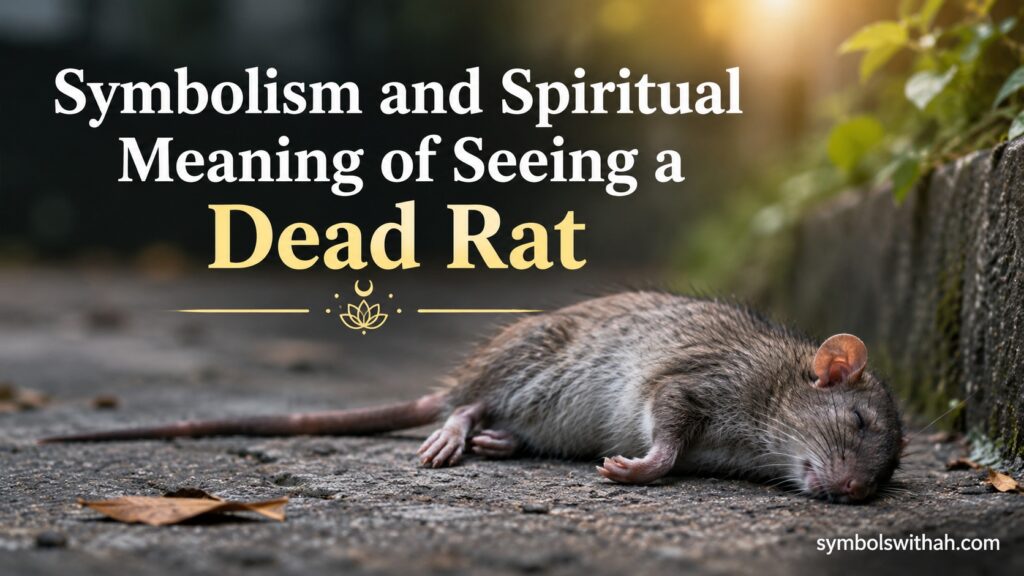

Seeing a dead rat can be disturbing, especially when it appears unexpectedly. The symbolism and spiritual meaning of seeing a dead rat often centers on endings, hidden problems, betrayal, and transformation.
In the United States, rats carry strong cultural associations. They can represent disease, secrecy, survival, urban hardship, or betrayal. However, their meaning isn’t always negative.
Spiritually, some people view a dead rat as a sign that an unwanted chapter has ended. Others see it as a reminder to notice something that has remained hidden. The meaning often depends on where you saw it and how you felt.
Read More: Birds Flying Into Your House: Spiritual Meaning
Quick Answer
The symbolism and spiritual meaning of seeing a dead rat often represents an ending, exposed problem, broken trust, or release from something unwanted. In the USA, the image can also connect with betrayal because “rat” has long been used for an informer.
Spiritually, it may symbolize closure rather than a prediction of bad luck.
TL;DR
- A dead rat can symbolize the end of a difficult chapter.
- It may represent hidden problems finally becoming visible.
- American culture strongly connects rats with betrayal and secrecy.
- Spiritually, some people interpret it as release and transformation.
- Other cultures give rats positive meanings linked with cleverness and prosperity.
- The real-life sighting should still be understood practically first.
What Does a Dead Rat Symbolize?
A dead rat combines two powerful symbols: the rat and death. Each carries different meanings, so their combination can feel especially intense.
In American culture, rats often represent things that remain hidden. Death then adds themes of completion, loss, consequences, and change.
Common Symbolic Meanings
People commonly associate a dead rat with:
• The end of something harmful
• Hidden problems becoming visible
• Betrayal or broken trust
• Release from fear or stress
• Decay and neglected situations
• Transformation after an unpleasant experience
However, symbolism isn’t a fixed code. Your personal experience can change what the image represents.
Why Death Changes the Rat’s Meaning
A living rat can symbolize survival and adaptability. A dead rat may suggest that those qualities have reached an ending.
For example, someone leaving a stressful relationship might view the image differently. Instead of seeing danger, they may see closure.
Likewise, someone facing an unresolved problem may interpret the sight as a reminder. The message becomes less about prediction and more about paying attention.
Historical Roots of Rat Symbolism
Rat symbolism is much older than modern horror stories or urban legends. Different civilizations viewed rodents through both positive and negative lenses.
Ancient societies often noticed how rats survived, reproduced, found food, and lived close to people. Those qualities could inspire admiration, fear, or both.
Ancient and Pre-Christian Associations
In some ancient Mediterranean traditions, mice and rats had connections with divine forces, prophecy, disease, and destruction. Their symbolism wasn’t uniformly negative.
Ancient Greek traditions, for example, connected mice with Apollo in certain local traditions. Ancient Egyptian beliefs also gave rodents varied symbolic roles.
This duality matters because modern readers sometimes assume rats have always represented evil. History shows something more complicated.
Rats, Death, and Disease
Later European history strengthened the darker side of rat symbolism.
Plague became deeply connected with rats and fleas in popular memory. However, historians and scientists continue to debate exactly how different plague outbreaks spread.
The association still became powerful. Over time, rats became visual shorthand for filth, disease, crowded cities, and decay.
That history continues to influence how Americans react to a dead rat today.
Why Rats Became Negative Symbols in America
American attitudes toward rats developed through urban growth, public health concerns, language, and popular culture.
The United States experienced a major plague outbreak beginning in San Francisco in 1900. Infected rats and their fleas became part of the public story surrounding the disease. (Smithsonian Magazine)
The American Urban Image
As American cities expanded, rats became strongly associated with:
• Alleys and neglected buildings
• Garbage and crowded neighborhoods
• Hidden movement at night
• Urban decay
• Disease fears
• Survival under difficult conditions
These associations shaped movies, novels, cartoons, news stories, and everyday speech.
Consequently, a dead rat can trigger an immediate emotional reaction. People often connect it with something unhealthy or hidden.
The “Rat” as an Informer
American English also gave the rat another symbolic meaning.
Calling someone a “rat” can suggest betrayal or informing on others. Phrases such as “ratting someone out” reinforce this association.
Therefore, a dead rat can symbolically suggest that betrayal has been exposed or ended.
This interpretation becomes especially strong in crime stories and gangster-themed entertainment.
What Does a Dead Rat Mean in a Gangster Context?
A dead rat can carry a very different meaning in gangster stories than it does in spiritual reflection.
In crime fiction, the rat often represents an informer, traitor, or person who has broken loyalty. Because of that slang connection, a dead rat can become a threatening symbol.
Gangster and Crime Symbolism
In this setting, a dead rat may suggest:
• Betrayal
• Punishment
• Broken loyalty
• Exposure of a secret
• Fear of consequences
• A warning to others
However, this meaning belongs mainly to cultural storytelling. Finding a dead rat in real life doesn’t prove that anyone is sending a message.
The gangster association is useful because it explains why the symbol can feel threatening. American movies and television have repeatedly reinforced these connections.
Why Context Matters
A dead rat in a crime drama has a completely different meaning from one appearing in a spiritual dream.
Likewise, a rat pictured beside religious imagery may carry another meaning entirely. Symbolism depends heavily on setting, surrounding images, and personal associations.
Spiritual Meaning of Seeing a Dead Rat
Many modern spiritual interpretations focus on endings and transformation.
The rat can represent survival, resourcefulness, secrecy, or unwanted influences. Its death can therefore symbolize the end of one of those patterns.
End of a Difficult Cycle
One common interpretation is closure.
You may connect the image with a difficult relationship, stressful period, unhealthy habit, or unresolved conflict that is finally losing its power.
The symbolism doesn’t necessarily predict that something will happen. Instead, it can serve as a personal reflection point.
Hidden Problems Coming to Light
Rats often live in spaces people don’t normally see. They move through walls, drains, basements, storage areas, and other concealed places.
Symbolically, that makes them natural images of secrecy.
A dead rat appearing in an open space may therefore represent something hidden becoming impossible to ignore.
Releasing Negative Patterns
Some spiritual interpretations treat death as transformation rather than destruction.
From that perspective, the dead rat represents an old pattern that no longer belongs in your life.
That could involve fear, dishonesty, resentment, unhealthy attachments, or constant survival mode.
Dead Rat Symbolism by Context
Where you see the dead rat can influence the symbolic interpretation. The table below offers common modern interpretations rather than fixed spiritual rules.
| Context | Meaning in the USA | Common Associations | Symbolic Reading |
| Outside your home | Boundaries or hidden concerns | Protection, awareness | Something unwanted is being noticed |
| Near a doorway | Transition or closure | Thresholds, change | One chapter may be ending |
| On a street | Urban decay or consequences | Neglect, survival | An uncomfortable reality becomes visible |
| In a dream | Personal fears or unresolved issues | Anxiety, control | Inner concerns may need attention |
| In artwork | Rebellion or mortality | Decay, outsider identity | A deliberate statement about life or society |
These meanings aren’t universal. Instead, they show how context can change the emotional message.
What Does Seeing a Dead Rat Outside Your House Mean?
Finding a dead rat outside your home can feel especially meaningful because the home represents safety and personal boundaries.
In symbolic thinking, something appearing near your home may represent an issue entering your personal space. The dead animal can then suggest that the issue has been exposed or stopped.
Protection and Boundaries
Some people interpret this encounter as a reminder to protect their peace.
The symbolism may encourage you to consider where you need stronger boundaries. It can also represent the removal of something unwanted.
A Practical Meaning Comes First
A real dead rat also has an ordinary explanation. It may have died from poisoning, illness, predation, or environmental conditions.
So symbolic interpretation shouldn’t replace practical awareness. A physical dead rodent can indicate nearby rodent activity and deserves appropriate attention.
Cross-Cultural and Spiritual Meanings
Rats don’t have the same meaning everywhere.
That difference is important because American symbolism often emphasizes negative associations. Other traditions have preserved more positive views of the animal.
Chinese Cultural Associations
In Chinese tradition, the Rat is the first animal of the zodiac cycle.
It is commonly associated with cleverness, adaptability, opportunity, and resourcefulness. This provides a sharp contrast with the American image of the rat as a pest.
Therefore, a dead rat doesn’t automatically carry the same symbolic meaning across cultures.
Hindu Associations
In Hindu traditions, the rat or mouse is associated with Ganesha, the widely revered deity connected with wisdom, beginnings, and overcoming obstacles.
Artworks of Ganesha frequently show the rat as his vehicle. The Met describes the rat as an appropriate vehicle because of its traditional association with overcoming obstacles. (The Metropolitan Museum of Art)
This symbolism reminds us that an animal viewed negatively in one culture can hold sacred or meaningful associations elsewhere.
Why These Differences Matter
Cross-cultural symbolism prevents overly simple interpretations.
A dead rat may feel like a warning to one person. Another person may focus on adaptability, opportunity, or overcoming obstacles.
Neither response is automatically the universal meaning.
Emotional and Psychological Meaning
Your emotional reaction can reveal more about the symbol than any traditional interpretation.
A person who feels disgust may associate the rat with something they want removed. Someone else may feel relief because the animal represents an unwanted threat.
If You Feel Fear
Fear can point toward vulnerability or loss of control.
The rat may symbolize something that entered your life without permission. Its death may then suggest that the threat has weakened.
If You Feel Relief
Relief creates a more positive interpretation.
You may see the dead rat as evidence that a difficult situation has reached its final stage. Symbolically, it can represent freedom from something intrusive.
If You Feel Sadness
Not everyone sees rats as disgusting pests.
Pet rats have also become familiar companion animals for many people. They can display social behavior, curiosity, and intelligence.
For someone with positive experiences around rats, a dead rat may symbolize mortality, loss, or compassion rather than betrayal.
Dead Rat Dreams and Their Symbolism
Dreams involving dead rats can feel unusually vivid.
However, dreams don’t have one universal dictionary. Their meaning often depends on personal memories, emotions, and current circumstances.
Seeing a Dead Rat in a Dream
A dead rat in a dream may symbolize something you believe has ended.
That could involve a relationship, fear, conflict, habit, or period of uncertainty.
If the dream feels peaceful, the symbolism may lean toward closure. If it feels frightening, it may reflect anxiety about consequences or hidden problems.
Killing a Rat in a Dream
Killing a rat can symbolize confronting something you consider threatening or unwanted.
It may also represent taking control of a situation that previously felt difficult.
Still, dream interpretation works best as personal reflection. It shouldn’t be treated as a prediction of future events.
Modern Uses in Tattoos, Art, and Media
Dead rat imagery has become especially useful in modern visual culture because it creates an immediate emotional reaction.
Artists may use the image to explore mortality, rebellion, poverty, decay, or social criticism.
Dead Rat Tattoos
A dead rat tattoo can carry highly personal meanings, including:
• Survival after hardship
• Rejection of social expectations
• Mortality and impermanence
• The end of a painful chapter
• Rebellion against authority
• Outsider identity
The surrounding design often changes the interpretation.
For example, flowers may emphasize rebirth. A skull may emphasize mortality. Chains may suggest breaking free from restriction.
Horror and Pop Culture
Movies, television, games, and comics often use rats to create tension.
Their association with darkness, disease, secrecy, and hidden spaces makes them effective visual symbols. A dead rat can intensify the feeling that something is wrong.
However, entertainment frequently exaggerates these associations for dramatic effect.
Misunderstandings and Controversies
Dead rat symbolism can become misleading when people treat every interpretation as an established spiritual fact.
No single religious or cultural tradition gives every dead rat the same meaning.
A Dead Rat Isn’t Automatically a Bad Omen
Seeing one doesn’t guarantee that something bad will happen.
People may interpret the event spiritually, but that interpretation remains personal. A practical explanation may be much simpler.
Rats Aren’t Universally Negative
American culture often emphasizes negative meanings. Yet other traditions connect rats with cleverness, opportunity, sacred relationships, or overcoming obstacles.
Therefore, calling rats universally evil or unlucky oversimplifies their history.
Avoid Confusing Symbolism With Prediction
Symbolism can help people reflect on their experiences.
However, it shouldn’t become a claim that an animal encounter predicts death, betrayal, financial loss, or another specific event.
That distinction keeps spiritual interpretation thoughtful rather than fear-driven.
How Dead Rat Symbolism Has Changed Over Time
Rat symbolism has never remained completely fixed.
Ancient traditions could treat rodents as sacred, powerful, useful, dangerous, or connected with prophecy. Later European experiences with plague intensified darker associations.
American urban culture then added another layer through slang, crime stories, and public health history.
From Survival to Decay
The living rat often symbolizes adaptability.
The dead rat shifts the focus toward consequences, endings, and decay. Yet that doesn’t necessarily make the symbolism hopeless.
In many modern spiritual interpretations, death marks the closing of one stage before another begins.
From Fear to Reflection
Today, people increasingly encounter symbolism through social media, tattoos, dream interpretation, and personal spirituality.
As a result, the dead rat can become less about literal superstition and more about personal reflection.
For one person, it represents betrayal. For another, it represents freedom. Someone else may simply see an unpleasant reminder of urban life.
Frequently Asked Questions
1. Is seeing a dead rat a bad omen?
Not necessarily. Some traditions interpret it as a warning, while modern spiritual interpretations may view it as closure or transformation. There is no universal rule that a dead rat predicts bad luck.
2. What does a dead rat mean spiritually?
Spiritually, it can represent endings, release, hidden problems, or transformation. Some people interpret it as a reminder to let go of patterns that no longer serve them.
3. Does a dead rat symbolize betrayal?
It can, especially in American culture. The slang use of “rat” for an informer or betrayer gives the image an additional connection with broken trust.
4. What does a dead rat outside your house mean?
Symbolically, it can represent boundaries, hidden concerns, or the end of something unwanted. In practical terms, it may simply indicate rodent activity nearby.
5. Can a dead rat have a positive meaning?
Yes. Its death can symbolize the end of stress, release from an unhealthy situation, or the completion of a difficult chapter. The positive interpretation focuses on what has ended rather than the unpleasant image itself.
6. What does a dead rat mean in a dream?
It may symbolize an ending, unresolved fear, betrayal, or a problem becoming visible. Your emotions during the dream usually provide important clues about its personal meaning.
Conclusion
The symbolism and spiritual meaning of seeing a dead rat can point toward endings, exposure, betrayal, release, or transformation. In the United States, the image carries especially strong associations with secrecy, urban decay, disease, and broken trust.
However, rats have never held one universal meaning. Other cultures connect them with intelligence, opportunity, sacred symbolism, and adaptability.
If you encounter a dead rat, you don’t have to treat it as a prediction. Instead, you can use the experience as a quiet opportunity for reflection. Ask what feels finished, what needs attention, and what you may finally be ready to leave behind.