
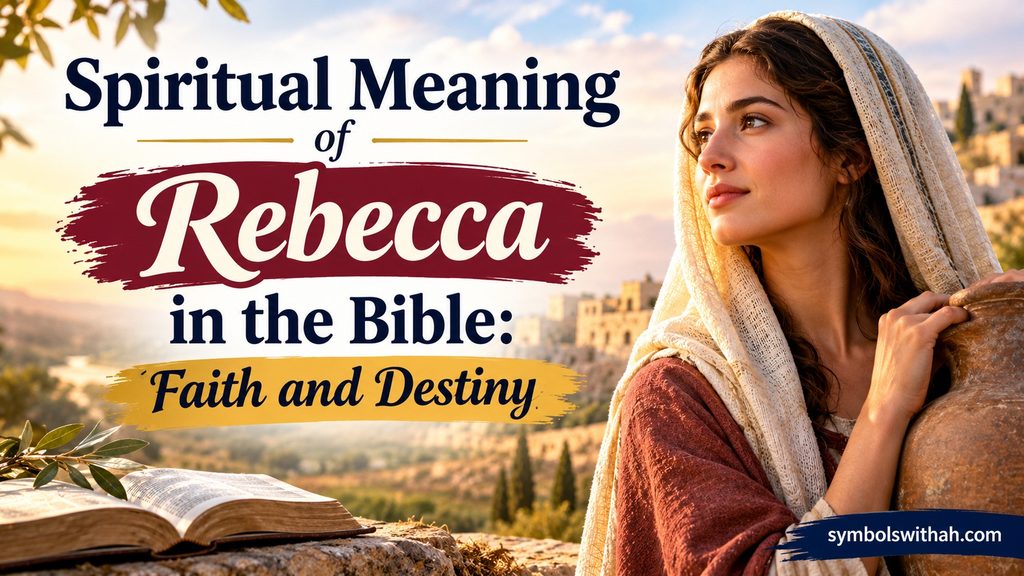

The spiritual meaning of Rebecca in the Bible: faith and destiny centers on trust, hospitality, courage, and the complicated choices that shape a family’s future. Known as Rebekah in most English translations of Genesis, she becomes Isaac’s wife and the mother of Jacob and Esau. Her story plays an important role in the biblical account of Abraham’s descendants.
Rebekah first appears when Abraham sends a servant to find a wife for Isaac. At a well, she offers water to the traveler and his camels. This simple act becomes a turning point in her life. However, her story includes much more than a marriage arranged through prayer and family connections.
Rebekah later makes bold decisions, experiences family struggles, and helps shape the future of Jacob. Her life therefore raises meaningful questions about faith, free choice, favoritism, and divine purpose. For modern American readers, her story offers lessons about hospitality, personal responsibility, and trusting a larger purpose without ignoring the consequences of our actions.
Read More: Left Foot Itching Spiritual Meaning and Beliefs
Quick Answer: What Is the Spiritual Meaning of Rebecca in the Bible?
In the Bible, Rebecca, also spelled Rebekah, symbolizes faith, hospitality, courage, motherhood, and the unfolding of God’s promises. Her story also explores human choice, family conflict, and the complex relationship between divine purpose and personal responsibility.
TL;DR
- Rebekah’s kindness at a well marks the beginning of her biblical story.
- Her decision to leave home reflects courage and willingness to embrace change.
- Her family life connects her with God’s promises to Abraham’s descendants.
- Her role in Jacob’s blessing raises questions about favoritism and deception.
- Her story offers lessons about faith, hospitality, wisdom, and accountability.
- The name Rebecca has an ancient Hebrew background, though its exact meaning remains debated.
Who Was Rebecca in the Bible?
Rebekah is one of the important women in the Book of Genesis. She enters the biblical story as the daughter of Bethuel and the sister of Laban. Later, she marries Isaac and becomes the mother of the twins Jacob and Esau.
Her story appears mainly in Genesis 24–27. These chapters describe her marriage, family life, and involvement in the blessing that Isaac intends for Esau.
Rebekah’s Place in the Biblical Family
Rebekah belongs to the family line connected with Abraham’s covenant. According to Genesis, God promises Abraham that his descendants will become a great nation.
Rebekah becomes central to that family history through her marriage to Isaac. Her sons, Jacob and Esau, also become important figures in the biblical narrative.
Jacob later receives the name Israel, and his descendants become associated with the twelve tribes of Israel. Consequently, Rebekah’s story connects an individual woman’s choices with a much larger biblical history.
Why Her Story Matters
Rebekah isn’t portrayed as a perfect person. She shows generosity and courage, but she also participates in a family deception.
That complexity makes her story especially meaningful. Readers can admire her strengths while still questioning some of her decisions.
Her life reminds us that biblical figures often carry both admirable qualities and serious flaws.
Rebecca Name Meaning and Hebrew Origins
The name Rebecca comes from the Hebrew name Rivqah, commonly rendered as Rebekah in English Bibles. Rebecca is another established spelling, especially familiar to many English-speaking readers.
The precise meaning of the Hebrew name isn’t certain. Some explanations connect it with the idea of tying or binding, but scholars don’t agree on a definitive interpretation.
What Does the Name Rebecca Mean Spiritually?
Modern name interpretations sometimes associate Rebecca with connection, commitment, or bringing people together. These ideas can reflect her role in joining Isaac’s household and continuing Abraham’s family line.
However, these spiritual associations shouldn’t be confused with a confirmed dictionary definition. The Bible doesn’t directly state that Rebecca’s name means faith, destiny, or blessing.
Instead, readers often connect the name with the events of her life. Her story supplies the spiritual themes, while the name’s exact linguistic origin remains debated.
Rebecca and Rebekah: What’s the Difference?
Both spellings refer to the same biblical woman.
- Rebekah: Common in English translations of Genesis.
- Rebecca: A familiar English spelling and the form used in Romans 9:10 in some translations.
- Rivqah: A transliteration closer to the Hebrew name.
The spelling may vary, but the biblical figure and her central story remain the same.
The Spiritual Meaning of Rebekah at the Well
One of the most memorable scenes in Rebekah’s story takes place at a well. Abraham’s servant has traveled to find a wife for Isaac and prays for guidance.
He asks God for a clear sign involving water. The woman who offers him a drink and also waters his camels will be the one chosen for Isaac.
Hospitality as a Sign of Character
Rebekah arrives at the well and gives the servant water. She then offers to draw water for his camels as well.
This second act matters because watering several thirsty camels requires substantial effort. Rebekah shows generosity through practical action rather than grand promises.
Her example suggests that kindness often appears in ordinary moments. A small act can reveal patience, willingness, and concern for someone else’s needs.
Divine Guidance and Human Observation
The servant interprets Rebekah’s behavior as an answer to his prayer. Her family connections also fit the purpose of his journey.
Within the biblical narrative, this meeting illustrates divine providence. Providence means the belief that God guides events toward a larger purpose.
However, the passage also emphasizes Rebekah’s actual behavior. The servant notices her generosity rather than relying on a mysterious sign alone.
For modern readers, the scene connects faith with paying attention to a person’s character.
Rebekah’s Faith, Courage, and Willingness to Change
Rebekah’s story takes a dramatic turn when the servant asks whether she will travel with him to become Isaac’s wife. Her family discusses the request, but Rebekah is also asked directly about her willingness to go.
She agrees to leave.
Leaving Home for an Uncertain Future
Rebekah’s decision means leaving her household and traveling to a place she hasn’t known as home. The journey carries uncertainty, yet she chooses to move forward.
Her response is often interpreted as an example of courage and trust. She cannot know every detail of her future, but she accepts a major change.
This doesn’t mean every difficult decision should be treated as a divine command. Rather, her story invites readers to consider how faith, personal willingness, and uncertainty can interact.
What Rebekah Teaches About Courage
Her decision offers several lessons:
- Courage sometimes means taking a thoughtful step into unfamiliar circumstances.
- Faith can involve movement rather than waiting for complete certainty.
- Major life changes deserve reflection, conversation, and personal willingness.
- A promising beginning doesn’t guarantee an uncomplicated future.
Rebekah’s story shows that a courageous choice can lead to both meaningful opportunities and difficult responsibilities.
Rebecca’s Spiritual Meaning in God’s Plan and Destiny
Rebekah’s life becomes part of the biblical account of God’s promises to Abraham. Her marriage to Isaac connects two family lines and leads to the birth of Jacob and Esau.
The story therefore explores destiny through relationships, decisions, and events that unfold over time.
God’s Promise and the Birth of the Twins
Genesis 25 describes Isaac praying because Rebekah has not yet had children. God answers, and Rebekah becomes pregnant with twins.
During her pregnancy, she experiences distress and seeks an explanation. The biblical account describes a message that two nations will emerge from her children.
This episode places her sons within a larger story about the future of their descendants. It also introduces the conflict that later shapes the family.
Does Destiny Remove Personal Choice?
Rebekah’s story doesn’t present destiny as a simple path without human decisions. Her actions affect her family, and those actions carry consequences.
Readers may interpret the story through different theological perspectives. Some emphasize God’s sovereignty, while others focus on human responsibility and the moral difficulties of the family’s choices.
A balanced reading recognizes both themes. The biblical narrative describes a larger promise while still showing the effects of individual behavior.
Rebekah as a Symbol of Motherhood and Family
Rebekah becomes the mother of Esau and Jacob, two brothers whose relationship shapes much of Genesis. Their differences create tension within the household, especially as they grow older.
Her role as a mother therefore carries both nurturing and complicated emotional dimensions.
The Meaning of Her Motherhood
Motherhood in Rebekah’s story involves more than giving birth. She influences family relationships and becomes deeply involved in her sons’ futures.
However, Genesis 25:28 says Isaac favors Esau, while Rebekah favors Jacob. This division contributes to the family’s growing conflict.
The passage doesn’t present favoritism as an ideal parenting practice. Instead, it shows how unequal affection can intensify rivalry and damage trust.
A Lesson About Family Loyalty
Rebekah’s loyalty to Jacob later leads her to help him obtain Isaac’s blessing. Her actions may be understood as an attempt to protect her favored son, but they also involve deception.
The episode raises an important question: Can a good intention justify dishonest behavior?
Her story encourages readers to consider how love can become entangled with fear, control, or favoritism. Healthy care requires both commitment and fairness.
Rebekah and Jacob: The Blessing, Deception, and Consequences
Genesis 27 describes one of the most debated episodes in Rebekah’s life. Isaac intends to bless Esau, his older son, but Rebekah helps Jacob disguise himself as Esau.
Jacob then approaches his father and receives the blessing intended for his brother.
Why Rebekah Helps Jacob
Earlier in Genesis, Rebekah receives a message concerning the future of her two sons. Some readers connect that message with her later actions on Jacob’s behalf.
Nevertheless, the biblical text doesn’t say that every detail of her deception was divinely commanded. Her choice remains part of a complicated family story.
Her actions help bring about the transfer of the blessing, but they also create immediate conflict. Esau becomes angry, and Jacob must leave home.
What the Story Teaches About Consequences
The episode illustrates the difference between believing in an outcome and choosing the means to achieve it. Rebekah may believe Jacob’s future matters, yet she uses deception to influence the result.
Readers can interpret the event through several themes:
- Favoritism can damage trust between family members.
- Deception may achieve an immediate goal but create lasting conflict.
- Belief in a larger purpose doesn’t remove moral responsibility.
- Family decisions can affect relationships across generations.
Rebekah’s story is spiritually significant partly because it refuses to offer a simple picture of flawless faith.
Rebecca’s Biblical Meaning in Christianity and Judaism
Rebekah belongs to the shared scriptural history of Judaism and Christianity. Both traditions recognize her place in the family narratives of Genesis, although later interpretations may emphasize different themes.
Understanding this shared background helps American readers approach her story with cultural and religious respect.
Rebekah in Jewish Tradition
In Jewish tradition, Rebekah is one of the matriarchs associated with the early history of the people of Israel. Her actions at the well are often read alongside themes of hospitality and generosity.
Her role as Jacob’s mother also connects her with the ancestry of Israel. However, Jewish interpretations of her choices and family conflicts are not all identical.
Rebekah in Christian Interpretation
Christian readers often consider Rebekah within the larger biblical story of God’s promises. Romans 9:10–13 refers to Rebekah and her twin sons while discussing God’s purpose and election.
This passage has played a role in Christian theological debates about grace, choice, and divine sovereignty. Different Christian traditions interpret these questions in different ways.
Neither tradition requires readers to ignore the difficult parts of Rebekah’s story. Her generosity, courage, favoritism, and deception all contribute to a fuller understanding of her character.
The Spiritual Lessons of Rebecca for Modern American Readers
In the United States, biblical names and stories often shape family traditions, religious education, and personal identity. Rebekah’s story can remain meaningful even for readers who approach it as literature or cultural history.
Her experiences connect ancient family life with familiar modern questions about trust, responsibility, and difficult choices.
Faith During Uncertainty
Rebekah agrees to leave her home without knowing everything her future will hold. Her decision can remind readers that uncertainty often accompanies meaningful change.
However, courage doesn’t require ignoring warning signs or abandoning careful thought. Her story is best used as a prompt for reflection, not a rule that every sudden opportunity must be accepted.
Hospitality and Generosity
Rebekah’s first major action is to help a traveler and his animals. That scene offers a practical example of care expressed through effort.
Modern readers can connect this theme with welcoming newcomers, helping neighbors, or offering support without expecting immediate rewards.
Taking Responsibility for Difficult Choices
Rebekah’s later deception shows that faith and good intentions don’t automatically make every decision wise. The story invites readers to examine both their goals and their methods.
This lesson remains relevant in family relationships, workplaces, and communities. Acting with integrity means considering how our choices affect others.
Rebecca’s Symbolism in Names, Art, and Modern Culture
Rebecca remains a familiar name in English-speaking countries, including the United States. Its biblical history gives it religious and cultural associations that families may value when naming a child.
However, people choose the name for different reasons. Some appreciate its scriptural roots, while others simply like its sound, spelling, or family connections.
Why Parents Choose the Name Rebecca
For some families, the name evokes faith, generosity, or a connection with biblical history. Others may choose it to honor a relative or preserve a family naming tradition.
These associations are personal rather than universal. A person named Rebecca doesn’t automatically share the character traits attributed to the biblical Rebekah.
Rebekah in Art and Storytelling
Artists and illustrators often portray Rebekah at the well, drawing water or meeting Abraham’s servant. These scenes emphasize hospitality, beauty, generosity, and the beginning of her marriage to Isaac.
Other artistic interpretations focus on her role as a mother or her involvement in Jacob’s blessing. Such portrayals may highlight her courage or examine the moral complexity of her choices.
Tattoos and Personal Spiritual Symbols
Someone who feels connected to Rebekah’s story might choose a water jar, a well, or a biblical name as personal artwork. These images can represent hospitality, faith, transition, or family heritage.
There isn’t one universally recognized tattoo symbol for Rebekah. The meaning depends on the person’s intention and the details of the design.
Common Misunderstandings About Rebecca’s Spiritual Meaning
Rebekah’s story has inspired many spiritual interpretations, but some claims go beyond what the biblical text actually says. Separating scripture from later personal symbolism helps readers understand her story more clearly.
Does Rebecca’s Name Literally Mean Faith or Destiny?
No definitive linguistic evidence establishes that the Hebrew name means “faith” or “destiny.” Those words describe themes readers may associate with her story, not a confirmed translation of her name.
The distinction matters because spiritual interpretations can become confused with language history. Her biblical actions provide the strongest basis for discussing faith and destiny.
Was Everything Rebekah Did Approved by God?
The biblical narrative presents Rebekah as part of the family through whom God’s promises continue. However, that doesn’t mean every decision she makes is described as morally perfect.
Her deception in Genesis 27 has serious consequences. Readers should distinguish the broader biblical storyline from approval of each human action within it.
Does Rebekah’s Story Predict Every Believer’s Future?
Rebekah’s life belongs to a specific biblical narrative. Her experiences don’t provide a formula that guarantees the same outcomes for modern readers.
Instead, her story offers themes for reflection: generosity, courage, family loyalty, and responsibility. People can draw spiritual lessons without assuming their own lives must follow the same path.
Frequently Asked Questions About Rebecca’s Spiritual Meaning
What does Rebecca mean in the Bible?
Rebecca, or Rebekah, is the wife of Isaac and the mother of Jacob and Esau. Her story is associated with hospitality, courage, family, and the continuation of God’s promises. The exact meaning of her Hebrew name remains uncertain.
What is the spiritual meaning of the name Rebekah?
Modern spiritual interpretations often connect Rebekah with faith, generosity, courage, and destiny. These themes come from her biblical story rather than a confirmed translation of her name. Individual families may attach additional personal meanings to it.
What does Rebekah symbolize at the well?
Rebekah’s actions at the well are commonly associated with hospitality and generosity. She offers water to Abraham’s servant and his camels, demonstrating practical kindness. Within the narrative, the meeting also becomes part of the story of Isaac’s marriage.
What can Christians learn from Rebekah?
Christians may reflect on her hospitality, willingness to embrace change, and role in the biblical family line. Her later deception also raises questions about honesty, favoritism, and personal responsibility. Her story offers both positive examples and difficult moral lessons.
Why did Rebekah help Jacob receive Isaac’s blessing?
Genesis 27 describes Rebekah arranging for Jacob to disguise himself as Esau. The episode takes place within a family already marked by favoritism and conflict. Readers differ in how they interpret her motives, but the deception clearly brings serious consequences.
Is Rebecca the same person as Rebekah?
Yes. Rebecca and Rebekah are English spellings of the same biblical woman’s name. Rebekah is common in English translations of Genesis, while Rebecca is also familiar in English-language use.
Conclusion: The Lasting Spiritual Meaning of Rebecca in the Bible
The spiritual meaning of Rebecca in the Bible connects faith, hospitality, courage, motherhood, and destiny. Her generosity at the well begins a story that becomes central to the biblical history of Abraham’s descendants. Her willingness to leave home also reflects the uncertainty that can accompany major life changes.
Yet Rebekah’s life is not a simple tale of perfect choices. Her favoritism and deception create family pain, reminding readers that good intentions don’t remove personal responsibility. Her story holds both inspiring qualities and difficult lessons.
For modern readers, Rebekah offers a reason to reflect on how faith and action work together. Her life encourages generosity, thoughtful courage, and honest consideration of the consequences of our choices. Ultimately, her story invites readers to pursue purpose without losing sight of integrity.