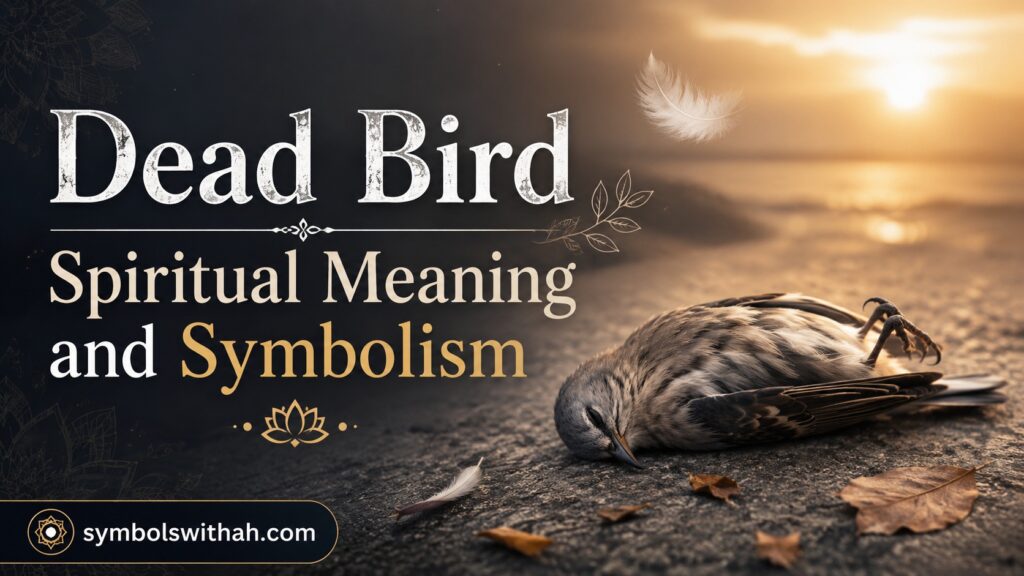

Seeing a dead bird can be an unexpectedly emotional experience. The Dead Bird Spiritual Meaning and Symbolism often centers on endings, transformation, loss, and the need to release something from the past.
Birds usually represent movement, freedom, hope, and connection with the sky. Therefore, seeing a bird lying still creates a powerful contrast. It can make an ordinary moment feel meaningful.
In the United States, people interpret this experience in different ways. Some connect it with spiritual signs or personal transformation. Others see it as a reminder of mortality or nature’s cycles.
Most importantly, a dead bird doesn’t automatically predict tragedy. A natural cause, window collision, predator, illness, or weather can explain what happened.
Symbolic meaning is therefore best treated as reflection rather than prediction.
Read More:Period on Your Birthday: Spiritual Meaning & Symbolism
Quick Answer
Dead Bird Spiritual Meaning and Symbolism in the USA often represents an ending, transformation, emotional release, or a reminder to slow down. In broader spiritual traditions, it can also symbolize transition, the soul, messages, and the natural cycle between life and death.
TL;DR
- A dead bird often symbolizes endings and personal transformation.
- It can represent releasing an old chapter or emotional burden.
- Older folklore sometimes treated dead birds as warnings or omens.
- American interpretations today are often more reflective than fearful.
- Bird species, location, and personal feelings can change the symbolism.
- Sometimes a dead bird simply reflects a natural event.
What Does a Dead Bird Symbolize?
A dead bird carries meaning because birds already have strong symbolic associations. Their ability to fly connects them with freedom, movement, hope, and the heavens.
Death changes that image. The bird is no longer moving upward or forward. Instead, it has returned to the earth.
The Main Symbolic Meanings
Several themes appear repeatedly in modern spiritual interpretations:
- The ending of an important life chapter
- Transformation after a period of difficulty
- Emotional release and letting go
- Loss of freedom, direction, or motivation
- Awareness of mortality and life’s temporary nature
- A reminder to pause and reflect
These meanings aren’t fixed rules. Instead, they provide symbolic lenses for understanding an emotional encounter.
Why the Image Feels So Powerful
A living bird represents motion. A dead bird represents stillness.
That contrast naturally creates a feeling of interruption. Something that should be flying is suddenly grounded.
For some people, this becomes a metaphor for their own lives. They may be changing careers, ending relationships, grieving someone, or questioning an old identity.
Historical Roots of Bird Symbolism
Bird symbolism is much older than modern spiritual websites or social media. Ancient societies carefully watched birds because their movements seemed connected with weather, seasons, migration, and the sky.
Consequently, birds became connected with divine communication, prophecy, souls, and the unseen world.
Ancient Egypt and the Soul
Ancient Egyptian symbolism provides one of the clearest examples.
The ba, an aspect of a person’s non-physical being, was commonly represented as a bird with a human head. Egyptian beliefs connected the ba with movement between the tomb and the world beyond.
This makes the bird especially important in discussions of death and spiritual transition. Ancient Egyptian artwork even showed the ba leaving the body and returning to it. (The Metropolitan Museum of Art)
Birds and Ancient Religious Thought
Birds also appeared throughout ancient Mediterranean and Near Eastern traditions.
Their ability to travel between earth and sky made them natural symbols of communication. However, different societies interpreted particular birds and behaviors differently.
Therefore, it’s inaccurate to claim that every ancient culture gave birds the same meaning.
Dead Birds, Omens, and Ancient Beliefs
The idea of animals serving as signs became especially important in traditional omen systems.
Ancient Romans, for example, developed elaborate practices involving the observation of birds. Their behavior could be interpreted when important decisions were being considered.
From Bird Behavior to Omens
Historically, people paid attention to:
- Unexpected bird appearances
- Unusual flight patterns
- Bird calls and movements
- Birds entering buildings
- Birds appearing around important events
However, folklore about dead birds specifically is less consistent than modern internet discussions sometimes suggest.
In some traditions, unusual bird encounters were connected with death. In others, birds represented protection, change, or spiritual movement.
Why Death Became Symbolic
Death has always created uncertainty.
When people couldn’t explain an unexpected event, symbolic explanations helped them give it meaning. A dead bird could therefore become a warning, a reminder, or a metaphor.
Over time, these interpretations became part of folklore.
Dead Bird Spiritual Meaning in the USA
American interpretations combine several different traditions.
European folklore arrived with settlers, while Indigenous cultures maintained their own distinct relationships with birds and feathers. Later, Christianity, literature, psychology, environmental awareness, and modern spirituality added further layers.
American Folk Beliefs
Older American folklore sometimes treated unusual bird behavior as an omen.
Historical collections of American and British folklore contain examples involving birds entering homes or striking windows. Importantly, these records don’t show one universal interpretation.
A bird could be considered lucky in one community and ominous in another.
Modern American Interpretation
Today, many Americans approach the symbol more personally.
Rather than assuming a dead bird predicts someone’s death, people may ask what the image represents in their own lives.
Common modern associations include:
- Closing a difficult chapter
- Accepting an unavoidable change
- Releasing emotional attachment
- Remembering someone who has died
- Recognizing life’s temporary nature
- Becoming more aware of nature
This shift makes the symbol less about prediction and more about reflection.
Spiritual Meaning of a Dead Bird
For people who use spiritual symbolism, a dead bird can represent a transition between states.
The bird’s movement has stopped, but the larger cycle of life continues.
Endings and New Beginnings
One common interpretation is that something has reached its natural conclusion.
That might involve a relationship, habit, belief, job, identity, or period of emotional struggle.
The symbolism doesn’t necessarily say that something bad will happen. Instead, it can suggest that something old is making room for something different.
Messages and Spiritual Reflection
Some spiritual traditions view birds as messengers between earthly and spiritual realms.
From that perspective, a dead bird may be interpreted as a message about transition or remembrance.
However, this is a matter of belief rather than something that can be scientifically proven.
The most useful approach is to treat the interpretation as an invitation to reflect, not as a guaranteed supernatural prediction.
Is a Dead Bird a Bad Omen?
A dead bird can certainly feel like a bad omen. Yet there is no universal spiritual rule saying that it predicts death or misfortune.
Why People Fear the Symbol
The fear comes partly from contrast.
Birds symbolize life, movement, and freedom. Seeing one dead reverses those associations.
That sudden reversal can feel disturbing, especially when the bird appears near your home.
A More Balanced Interpretation
A dead bird can symbolize something difficult without predicting something terrible.
For many modern readers, the stronger interpretation is:
- Ending rather than disaster
- Reflection rather than fear
- Change rather than punishment
- Release rather than permanent loss
- Awareness rather than prediction
Your emotional reaction also matters. Feeling peaceful, sad, frightened, or curious can influence the meaning you personally attach to the experience.
Dead Bird on Your Doorstep or Near Your House
Location can add another symbolic layer.
A doorstep is a threshold. It connects your private home with the outside world.
Dead Bird on a Doorstep
Symbolically, a dead bird at the door may represent an approaching transition.
Some people interpret it as a reminder to examine changes happening within the home or family. Others see it as a prompt to leave an old situation behind.
There is no traditional interpretation that applies universally.
Dead Bird in the Yard
A yard represents personal space while remaining connected with nature.
Therefore, a dead bird there may feel like a reminder of life’s natural cycles.
The symbolic interpretation may involve acceptance, closure, or renewed awareness of your surroundings.
What the Location May Suggest
| Context | Meaning in the USA | Common Associations | Notes |
| Doorstep | A personal transition | Threshold, change, closure | Often feels especially significant |
| Yard | Natural cycles | Mortality, acceptance, reflection | May have ordinary environmental causes |
| Near a window | Interrupted movement | Direction, obstacles, awareness | Window collisions are common |
| Roadside | Vulnerability and impermanence | Risk, movement, mortality | Traffic can be a direct cause |
| Dream | Inner emotional change | Grief, release, identity | Meaning depends strongly on the dream |
Dead Bird Symbolism by Species
The species can influence symbolism because different birds already carry different cultural associations.
A dead crow doesn’t necessarily suggest the same thing as a dead robin.
Dead Robin
Robins are often associated with spring, renewal, home, and new beginnings.
Therefore, a dead robin may symbolically represent the ending of a hopeful period or the need to find renewal after loss.
This doesn’t mean the event predicts misfortune.
Dead Crow or Raven
Crows and ravens have long carried complex symbolism.
They can represent intelligence, mystery, transformation, death, memory, or spiritual awareness.
Because their meanings vary widely, the species alone shouldn’t determine an interpretation.
Dead Dove
Doves are commonly associated with peace, love, innocence, and reconciliation.
A dead dove may therefore feel especially powerful. Symbolically, it can represent lost peace, the ending of conflict, or the need to restore emotional balance.
Dead Sparrow
Sparrows often symbolize ordinary life, community, resilience, and simplicity.
A dead sparrow can consequently become a reminder of life’s vulnerability and the importance of appreciating everyday experiences.
Cross-Cultural and Spiritual Interpretations
Bird symbolism exists across many cultures, but it doesn’t mean the traditions are interchangeable.
Each community developed meanings within its own religious, environmental, and historical setting.
Indigenous Traditions in North America
Birds and feathers hold important meanings in many Indigenous communities.
However, there is no single “Native American” interpretation of birds. Hundreds of nations have distinct traditions.
Feathers can have ceremonial, social, spiritual, or personal significance depending on the nation and context. Smithsonian collections document ceremonial feathers among communities including the Shawnee, Comanche, Seminole, and Dakota. (National Museum of the American Indian)
Therefore, modern spiritual content should avoid reducing these traditions to one simple meaning.
Ancient Egyptian Perspective
Ancient Egyptian beliefs provide a strong connection between birds, death, and the soul.
The ba-bird represented an aspect of a person’s being that could move beyond the tomb. This imagery was closely connected with funerary beliefs and renewal. (The Metropolitan Museum of Art)
This history helps explain why birds remain powerful symbols around death and transition.
Broader Spiritual Traditions
Across various spiritual systems, birds may symbolize:
- Communication between different realms
- Freedom from physical limitations
- The journey of the soul
- Transformation and renewal
- Connection with nature
- Messages connected with memory
These interpretations should be understood as traditions or beliefs, not universal facts.
Emotional and Psychological Meaning
Even without a spiritual belief, finding a dead bird can affect you deeply.
The reaction often comes from the sudden confrontation with mortality.
Grief and Loss
A dead bird can remind someone of another loss.
This may include a deceased relative, ended relationship, lost opportunity, or former version of themselves.
The bird becomes a symbolic object through which those feelings can surface.
Loss of Freedom
Because birds are strongly associated with flight, their death can symbolize lost freedom.
Someone experiencing emotional restriction may identify strongly with this image.
The symbolism can ask a simple question: Where do I feel unable to move forward?
Acceptance and Letting Go
Death also represents finality.
Symbolically, that can encourage acceptance of something that cannot be changed.
The message isn’t necessarily “something bad is coming.” It may instead be, “Something has ended, and it’s time to acknowledge it.”
Dead Bird in Dreams
A dead bird in a dream can carry a different meaning from finding one outdoors.
Dreams often use emotionally powerful images to represent personal experiences.
Common Dream Themes
A dead bird may symbolize:
- The end of a personal hope
- Fear of losing freedom
- Emotional exhaustion
- A changing identity
- Grief or unresolved sadness
- The need to release the past
Finding Versus Holding a Dead Bird
Dream details can matter.
Finding a dead bird may represent discovering that something has already changed. Holding one can feel more personal and may suggest direct involvement with loss.
Watching a bird die can create a different emotional message again.
Rather than using a fixed dream dictionary, consider what the bird and death meant to you within the dream.
Modern Uses of Dead Bird Symbolism
The dead bird has become a recognizable image in modern art and personal expression.
Its meaning can range from sadness to transformation.
Tattoos and Art
Some people use dead or fallen birds in tattoos to represent:
- Survival after hardship
- A completed chapter
- Grief and remembrance
- Transformation
- Lost freedom
- Acceptance of mortality
Artists may also combine birds with flowers, clocks, moons, trees, or broken wings.
These combinations make the meaning more personal.
Social Media and Personal Expression
Online, dead-bird imagery often appears alongside discussions of healing, grief, change, and spiritual growth.
The image works because it communicates complicated emotions quickly.
However, social media can also simplify complex traditions into one dramatic message. A claim that every dead bird predicts death is therefore misleading.
What Causes Birds to Die Near Homes?
Symbolic interpretation shouldn’t replace ordinary explanations.
Birds can die for many natural or human-related reasons.
Window Collisions
Glass is a major danger for birds because reflections can make windows appear like open space.
A major U.S. study estimated that hundreds of millions of birds die from building collisions each year. (Audubon)
Therefore, a bird found beneath a window may have a straightforward explanation.
Other Natural Causes
Possible causes include:
- Predator attacks
- Severe weather
- Disease
- Starvation
- Old age
- Vehicle collisions
- Habitat-related hazards
This doesn’t remove personal symbolism. It simply separates physical cause from spiritual interpretation.
Misunderstandings and Controversies
Dead bird symbolism can become problematic when interpretations are presented as absolute truths.
The “Someone Will Die” Myth
One of the most frightening claims is that finding a dead bird predicts someone’s death.
There is no reliable evidence supporting that conclusion.
Older folklore contains death-related bird omens, but folklore varies greatly. A symbolic tradition isn’t the same as a prediction.
Avoiding Cultural Oversimplification
Another problem is combining unrelated traditions.
For example, saying that all Indigenous peoples view a dead bird as one specific spiritual message ignores enormous cultural diversity.
Respectful symbolism should identify traditions carefully and avoid treating them as interchangeable.
Spiritual Meaning Versus Physical Reality
Both perspectives can exist together.
A bird may have died because of a window collision. You may still find the experience personally meaningful.
The physical explanation describes what happened. Symbolism explores what the experience means to you.
How Dead Bird Symbolism Has Changed Over Time
The meaning of a dead bird hasn’t remained fixed.
Older societies often placed unusual animal behavior within religious or omen systems. Later writers used birds as metaphors for grief, freedom, mortality, and lost hope.
From Omens to Reflection
Modern American spirituality often emphasizes personal interpretation.
Instead of asking, “What disaster does this predict?” people may ask, “What change am I experiencing?”
This is an important shift.
The symbol becomes less prophetic and more psychological.
From Fear to Transformation
Contemporary interpretations frequently focus on transformation.
Death becomes the closing point of one stage rather than proof of impending tragedy.
That doesn’t erase older interpretations. Instead, it adds another layer to an already complex symbol.
What Should You Do When You Find a Dead Bird?
You don’t need to panic or immediately assign supernatural meaning to the event.
Instead, pause and consider both practical and personal perspectives.
Start With the Physical Explanation
If the bird is near glass, roads, or buildings, consider an environmental cause.
Also keep children and pets away from wildlife remains.
If you need to handle a carcass, avoid direct contact and follow local wildlife guidance.
Then Consider the Symbolic Meaning
If the encounter feels meaningful, ask yourself:
- What has recently ended in my life?
- Am I resisting an important change?
- What am I ready to release?
- Have I been thinking about someone I’ve lost?
- Where do I need greater freedom or direction?
These questions can turn an unsettling encounter into a moment of thoughtful reflection.
FAQs
1. What does finding a dead bird mean spiritually?
It often symbolizes an ending, transformation, release, or transition. Some spiritual traditions also connect birds with messages or the soul’s journey.
However, the meaning depends on personal belief and context.
2. Is a dead bird a bad omen?
Not necessarily. Some older folklore treats unusual bird encounters as warnings, but modern interpretations often focus on change and reflection instead.
A dead bird doesn’t automatically predict death or bad luck.
3. What does a dead bird on your doorstep mean?
Symbolically, a doorstep can represent a threshold between one stage and another. A dead bird there may therefore represent change, closure, or something ending close to home.
Still, ordinary causes should be considered first.
4. What does a dead bird in your yard mean?
A dead bird in the yard can symbolize natural cycles, acceptance, and personal transition. It may also simply reflect illness, predation, weather, or another natural cause.
The location can add personal symbolism without proving a supernatural message.
5. What does a dead bird symbolize in dreams?
A dead bird in a dream may represent lost hope, emotional change, grief, or the end of a personal chapter. The dream’s emotions and details usually matter more than a fixed interpretation.
It doesn’t necessarily represent literal death.
6. Does the type of dead bird matter spiritually?
Yes, within symbolic traditions, species can influence interpretation. Robins, crows, doves, sparrows, and other birds already carry different cultural associations.
However, there isn’t one universal species-to-meaning system.
Conclusion
The Dead Bird Spiritual Meaning and Symbolism is best understood through several layers. It can represent endings, transformation, grief, lost freedom, acceptance, or the natural cycle of life.
In the United States today, many people interpret the image more reflectively than prophetically. Older folklore may emphasize omens, while modern spirituality often emphasizes personal growth and emotional release.
At the same time, a dead bird can have a completely ordinary physical cause. If the experience feels meaningful to you, let it encourage thoughtful reflection rather than fear. Sometimes the most useful symbolism is simply a reminder to notice what is ending, what remains, and what may be ready to begin.