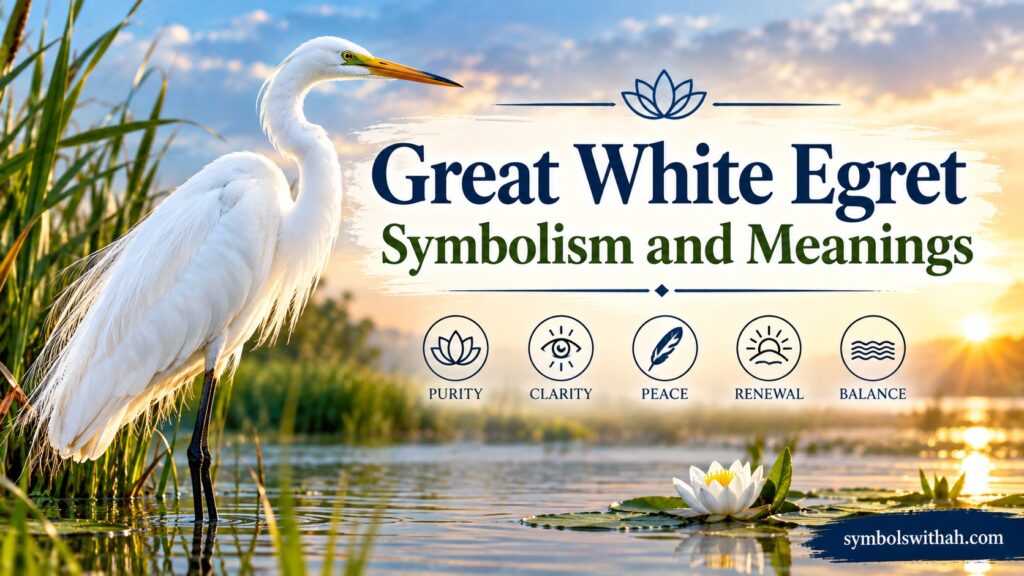

Meta title: Great White Egret Symbolism and Spiritual Meaning
Meta description: Explore great white egret symbolism, spiritual meanings, and American history. Discover what this elegant bird represents in nature and everyday life.
Featured image prompt: A majestic great white egret standing gracefully in a peaceful American wetland at sunrise, white feathers glowing in golden light, reflective water, soft marsh grasses, natural cinematic photography, elegant composition, 16:9 landscape format, with the title “Great White Egret Symbolism and Meanings” and “symbolswithah.com” in the bottom corner.
Alt text: Great white egret standing in shallow wetland water at sunrise, symbolizing grace, patience, renewal, and hope.
Research snapshot: October 16, 2026 | Timezone: America/New_York
Read More: Snake Tattoo Meaning and Spiritual Symbolism: Renewal, Power & Protection
Great White Egret Symbolism and Meanings: Grace, Renewal, and Hope
A great white egret can transform an ordinary walk beside a pond into a memorable moment. Its brilliant feathers, slender neck, and unhurried movements create an impression of quiet confidence. For many people, Great White Egret Symbolism and Meanings connect this remarkable bird with grace, patience, purity, and personal renewal.
In the United States, however, the egret carries an especially meaningful history. Its recovery from devastating feather hunting helped inspire an influential bird conservation movement. Today, the great egret also serves as the symbol of the National Audubon Society, linking its elegant appearance with environmental protection and collective responsibility.
Spiritual interpretations add another layer to this bird’s appeal. Some people associate an egret sighting with emotional balance, thoughtful decisions, or a fresh beginning. Others simply appreciate its beauty and the peaceful atmosphere surrounding wetlands.
These interpretations aren’t universal rules or proven supernatural messages. Instead, they offer ways to reflect on nature, personal experiences, and the values a graceful bird can represent.
Quick Answer
Great White Egret Symbolism and Meanings commonly include grace, patience, purity, independence, renewal, and environmental protection in the United States. Spiritually, people may interpret an encounter with this bird as a reminder to remain calm, trust their judgment, and move forward with greater clarity.
TL;DR
- Grace: The egret represents elegance, dignity, and quiet confidence.
- Patience: Its careful hunting behavior reflects timing and thoughtful action.
- Purity: Its white feathers often suggest clarity, peace, and fresh beginnings.
- Renewal: Its recovery represents resilience and the possibility of restoration.
- American history: The egret symbolizes successful bird conservation and environmental responsibility.
- Spiritual reflection: An encounter can inspire stillness, awareness, and personal growth.
1. What Does a Great White Egret Symbolize?
The great white egret is a striking bird whose appearance naturally invites symbolic interpretation. Its tall body, immaculate feathers, and deliberate movements suggest qualities that people often admire in themselves and others.
In American culture, its conservation history also gives the bird a meaning beyond physical beauty. It represents the possibility of protecting something vulnerable before it disappears.
Grace and Quiet Confidence
The egret’s long legs and curved neck give it an elegant silhouette. Even while hunting, it often moves slowly and deliberately rather than wasting energy.
Symbolically, this behavior can represent confidence without arrogance. It reminds observers that strength doesn’t always require noise, speed, or dramatic gestures.
Patience and Good Timing
An egret may stand almost motionless while watching fish in shallow water. Then, in a fraction of a second, it strikes with its sharp bill.
This contrast makes the bird a useful symbol of patience followed by decisive action. Its example suggests that waiting thoughtfully can sometimes be more effective than rushing.
Renewal and Resilience
The egret’s survival after widespread hunting adds a powerful layer of meaning. Its recovery demonstrates how collective action can help restore damaged natural populations.
Consequently, the bird can represent second chances, perseverance, and hope after difficult periods.
2. Great White Egret Appearance and Its Symbolic Meaning
A bird’s physical features often shape the associations people develop around it. The great egret’s white plumage, dark legs, yellow bill, and distinctive posture create several natural points of symbolic connection.
These interpretations are personal and cultural rather than fixed meanings assigned by nature.
What Its Colors Represent
The great egret’s most recognizable feature is its bright white plumage. During the breeding season, adults also develop delicate ornamental feathers along their backs.
Different features can suggest different ideas:
- White feathers: Purity, peace, clarity, and simplicity.
- Yellow bill: Alertness, discernment, and focused attention.
- Black legs: Groundedness, stability, and connection with the earth.
- Reflective water: Emotional depth, change, and self-awareness.
What Its Posture Represents
An egret standing upright can suggest dignity and self-possession. Its stillness may also evoke meditation, restraint, or the ability to observe before reacting.
When it spreads its wings and takes flight, the impression changes. That movement can symbolize freedom, transition, and willingness to explore new possibilities.
Ultimately, the meaning depends on which feature captures your attention and what it brings to mind.
3. Great White Egret History and Ancient Roots
Birds have inspired stories, art, and religious imagery across human history. However, it’s important to distinguish documented historical traditions from modern spiritual interpretations.
The great egret belongs to the heron family, and related long-legged waterbirds appear in many ancient cultural settings. Their associations differ widely, so a meaning attributed to one species shouldn’t automatically be applied to every egret.
Egrets in the Ancient World
In ancient Egypt, waterbirds and marshland creatures appeared in religious imagery and stories about the natural world. The sacred bennu bird, associated with renewal and creation, is often compared visually with heron-like birds. However, the exact relationship between the bennu and particular modern bird species remains uncertain.
This imagery helps explain why modern readers sometimes connect long-legged white birds with rebirth or spiritual awakening. Still, there isn’t sufficient evidence to claim that ancient Egyptians universally regarded the great egret itself as a symbol of purity or renewal.
Traditional European Associations
In European art and natural history, white herons and egrets attracted attention for their unusual plumage. Their ornamental feathers eventually became fashionable accessories, particularly during the nineteenth century.
That history reveals an important contrast. The same beauty that inspired admiration also made these birds vulnerable to exploitation.
From Decorative Feathers to Conservation
By the late nineteenth century, commercial feather hunting had devastated great egret populations in North America. Hunters targeted breeding birds for their long ornamental feathers, often killing adults while their young remained in nests.
In response, conservationists organized campaigns against the feather trade. The movement helped establish bird-protection organizations and strengthen wildlife safeguards across the United States.
This history gives the great egret a documented American meaning: beauty protected through public awareness and collective action.
4. Great White Egret Symbolism in the United States
The great egret occupies a distinctive place in American conservation history. Unlike symbolic meanings based primarily on personal belief, its connection with environmental protection has a clear historical foundation.
For American readers, the bird represents both the fragility of wildlife and the benefits of sustained conservation efforts.
The Egret and the American Conservation Movement
During the late 1800s, fashionable hats sometimes featured feathers taken from wild birds. The demand for ornamental plumes encouraged intensive hunting of egrets and other waterbirds.
In 1896, Harriet Hemenway and Minna B. Hall helped organize the Massachusetts Audubon Society in response to this destruction. Their efforts contributed to a broader movement that eventually supported stronger protections for birds.
The National Audubon Society adopted the great egret as its symbol in 1953. Its image now recalls the history of bird conservation and the importance of safeguarding vulnerable species.
What the Egret Represents in American Life
Today, the great egret can carry several related meanings for people in the United States:
- Environmental responsibility: Protecting wildlife and preserving healthy habitats.
- Collective action: Showing how organized communities can create lasting change.
- Resilience: Recovering after severe population declines and human pressure.
- Respect for nature: Recognizing wildlife as more than a decorative resource.
The bird also appears in American nature photography, wetland education, and wildlife observation. For many people, seeing an egret offers a simple reminder that conservation can produce meaningful results.
5. Great White Egret Spiritual Meaning
A great egret sighting may feel meaningful when it occurs during a period of uncertainty or personal change. Some spiritual interpretations treat the bird as an invitation to become more attentive, patient, and emotionally balanced.
These interpretations are personal reflections rather than established facts about supernatural messages. You can appreciate their meaning without assuming every sighting carries a predetermined instruction.
Spiritual Meaning of Patience
The egret’s hunting style offers a natural image of deliberate waiting. Instead of chasing every movement, it watches carefully and acts when an opportunity appears.
Spiritually, this behavior may encourage you to pause before making an important decision. It can also remind you that progress doesn’t always happen at the pace you expect.
Spiritual Meaning of Purity and Clarity
The bird’s white feathers often inspire associations with simplicity and peace. In a personal spiritual practice, the egret may represent a desire to release distractions and reconnect with your priorities.
This doesn’t mean you must eliminate difficult emotions. Rather, the image can encourage you to approach them with greater honesty and calm.
Spiritual Meaning of Renewal
Because the egret survived a period of severe human-caused decline, its story lends itself to reflections about recovery. Someone rebuilding their confidence or beginning a new chapter may find encouragement in that history.
The central idea is hopeful: setbacks can be serious without necessarily determining the future.
6. What Does Seeing a Great White Egret Mean?
The circumstances surrounding a sighting can shape its personal significance. An egret seen beside a quiet pond may evoke different feelings from one flying across a busy road.
Rather than treating each encounter as a fixed omen, consider what you noticed and what was happening in your life.
Seeing an Egret Near Water
Water often carries symbolic associations with emotions, reflection, and change. When an egret appears beside a lake, marsh, or river, the combined scene may inspire thoughts about emotional balance.
Its patient behavior can also encourage you to observe a situation before reacting. However, the bird may simply be feeding, resting, or moving through its habitat.
Seeing an Egret Fly Overhead
A flying egret may symbolize freedom, perspective, or movement into a new phase. Its broad white wings create an image of lightness and forward motion.
If you’re considering a change, the sighting might serve as a personal reminder to examine your options. It doesn’t predict that a particular outcome will occur.
Seeing an Egret Repeatedly
Repeated encounters can feel especially striking, particularly when you begin noticing the bird in different places. Once something captures your attention, you’re also more likely to recognize it again.
Some spiritual traditions interpret recurring animal encounters as meaningful reminders. You can use repeated sightings as opportunities for reflection without assuming that coincidence proves a supernatural pattern.
A Simple Reflection Practice
After an encounter, consider these questions:
- What was I thinking about when I noticed the bird?
- Which quality stood out most: stillness, elegance, or flight?
- Is there a decision that would benefit from more patience?
- Does the encounter remind me of something worth protecting?
Your answers can help turn an ordinary wildlife sighting into a thoughtful personal moment.
7. Great White Egret Symbolism in Different Cultures
Long-legged waterbirds appear in art, folklore, and spiritual imagery across several regions. Nevertheless, cultural meanings vary, and there isn’t one universal interpretation of the great egret.
A respectful approach recognizes specific traditions without treating different societies as interchangeable.
Asian Artistic and Cultural Traditions
In some East Asian artistic traditions, cranes and other elegant long-legged birds appear in imagery associated with longevity, dignity, or good fortune. Their exact meanings depend on the species, artistic setting, and cultural tradition.
Because cranes and egrets are different birds, their symbolism shouldn’t be treated as identical. Still, their graceful forms can create overlapping visual associations with elegance and composure.
African and Other Regional Traditions
Herons and egrets inhabit many African landscapes, where birds may appear in local stories, artistic practices, and community relationships with wetlands. Specific meanings vary by people, language, and region.
Without a reliable source for a particular tradition, it’s better not to assign a single spiritual meaning to an entire continent.
A Shared Connection With Water
Across many societies, waterbirds attract attention because they move between water, land, and air. Their behavior makes them compelling subjects for reflections on adaptability and different ways of experiencing the natural world.
These connections can be meaningful without suggesting that every culture shares the same beliefs.
8. Emotional and Psychological Meaning of the Great Egret
The great egret’s visual qualities can influence how people feel when they encounter it. Its quiet posture, bright feathers, and slow movements may create an impression of calm in an otherwise busy environment.
These emotional responses vary from person to person. They can still explain why the bird has become a compelling image in art, photography, and personal reflection.
Calmness and Emotional Balance
Watching an egret hunt can encourage a slower pace of attention. Its stillness contrasts with the constant movement of modern life, making it an appealing image of quiet concentration.
For someone feeling overwhelmed, the bird may represent a wish to respond thoughtfully instead of reacting immediately. This is a useful personal association, not a psychological effect guaranteed by seeing the animal.
Independence and Self-Trust
An egret often feeds alone, carefully searching for prey in shallow water. This behavior can inspire associations with self-reliance and comfort in one’s own company.
Symbolically, the bird may remind you that solitude doesn’t always mean loneliness. Time alone can also create space for reflection, creativity, and clearer decisions.
Confidence Without Display
The egret’s striking appearance doesn’t require constant movement or noise. It can stand quietly while remaining highly attentive to its surroundings.
For some people, that contrast represents understated confidence. It suggests that personal strength can come from awareness and consistency rather than seeking approval.
9. Great White Egret Meaning in Dreams
Dream interpretations are personal and depend heavily on an individual’s experiences, emotions, and cultural background. There is no reliable evidence that dreaming about an egret predicts specific future events.
Still, considering the bird’s familiar symbolic associations can help you explore what a dream means to you.
Dreaming of a White Egret Standing Still
A motionless egret might bring to mind patience, observation, or a need to pause. If you face a difficult choice, the dream could reflect your desire to think carefully before acting.
However, the meaning may be entirely different if the bird made you feel uneasy or reminded you of a personal memory.
Dreaming of an Egret Flying
A flying egret may suggest freedom, transition, or the wish to move beyond an existing limitation. Its movement could mirror a change you’re considering in work, relationships, or personal priorities.
Pay attention to whether the flight felt peaceful, urgent, or frightening. Your emotional response often provides more useful context than a generic dream dictionary.
Dreaming of an Injured or Dead Egret
An injured bird may evoke vulnerability, loss, or concern about something valuable. A dead egret might bring up feelings about endings, regret, or environmental harm.
Neither dream necessarily predicts misfortune. Instead, consider whether the image connects with an actual concern in your waking life.
10. Great White Egret Symbolism in Tattoos, Art, and Home Decor
Animal imagery often helps people express personal values without using words. The great egret’s elegant outline makes it especially suitable for minimalist artwork, nature-inspired decor, and symbolic tattoos.
Its meaning changes with the design, surrounding elements, and personal reasons for choosing it.
Great Egret Tattoos
A great egret tattoo may represent grace, patience, independence, or environmental awareness. Someone who loves wetlands might choose the bird to honor a meaningful landscape or wildlife experience.
Common design choices include:
- A standing egret: Patience, composure, and grounded confidence.
- An egret in flight: Freedom, transformation, and new possibilities.
- An egret beside water: Reflection, emotional depth, and balance.
- A detailed wildlife portrait: Respect for nature and personal connection.
A tattoo doesn’t have to communicate one universally recognized meaning. Its strongest significance may come from the experience or memory it represents.
Egret Artwork and Home Decor
An egret painting can introduce a peaceful, nature-centered atmosphere to a room. White plumage also contrasts beautifully with blue water, green marsh grasses, and muted natural colors.
In a coastal home, the bird may suggest a connection with shorelines and wetlands. In a minimalist interior, its slender silhouette can complement an uncluttered aesthetic.
Photography and Social Media
Wildlife photographs often emphasize the egret’s beauty and apparent stillness. Captions about patience, peace, or protecting nature can connect those visual qualities with personal values.
However, not every photograph needs a spiritual message. Sometimes the most meaningful response is simply appreciating a remarkable animal in its natural habitat.
11. Great White Egret Symbolism, Misunderstandings, and Conservation
The egret’s history demonstrates how symbolic admiration can coexist with harmful human behavior. Understanding that tension prevents its beauty from overshadowing the real animal and the habitat it needs.
It also helps separate documented history from interpretations based on modern spiritual beliefs.
The Feather Trade and Its Consequences
During the late nineteenth and early twentieth centuries, fashionable hats created demand for ornamental bird feathers. Great egrets were among the species targeted by plume hunters, especially during breeding season.
The resulting slaughter damaged breeding colonies and threatened the birds’ survival. Conservation campaigns helped build public opposition to the trade and encouraged stronger wildlife protections.
Why the Egret Became a Conservation Symbol
The National Audubon Society’s adoption of the great egret connected the bird’s image with a concrete conservation achievement. The symbol recalls how public pressure, organized advocacy, and protective measures helped wildlife populations recover.
Today, it can also remind Americans that conservation requires continued effort. A species’ recovery doesn’t mean every wetland is safe or every population faces no further threats.
Common Misunderstandings
A few distinctions are especially important:
- A white bird isn’t automatically a spiritual messenger or supernatural omen.
- An egret’s presence doesn’t guarantee luck, love, or financial success.
- A great egret is not the same species as a crane or a stork.
- Spiritual interpretations don’t replace the bird’s real ecological needs.
- Admiring wildlife should never encourage disturbing nests or feeding wild birds inappropriately.
Respect for the egret includes appreciating its symbolism while allowing it to remain wild.
12. How Great White Egret Symbolism Has Changed Over Time
The great egret’s meaning has changed as human relationships with wildlife have evolved. Its feathers once made it a fashionable commodity, while its recovery later helped make it an emblem of conservation.
This shift illustrates how a single animal can represent beauty, exploitation, resilience, and responsibility across different periods.
From Fashionable Ornament to Protected Wildlife
In the late 1800s, demand for ornamental feathers placed enormous pressure on egrets and other waterbirds. Their appearance was admired, but that admiration often encouraged destructive hunting.
By the early twentieth century, bird-protection campaigns helped change public attitudes. Conservation laws and protections for breeding colonies supported the recovery of great egret populations.
Today, the bird is widely recognized in American conservation history as an example of what sustained protection can accomplish.
Symbolic Meanings Then and Now
| Period or context | Main association | Why it matters |
| Late nineteenth-century fashion | Beauty and ornamental status | Demand for feathers encouraged destructive hunting. |
| Early twentieth-century conservation | Protection and responsibility | Public campaigns helped build support for wildlife safeguards. |
| Modern American culture | Resilience and environmental awareness | The egret recalls a significant conservation success. |
| Contemporary spiritual reflection | Patience, peace, and renewal | Personal interpretations connect its behavior with human experiences. |
| Modern art and personal expression | Grace and independence | Its recognizable form suits tattoos, photography, and decor. |
The table shows how historical events can shape a symbol’s meaning. Although spiritual interpretations remain personal, the egret’s conservation history provides a documented foundation for its modern American significance.
13. Frequently Asked Questions About Great White Egret Symbolism
1. What Does a Great White Egret Symbolize Spiritually?
A great white egret can symbolize patience, purity, grace, and renewal in modern spiritual interpretations. Some people view its appearance as a reminder to remain calm and trust their judgment. These meanings are personal beliefs rather than universal spiritual rules.
2. Is Seeing a Great White Egret a Good Omen?
Some people interpret an egret sighting as a positive sign of hope, clarity, or new beginnings. However, no reliable evidence establishes it as a prediction of future events. You can appreciate the encounter without treating it as a guarantee of good fortune.
3. What Does a White Egret Represent in American Culture?
In the United States, the great egret has a documented connection with wildlife conservation. It became the symbol of the National Audubon Society in 1953, recalling the movement that helped protect birds from plume hunting. Its appearance also inspires associations with elegance and patience.
4. What Does It Mean When an Egret Visits Your Yard?
An egret visiting your yard may simply be searching for fish, frogs, insects, or suitable feeding habitat. Symbolically, you might associate the encounter with patience, awareness, or a closer connection with nature. Its presence doesn’t necessarily indicate a supernatural message.
5. What Does a Great Egret Mean in a Dream?
A great egret in a dream may bring to mind peace, independence, patience, or change. Its meaning depends on the dream’s setting and your feelings during the experience. Consider your current circumstances instead of assuming the dream predicts a particular outcome.
6. What Is the Difference Between a Great Egret and a Great Blue Heron Spiritually?
There are no universally established spiritual meanings that distinguish these two birds. Modern symbolic interpretations often associate the white egret with purity and clarity, while the great blue heron may suggest patience or adaptability. These associations are flexible interpretations, not fixed cultural facts.
14. Conclusion: The Lasting Meaning of the Great White Egret
The great white egret offers a compelling combination of natural beauty and historical significance. Its graceful movements invite associations with patience, clarity, and quiet confidence. Meanwhile, its recovery from devastating feather hunting gives it a powerful place in American conservation history.
For anyone exploring Great White Egret Symbolism and Meanings, the bird offers several ways to reflect on life. You might see its stillness as a reminder to slow down, its flight as an image of freedom, or its survival as an example of resilience.
Ultimately, the egret’s meaning doesn’t need to be mysterious to feel meaningful. The next time you spot one beside a pond or marsh, take a moment to appreciate its presence and the living landscape around it. Sometimes, the simplest encounters with nature leave the most lasting impressions.