
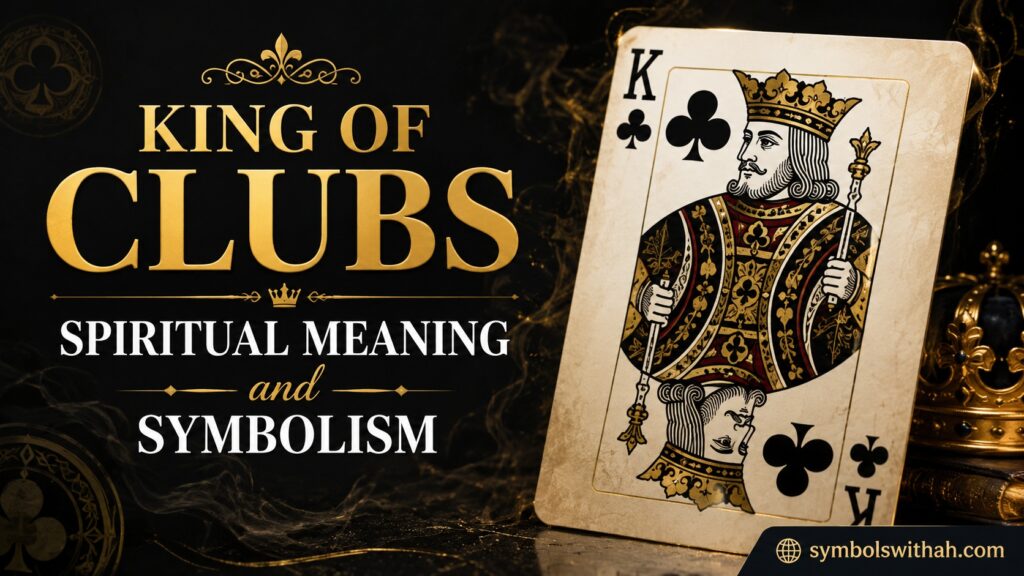

The King of Clubs Spiritual Meaning and Symbolism brings together two powerful ideas: the authority of a king and the active energy represented by the club suit. In modern American culture, the card is usually recognized first as a familiar playing card. However, people also encounter it in cartomancy, tattoos, art, dreams, and spiritual discussions.
The King of Clubs can suggest leadership, confidence, ambition, practical intelligence, and decisive action. Still, its meaning depends heavily on context. A card in an ordinary game doesn’t automatically carry a spiritual message.
Historically, playing cards have changed greatly across cultures and centuries. Early decks used many different suits and figures. The familiar French suits of hearts, diamonds, clubs, and spades became standardized during the late medieval period.
Today, Americans may see the King of Clubs as a symbol of authority and determination. Others interpret it more personally, especially during card readings. Understanding both histories helps separate traditional card culture from newer spiritual interpretations.
Read More: White Spider Spiritual Meaning and Symbolic
Quick Answer
In American symbolism, the King of Clubs Spiritual Meaning and Symbolism is often associated with leadership, confidence, intelligence, ambition, and purposeful action. In spiritual or cartomancy settings, it can represent someone who combines authority with practical wisdom and the courage to act.
TL;DR
- The King represents authority, maturity, leadership, and responsibility.
- Clubs commonly suggest action, energy, work, growth, or ambition.
- Together, they can symbolize confident and intelligent leadership.
- Playing cards reached Europe from eastern traditions during the medieval period.
- American culture connects the card strongly with games and chance.
- Modern spiritual interpretations add personal growth and intuitive meaning.
What Is the King of Clubs?
The King of Clubs is one of the four kings in a standard 52-card deck. It usually shows a black club symbol beside a royal figure.
The exact artwork varies by deck. Some designs show a crowned ruler, while others use a simpler double-ended portrait. Therefore, the visual appearance shouldn’t be treated as one fixed spiritual code.
The Card’s Main Features
A traditional King of Clubs contains several recognizable elements:
• A black club suit symbol
• A male court figure representing a king
• Rich colors and royal clothing in many designs
• A formal or commanding posture
• Decorative symbols that vary between card patterns
The black color comes from the standard suit system rather than a universal spiritual meaning. In other words, black doesn’t automatically make the card negative.
Why Context Matters
A King of Clubs used during poker has a different purpose from one used during a symbolic reading.
That distinction is important. Playing cards are primarily recreational objects, while cartomancy gives them interpretive meanings. Modern spiritual interpretations should therefore be understood as traditions of interpretation, not historical facts about what the card “must” mean.
What Does the King of Clubs Symbolize?
The King of Clubs combines the rank of king with the symbolism people commonly assign to clubs.
In many modern interpretations, the combination points toward controlled power. It isn’t simply about having authority. Instead, it can suggest knowing how to use authority responsibly.
Three Core Meanings
The strongest symbolic themes include:
• Leadership based on confidence and practical judgment
• Ambition supported by discipline and focused action
• Intelligence combined with courage and personal authority
These meanings work well as a symbolic framework. However, they aren’t universal rules shared by every card-reading tradition.
A Balanced Interpretation
The positive side of the card emphasizes responsible strength. It can represent someone who takes initiative without needing constant approval.
The challenging side is different. Too much authority can become stubbornness, arrogance, control, or impatience.
Therefore, the King of Clubs can symbolize both power and the responsibility that comes with power.
Historical Origins of Playing Cards
Playing cards have a much older history than the modern American deck suggests. Their development involved several regions, cultures, and changing artistic traditions.
Card games appeared in Europe around the middle of the fourteenth century. Evidence points toward transmission from the Near East, with trade routes playing an important role.
Earlier Eastern Traditions
Playing-card traditions existed outside Europe before today’s familiar deck developed.
Historical evidence connects card traditions with China, India, and the Middle East. However, these traditions did not all use the same suits or structure.
That matters because modern claims about one ancient, universal meaning for the King of Clubs are often too simple.
Medieval European Development
Early European cards were highly varied. Different regions used different suit symbols, numbers, and court figures.
Some medieval decks included kings, queens, knights, officials, and occupational figures. The imagery often reflected the social world of medieval courts.
Eventually, French-suited cards became highly influential. By the mid-fifteenth century, the four familiar suits had become much more standardized.
Why Is the King Symbolically Powerful?
The king is an old cultural image of authority. Long before modern playing cards, royal figures represented government, responsibility, hierarchy, and social power.
That makes the king rank especially easy to interpret symbolically.
The King as an Archetype
In symbolic language, the king can represent the mature authority within a person.
Instead of simply commanding others, the idealized king protects, organizes, judges, and accepts responsibility. This creates a useful contrast between authority and domination.
The positive king archetype suggests:
• Responsibility for decisions and their consequences
• Confidence without unnecessary aggression
• Wisdom gained through experience
• Protection of people, values, or responsibilities
• Ability to create structure during uncertainty
These ideas aren’t unique to playing cards. Royal imagery has appeared in art, mythology, literature, and political symbolism for centuries.
Historical Court Imagery
Playing-card kings were not always intended to represent one specific historical king. Instead, artists frequently adapted royal clothing and symbols to fit their own periods.
For example, museum collections contain King of Clubs cards associated with figures such as Arthur, Henry IV, Alexander the Great, and other historical or legendary personalities.
This shows how flexible the card’s identity has always been.
What Does the Club Symbolize?
The club is one of the four French suits used in modern American playing cards. Its shape resembles a three-lobed or four-lobed black emblem.
Its historical meaning is more complicated than many modern spiritual websites suggest.
Clubs and Earlier Suit Systems
French clubs developed from earlier European suit traditions. Italian decks, for example, used batons or staffs as one of their suits.
Over time, different cultures changed suit designs. Some German decks used acorns, leaves, hearts, and bells instead.
Therefore, the idea that clubs have had one fixed spiritual meaning since ancient times isn’t supported by card history.
Modern Symbolic Associations
In contemporary spiritual interpretation, clubs are often connected with action, energy, work, creativity, and ambition.
Those associations fit naturally with the image of a club or staff as something active and useful. Still, these are interpretive associations rather than universally documented historical meanings.
When combined with the king, the suit can therefore suggest mastery of action.
King of Clubs Meaning in America
The American meaning of the King of Clubs is shaped strongly by ordinary playing-card culture.
Cards are common in American homes, casinos, family gatherings, magic performances, and games. The King of Clubs therefore carries a familiar recreational meaning before it takes on any spiritual interpretation.
American Associations
For many Americans, the card may suggest:
• Poker and traditional card games
• Luck, competition, and calculated risk
• Confidence and strategic thinking
• Old-fashioned masculine or royal imagery
• Entertainment, magic, and popular culture
The card also appears in historical American advertising and commercial artwork. For example, an 1888 American tobacco trade-card series included a King of Clubs among its designs.
The Card and American Identity
Playing cards became part of everyday American visual culture over time.
The King of Clubs can therefore carry a distinctly familiar feeling. It may look mysterious in spiritual artwork, yet it remains connected to something ordinary and recognizable.
That contrast is part of its modern appeal.
King of Clubs in Cartomancy
Cartomancy is the practice of using cards for divination or symbolic interpretation. It developed through European fortune-telling traditions rather than being part of the original purpose of playing cards.
Modern readers may assign specific meanings to each card.
Common Interpretive Themes
In contemporary cartomancy, the King of Clubs is often read as a strong personality or leadership influence.
Common interpretations include:
• A confident leader entering a situation
• A skilled mentor or experienced authority figure
• Ambition supported by intelligence and planning
• Courage to take responsibility for difficult choices
• Progress through disciplined action
These interpretations vary between readers. There isn’t one official spiritual dictionary that controls every reading.
A Useful Question to Ask
Rather than asking, “What must this card mean?” consider asking, “What quality does this card make me notice?”
That approach allows the symbolism to become reflective without treating it as a guaranteed prediction.
King of Clubs Spiritual Meaning in Love
In relationship symbolism, the King of Clubs can represent confidence, loyalty, maturity, or a strong personality.
However, the meaning can change depending on the surrounding cards and the question being asked.
Positive Relationship Meaning
The card may symbolize someone who values independence and responsibility. Such a person may prefer direct communication rather than emotional games.
It can also represent a relationship entering a more mature stage.
The Shadow Side
Every strong archetype has a possible imbalance.
The King of Clubs can also symbolize:
• Controlling behavior disguised as confidence
• Emotional stubbornness during disagreements
• Excessive focus on work or achievement
• Difficulty admitting vulnerability
The lesson is not that leadership is bad. Instead, it suggests that healthy strength needs flexibility.
King of Clubs Meaning for Career and Success
The King of Clubs naturally fits career symbolism because the card combines authority with action.
In modern interpretations, it can represent initiative, strategy, responsibility, and professional confidence.
Career Associations
People may connect the card with:
• Taking charge of an important project
• Developing stronger decision-making skills
• Building authority through experience
• Turning ideas into practical results
• Becoming a mentor or respected leader
This doesn’t mean the card predicts a promotion. Rather, it can act as a symbolic prompt to examine how you handle responsibility.
Leadership Without Force
The healthiest interpretation focuses on earned authority.
A strong leader doesn’t need to dominate every conversation. Instead, leadership can come from preparation, consistency, judgment, and trust.
That distinction makes the King of Clubs especially relevant to modern professional life.
Cross-Cultural and Spiritual Interpretations
The King of Clubs doesn’t have one universal spiritual meaning across world religions.
Playing-card traditions developed through different cultures, while modern spiritual interpretations often combine older symbolism with newer personal practices.
European Traditions
European card imagery frequently reflected royal and social hierarchies.
Historical decks could connect kings with specific rulers, heroes, or national figures. The Fitzwilliam Museum, for example, preserves a nineteenth-century King of Clubs representing Arthur.
Broader Spiritual Interpretation
Modern readers may interpret the card through ideas such as:
• Personal authority
• Inner strength
• Mature decision-making
• Purposeful action
• Growth through responsibility
These interpretations should be treated as modern symbolic frameworks. They shouldn’t be presented as universal teachings shared by every culture.
Emotional and Psychological Meaning
Symbols can influence emotions because people connect images with personal memories and cultural ideas.
The King of Clubs often creates an impression of confidence. Its royal imagery can feel commanding, while the black club gives it a bold visual presence.
Feelings the Card Can Evoke
Depending on context, people may associate it with:
• Confidence
• Determination
• Security
• Ambition
• Discipline
• Independence
• Responsibility
At the same time, some people may find its imagery intimidating.
The Shadow Meaning
Psychologically, the card can also represent the danger of overidentifying with strength.
Someone may appear confident while privately feeling pressure to control everything. In that sense, the card can encourage balance between decisiveness and openness.
Modern Uses of the King of Clubs
Today, the King of Clubs appears far beyond traditional card games.
Its recognizable shape makes it useful for fashion, tattoos, artwork, graphic design, collectibles, and symbolic imagery.
Tattoos and Personal Identity
A King of Clubs tattoo may represent confidence, resilience, competition, or a personal connection to card culture.
Some people choose it simply because they like the visual design. Others give it a private meaning based on personal experiences.
Art and Decor
Vintage playing cards can create a nostalgic atmosphere.
The King of Clubs works especially well in masculine, classic, casino-inspired, or mysterious visual themes. However, its meaning depends more on the surrounding design than the card alone.
Digital Culture
Playing-card symbols also work well in digital graphics and social media designs.
The card can quickly communicate ideas about games, strategy, luck, competition, or mystery without requiring much explanation.
Misunderstandings and Controversies
The King of Clubs is generally not a universally recognized religious symbol. Many claims about secret meanings are modern interpretations rather than established history.
That distinction is important when researching spiritual symbolism.
Playing Cards Are Not Automatically Spiritual
A person holding the King of Clubs during a game isn’t necessarily sending a spiritual message.
The same card can simply be a game piece. Meaning comes from context.
Avoiding Overconfident Claims
Some modern interpretations describe the King of Clubs as if its meaning has remained unchanged for thousands of years.
Historical evidence doesn’t support such a simple timeline. European playing cards themselves changed substantially, and early decks used many different suit systems.
Gambling Associations
Playing cards have long been connected with gambling.
European religious and civic authorities sometimes condemned card playing because of its association with gambling and perceived social harm.
Today, however, cards are also used for family games, entertainment, magic, collecting, education, and art.
How the Meaning Has Changed Over Time
The King of Clubs has never had only one identity.
Its meaning developed alongside changing card designs, artistic traditions, games, and cultural attitudes.
A Simple Historical Timeline
| Period | King of Clubs Context | Common Symbolic Focus | Key Point |
| Medieval Europe | Early court-card traditions | Rank and social hierarchy | Decks varied widely |
| Fifteenth century | French suits become influential | Royal and court imagery | Suit systems became more standardized |
| Early modern era | Heraldic and historical decks | Rulers and identity | Kings could represent real figures |
| Nineteenth century | Mass-produced cards | Entertainment and commerce | Card imagery became widely accessible |
| Modern era | Games, art, and cartomancy | Strategy and personal symbolism | Meanings became more individualized |
Museum collections show just how diverse historical King of Clubs designs could be. Some depict rulers, while others use imaginative or humorous figures.
From Authority to Personal Power
Earlier imagery often emphasized external rank.
Modern spiritual interpretations frequently turn that idea inward. The king can now represent personal maturity, self-command, and responsible use of power.
That shift helps explain why the card remains attractive to modern audiences.
What Does Seeing the King of Clubs Mean?
If you repeatedly notice the King of Clubs, you may naturally wonder whether it has personal significance.
There isn’t a proven universal rule saying that repeatedly seeing a card predicts a specific event.
A Reflective Interpretation
Instead, you might use the card as a prompt to consider:
• Where do I need to take greater responsibility?
• Am I acting confidently or trying to control others?
• Which goal deserves more disciplined effort?
• Could experience help me make a better decision?
• Where should ambition be balanced with patience?
This approach respects spiritual curiosity without turning symbolism into certainty.
Dreams and Repeated Encounters
Dreams can incorporate familiar objects for many personal reasons.
If the King of Clubs appears in a dream, its meaning may depend on your emotions and experiences. Someone who loves card games may interpret it differently from someone who associates cards with fortune-telling.
Personal context matters more than a fixed dream dictionary.
FAQs
1. What does the King of Clubs symbolize?
The King of Clubs commonly symbolizes leadership, confidence, ambition, intelligence, and decisive action. In cartomancy, it may represent a strong leader or mature authority figure.
2. Is the King of Clubs a good card?
Many modern interpretations consider it positive because it emphasizes strength and capable leadership. However, it can also warn against stubbornness, control, or excessive pride.
3. What does the King of Clubs mean in love?
It can symbolize confidence, maturity, loyalty, and a strong relationship personality. In a challenging context, it may point toward controlling behavior or emotional rigidity.
4. What does the King of Clubs mean in a card reading?
In cartomancy, it is often interpreted as leadership, practical intelligence, ambition, or a powerful person. Exact meanings vary between reading traditions and the surrounding cards.
5. Is the King of Clubs connected to tarot?
Not directly. The King of Clubs belongs to standard playing cards, while the King of Wands belongs to tarot; modern readers sometimes compare their leadership themes.
6. What does the club symbol mean spiritually?
Modern spiritual interpretations often associate clubs with action, energy, creativity, work, and ambition. These associations are interpretive rather than one universal historical meaning.
Conclusion
The King of Clubs is a fascinating symbol because it combines familiar card imagery with powerful ideas about authority. Its king suggests maturity and leadership, while the club can suggest action, effort, and forward movement.
Historically, however, the card wasn’t created with one fixed spiritual message. Playing cards developed across cultures, and their suits and court figures changed considerably over time.
Today, the King of Clubs Spiritual Meaning and Symbolism can be understood as a reminder of confident action guided by judgment. Whether you see it in a card game, artwork, tattoo, dream, or personal reading, its most useful message may be simple: strength becomes meaningful when it’s used with wisdom and responsibility.