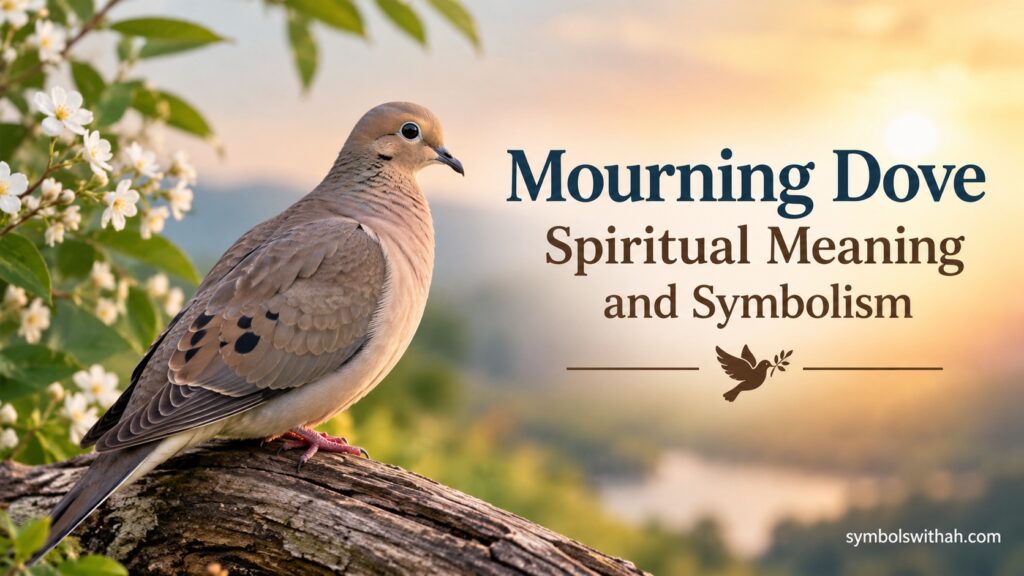

The Mourning Dove Spiritual Meaning and Symbolism comes from a fascinating contrast. Its soft call can sound sorrowful, yet the bird itself often represents peace, tenderness, hope, and renewal. That contrast is one reason mourning doves hold such a strong place in American symbolism.
The mourning dove (Zenaida macroura) is one of the most familiar birds in North America. It lives comfortably around fields, roadsides, neighborhoods, gardens, and suburban homes. Its gentle appearance and distinctive coo have made it part of everyday American life.
For many people, seeing or hearing one during grief feels especially meaningful. However, symbolism is personal and cultural rather than scientific proof of a supernatural message. The same bird can represent comfort to one person and simple beauty to another.
Read More: Crows Gathering in Large Numbers Spiritual Meaning: What It May Symbolize
Quick Answer
Mourning Dove Spiritual Meaning and Symbolism usually centers on peace, remembrance, gentle love, grief, hope, and emotional renewal. In the United States, the bird’s familiar presence often connects ordinary nature with memories of loved ones and moments of quiet reflection.
TL;DR
- Mourning doves commonly symbolize peace, love, grief, and hope.
- Their mournful-sounding call inspired the word “mourning.”
- Dove symbolism has deep roots in ancient religious and cultural traditions.
- In America, doves often represent peace, remembrance, and spiritual comfort.
- Their appearance after loss may feel meaningful without proving a supernatural message.
- Today, mourning doves appear in tattoos, memorial art, gardens, and spiritual practices.
What Does a Mourning Dove Look Like?
Understanding the bird itself makes its symbolism easier to appreciate. Unlike the bright white dove used in many religious paintings, the mourning dove has subtle, earthy coloring.
Appearance and Natural Traits
Mourning doves usually have soft gray-brown bodies, pointed tails, dark wing spots, and delicate pinkish tones. Their long, tapered tails give them an elegant silhouette.
Their famous call is a low series of coos. Humans often hear it as sad or mournful, but the sound is actually part of normal dove behavior. Males commonly use the perch-coo during courtship and territorial behavior.
That difference matters. The bird isn’t literally expressing human grief.
Instead, people created an emotional association from the sound they heard.
Why Is It Called a “Mourning” Dove?
The name comes from the bird’s mournful-sounding voice. Its slow, repeated coo can resemble a quiet lament.
For generations, that sound has encouraged people to connect the bird with:
- Grief and remembrance
- Quiet reflection
- Emotional tenderness
- Peace after hardship
- Longing and separation
However, the name describes the sound, not a scientific diagnosis of the bird’s emotional state.
What Does a Mourning Dove Symbolize?
Mourning dove symbolism has several overlapping layers. Some come from the bird’s natural behavior, while others come from older meanings attached to doves generally.
Core Symbolic Meanings
The most common interpretations include:
- Peace: A reminder to seek calm during conflict or uncertainty.
- Grief: A natural symbol of mourning, remembrance, and emotional tenderness.
- Love: A representation of affection, partnership, and devotion.
- Hope: A suggestion of light after a difficult period.
- Renewal: A reminder that life continues through changing seasons.
- Spiritual connection: A symbolic link between earthly life and sacred ideas.
The mourning dove’s symbolism becomes especially powerful because these meanings can coexist.
A bird can represent sadness without being a symbol of despair.
It can represent remembrance while also suggesting that life continues.
What Is the Historical Meaning of the Dove?
The mourning dove itself is a North American species, so its exact symbolism should not be projected backward into every ancient culture. However, dove symbolism in general is extremely old.
Ancient Roots of Dove Symbolism
Doves and related birds appear in ancient Near Eastern and Mediterranean religious traditions. Their associations included love, fertility, gentleness, purity, and divine presence.
In the ancient Mediterranean world, doves were connected with deities and sacred spaces. The bird’s peaceful behavior and association with reproduction helped create meanings around love and fertility.
However, these ancient traditions involved different dove species.
That distinction is important when discussing the mourning dove specifically.
The modern American mourning dove did not exist as a culturally recognized species in ancient Greece or ancient Israel.
Instead, modern mourning-dove symbolism inherits some broader dove traditions and combines them with North American experiences of the bird.
From Ancient Symbol to Modern Meaning
Over time, dove imagery became associated with:
- Peace between opposing sides
- Purity and innocence
- Love and affection
- Hope after destruction
- Spiritual presence
- The transition from sorrow toward renewal
The mourning dove adds another emotional layer because of its distinctive call.
What Is the Biblical Meaning of a Mourning Dove?
Doves have important symbolic roles in the Bible. However, Scripture generally discusses doves or related birds, rather than assigning a unique symbolic meaning to the modern species Zenaida macroura.
Noah and the Dove
One of the best-known biblical examples appears in Genesis.
Noah sends a dove from the ark after the floodwaters begin to recede. The bird later returns carrying a freshly plucked olive leaf. The event signals that the waters have diminished and that dry land is returning.
This story helped establish a powerful symbolic connection between the dove and hope after destruction.
The Dove and the Holy Spirit
The New Testament also connects dove imagery with the Holy Spirit during Jesus’ baptism. The Gospel accounts describe the Spirit descending “like a dove.”
Because of this tradition, Christian art often uses the dove to suggest:
- Peace
- Purity
- Divine presence
- Spiritual renewal
- Innocence
- Hope
A careful distinction remains important. Biblical dove symbolism doesn’t mean every mourning dove sighting has a specific biblical message.
What Does a Mourning Dove Mean in American Culture?
In the United States, the mourning dove has a particularly interesting cultural position. It isn’t rare or exotic. Instead, it’s a familiar backyard bird.
An Everyday American Symbol
Mourning doves can appear near homes, roadsides, farms, parks, and open spaces. Audubon notes that the species is common across much of North America and often lives close to human communities.
That familiarity gives the bird a special symbolic quality.
A person doesn’t need to visit a remote wilderness to encounter one.
The bird may appear outside a kitchen window or on a telephone wire.
Peace in American Imagery
American public art has also used dove imagery to represent peace. For example, the Peace Monument at the U.S. Capitol complex once included a dove within a larger symbolic arrangement representing peace and civilization.
The broader dove became especially recognizable as a peace symbol in Western culture.
The mourning dove adds a softer emotional dimension: peace that exists alongside memory and loss.
What Does Seeing a Mourning Dove Mean Spiritually?
Many modern spiritual traditions interpret a mourning dove as a gentle sign of peace or reassurance.
However, there is no scientific test that can establish a universal supernatural meaning for seeing one.
Common Spiritual Interpretations
People may interpret a mourning dove’s appearance as:
- A reminder to slow down and become present.
- A symbol of peace during emotional uncertainty.
- A comforting reminder of someone who has died.
- Encouragement to release resentment or emotional tension.
- A sign of hope after a difficult chapter.
- A reminder that grief and love can exist together.
These interpretations belong to personal spirituality and cultural belief.
They shouldn’t be confused with established facts about bird behavior.
After the Death of Someone Loved
This is perhaps the most emotionally powerful interpretation.
Someone grieving may notice a mourning dove shortly after a funeral, anniversary, dream, or difficult memory. The encounter can feel deeply personal.
That experience doesn’t need to be scientifically proven to have emotional value.
A person may simply choose to treat the moment as a meaningful reminder of love and memory.
What Does a Mourning Dove Mean When You See One?
The meaning often depends on context rather than the bird alone.
For example, seeing one during an ordinary morning may simply encourage appreciation for nature. Seeing one while thinking about someone you lost may naturally become associated with remembrance.
Context Can Change the Meaning
| Situation | Meaning in the USA | Common Association | Helpful Perspective |
| One dove nearby | Peace or quiet reflection | Calm, solitude | Notice your emotional response |
| Two doves together | Partnership and affection | Love, companionship | Inspired partly by pair bonding |
| Dove near a memorial | Remembrance and comfort | Grief, memory | A personal symbolic connection |
| Hearing its call | Reflection and nostalgia | Mourning, serenity | The sound inspired its common name |
| Dove in a garden | Everyday peace | Nature, simplicity | Often a normal wildlife encounter |
Mourning doves form strong pair bonds and show gentle behaviors such as mutual preening. These behaviors help explain why people associate pairs with affection and companionship.
Still, the popular claim that every mourning dove pair mates for life is too simplistic.
What Does a Mourning Dove Mean After Someone Dies?
For many people, a mourning dove becomes a symbol of remembrance after a death.
The connection is especially strong because the bird’s call sounds like a quiet lament. Its presence can therefore mirror the emotional experience of grief.
A Symbol of Continuing Love
The most comforting interpretation isn’t necessarily “the deceased has returned.”
Instead, the dove can represent the continuing bond between memory and love.
You might hear its call and remember someone’s voice.
You might see two doves and remember a relationship.
You might notice one near a familiar place and pause for a moment.
The meaning comes from the relationship between the symbol and your memory.
What Does a Mourning Dove Mean in Different Spiritual Traditions?
Dove symbolism appears across many religious and cultural settings. However, interpretations differ significantly.
Christianity
Christian traditions commonly associate the dove with the Holy Spirit, peace, purity, and renewal. The biblical stories of Noah and Jesus’ baptism are major sources of these associations.
Judaism and Ancient Near Eastern Traditions
Doves appear in biblical and ancient Near Eastern contexts involving sacrifice, purity, peace, and religious life. These traditions should not automatically be equated with modern mourning-dove spirituality.
Indigenous North American Traditions
Indigenous nations have distinct histories, languages, teachings, and relationships with birds. There isn’t one universal “Native American meaning” for the mourning dove.
Some modern sources claim that many tribes share particular dove meanings. Such broad claims often flatten important cultural differences.
A respectful approach is to discuss individual nations and documented traditions rather than treating Indigenous cultures as one belief system.
Modern Spirituality
Contemporary spiritual writers often describe mourning doves as messengers of comfort, peace, healing, or spiritual connection. These are modern interpretations rather than universally established religious teachings.
What Is the Emotional and Psychological Meaning of a Mourning Dove?
Symbols work partly because humans naturally connect sensory experiences with memories.
The mourning dove is particularly effective because its sound has a strong emotional quality.
Why Its Call Feels Sad
A slow, repeating sound can create feelings of stillness and longing.
The word “mourning” then reinforces that interpretation.
However, the bird’s actual behavior tells another story. The male’s coo is primarily connected with courtship and territorial behavior.
This creates an interesting psychological contrast:
The bird isn’t grieving, but humans can experience its sound as grief.
That doesn’t make the symbolism meaningless.
Instead, it shows how symbolism develops through human perception.
Emotional Associations
Mourning doves commonly evoke:
- Nostalgia for people or places
- Quietness after emotional stress
- Tenderness and affection
- Acceptance of change
- Comfort during remembrance
- Appreciation for ordinary moments
What Does a Mourning Dove Mean in Dreams?
Dream symbolism is highly personal. There is no universal dream dictionary that can determine exactly what a mourning dove means.
Still, common interpretations connect the bird with emotional themes.
Common Dream Associations
A mourning dove in a dream might reflect:
Peace: You may associate the bird with calm after conflict.
Grief: The image may surface during periods of loss or remembrance.
Love: A pair of doves can evoke partnership or emotional attachment.
Transition: A flying bird can represent movement from one stage of life to another.
Hope: A dove may symbolize the possibility of emotional renewal.
The most useful question is often simple:
What did the dove make you feel?
Your emotional reaction can reveal more than a fixed symbolic dictionary.
How Is Mourning Dove Symbolism Used Today?
Mourning dove imagery remains popular because it works across several emotional themes.
Tattoos and Memorial Art
A mourning dove tattoo can represent:
- Remembering a loved one
- Peace after hardship
- A meaningful relationship
- Spiritual faith
- Emotional healing
- Freedom and renewal
Memorial designs often combine the bird with dates, names, flowers, olive branches, clouds, or handwritten phrases.
Because the mourning dove has muted natural colors, artists can also create subtle designs rather than bright, dramatic imagery.
Home Decor and Gardens
Dove imagery can create a peaceful feeling in bedrooms, meditation spaces, gardens, and memorial areas.
In outdoor spaces, the real bird can become part of that symbolism naturally.
A birdbath, native plants, and seed-producing plants may make a yard more welcoming to birds. However, the goal should be healthy wildlife habitat rather than forcing a symbolic encounter.
Social Media and Digital Memorials
People sometimes use dove images in remembrance posts.
A dove emoji or illustration may communicate:
“I remember you.”
It can also suggest peace, sympathy, love, or spiritual reflection.
That meaning depends heavily on context.
Is a Mourning Dove a Good or Bad Omen?
A mourning dove isn’t inherently a good or bad omen.
Its reputation varies according to individual beliefs, personal experiences, and cultural traditions.
Why Some People Associate It With Death
The strongest negative association comes from its name and call.
Because the sound resembles mourning, some people historically interpreted the bird as connected with death.
Modern spiritual sources may also describe a dove appearing after a death as a message from someone who passed away. However, these interpretations are matters of belief rather than established evidence.
A More Balanced Interpretation
A more useful symbolic reading is that the mourning dove represents how love and grief can coexist.
It doesn’t have to predict death.
Instead, it can become a reminder to honor memories while continuing forward.
Why Does Mourning Dove Symbolism Focus on Peace and Grief?
At first glance, peace and grief seem like opposites.
Yet the mourning dove brings them together naturally.
Its call sounds melancholy, while its appearance is gentle. Dove traditions already carry strong associations with peace, and its behavior around people makes it a familiar presence.
This creates a layered symbol:
Grief → remembrance → acceptance → peace → hope
That sequence isn’t a religious rule or scientific process.
It’s a symbolic pattern that many people find emotionally meaningful.
How Has Mourning Dove Symbolism Changed Over Time?
Symbolism rarely stays fixed.
The mourning dove’s modern meaning developed from several older layers.
Earlier Associations
Older dove symbolism emphasized:
- Love and fertility
- Purity and gentleness
- Peace and reconciliation
- Religious devotion
- Messages of hope
Modern American Associations
Today, mourning dove symbolism often emphasizes:
- Personal remembrance
- Emotional comfort
- Quiet spirituality
- Nature and mindfulness
- Memorial tattoos
- Peaceful home and garden imagery
The shift reflects modern life.
People increasingly encounter spiritual symbolism through personal experience, social media, art, tattoos, and nature observation.
Common Misunderstandings About Mourning Dove Symbolism
A little context prevents symbolism from becoming misinformation.
The Bird Is Not Literally Mourning
Its name comes from its sound.
The male’s coo is associated with courtship and territorial behavior rather than human-style mourning.
Every Dove Isn’t a Mourning Dove
The white dove in religious art may represent a broader dove tradition.
A wild mourning dove is a specific North American species with its own appearance and behavior.
Seeing One Doesn’t Predict Death
There is no scientific evidence that a mourning dove sighting predicts someone’s death.
Personal spiritual beliefs may interpret an encounter differently.
“They Always Mate for Life” Is Too Simple
Mourning doves form strong pair bonds, but popular descriptions can overstate lifelong pairing. Cornell documents clear pair-bonding behavior without requiring the claim that every pair stays together permanently.
FAQs
1. What does a mourning dove symbolize spiritually?
A mourning dove commonly symbolizes peace, comfort, remembrance, love, and hope. Some spiritual traditions also interpret it as a messenger or sign of reassurance.
2. Is seeing a mourning dove a sign from a loved one who died?
Some people interpret a mourning dove that way, especially during grief. However, that interpretation is spiritual or personal rather than something science can verify.
3. What does a mourning dove mean in the Bible?
The Bible associates doves with themes including hope, purity, sacrifice, and the Holy Spirit. The dove returning with an olive leaf in Genesis is especially associated with renewed life and the end of the flood.
4. Why is it called a mourning dove?
The name comes from the bird’s soft, mournful-sounding call. The call is actually part of normal behavior, especially among males during courtship and territorial activity.
5. What does two mourning doves symbolize?
Two mourning doves can symbolize companionship, love, partnership, and emotional loyalty. Their strong pair-bonding behaviors help explain these associations.
6. Is a mourning dove a symbol of peace?
Yes, mourning doves are commonly connected with peace because they belong to the broader dove symbolism of peace and reconciliation. Their gentle appearance also strengthens that modern association.
Conclusion
The Mourning Dove Spiritual Meaning and Symbolism brings together several powerful ideas: peace, grief, love, remembrance, hope, and renewal. Its mournful-sounding call explains its name, while its gentle appearance and familiar presence give the bird a much softer emotional character.
In American culture, the mourning dove has become an everyday symbol of quiet reflection. It may appear on a backyard fence, near a memorial, or during an ordinary afternoon. For some people, that moment carries spiritual meaning. For others, it simply offers a peaceful connection with nature.
Either way, the mourning dove invites a useful reflection: grief doesn’t erase love, and remembrance doesn’t prevent hope.