
If you have seen “OP” in a text, comment, Reddit thread, or gaming chat, you may have wondered what those two letters actually mean. The answer depends heavily on the conversation.
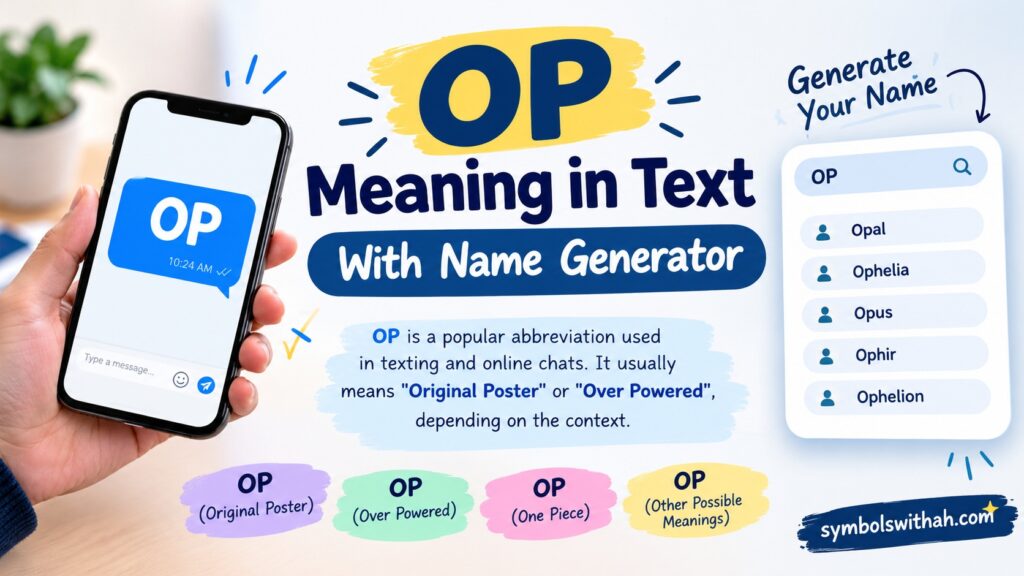
In online discussions, OP usually means “Original Poster,” referring to the person who created the post or started the thread. It can also mean “Original Post,” referring to the content itself. In gaming, however, OP usually means “Overpowered,” describing something unusually strong or difficult to counter.
That small distinction matters. Saying “OP replied” points toward a person, while “that character is OP” usually describes excessive power. Once you recognize the surrounding clues, the meaning becomes surprisingly easy to identify.
Read More: STTM Meaning in Text: What Does STTM Mean?
Quick Answer
OP meaning in text usually refers to Original Poster or Original Post in online discussions. In gaming, OP commonly means Overpowered, describing a character, weapon, ability, or strategy that is exceptionally powerful.
TL;DR
• OP often means Original Poster on Reddit and forums.
• OP can also mean Original Post, meaning the first post itself.
• In gaming, OP means Overpowered.
• Anime communities may use OP for Opening or opening theme.
• The sentence around OP usually reveals its intended meaning.
• OP can be neutral, complimentary, or critical depending on context.
What Does OP Mean in Text?
The phrase OP meaning in text does not have one universal definition. Instead, OP is a context-dependent abbreviation that changes meaning according to the subject being discussed.
The three most useful meanings to remember are Original Poster, Original Post, and Overpowered. These cover the overwhelming majority of everyday internet uses.
| OP Meaning | Refers To | Common Context |
| Original Poster | Person who created the post | Reddit, forums, social discussions |
| Original Post | The first post itself | Threads and online discussions |
| Overpowered | Something unusually strong | Gaming |
| Opening | Opening sequence or theme | Anime and fandom communities |
| Other specialized meanings | Field-specific terminology | Technical or professional settings |
The important point is simple: do not interpret OP in isolation. Look at what the person is discussing first.
For example:
“OP replied to my comment.”
Here, OP refers to the person who created the original post.
Now compare it with:
“That new weapon is OP.”
The second sentence clearly uses OP as Overpowered.
OP Meaning as “Original Poster”
The most common meaning in many online discussion spaces is Original Poster.
An Original Poster is the person who created the post, thread, question, or discussion being referenced. Instead of repeatedly writing someone’s username, commenters can simply call that person “OP.”
For example:
“OP explained everything in the comments.”
The commenter is talking about the person who created the original discussion.
This usage is especially natural in threaded conversations because many people may participate after the first post. The abbreviation gives readers a quick way to distinguish the person who started the conversation from everyone who joined later.
What Does Original Poster Mean?
The Original Poster is essentially the originating contributor of a particular online discussion.
That could be someone who:
• Asked a question
• Shared a personal story
• Posted a photograph
• Started a debate
• Uploaded a video
• Requested advice
• Created a forum thread
For instance, imagine someone posts:
“I moved into a new apartment and keep hearing strange noises at night. Any ideas?”
A commenter might respond:
“OP should probably talk to the landlord.”
In this situation, OP means the person who created that question.
OP Can Be Used Like a Person’s Name
One useful clue is grammar.
When OP refers to the Original Poster, it often behaves like a person’s name.
Examples include:
“OP said they already tried that.”
“I agree with OP.”
“Someone should ask OP.”
“OP updated the story.”
Because OP refers to a person, verbs and pronouns around it often make the meaning obvious.
OP Meaning as “Original Post”
There is another closely related interpretation: Original Post.
Instead of referring to the person who created the discussion, this version refers to the actual content that started the conversation.
This distinction can be subtle because both meanings are abbreviated as OP.
Consider these two sentences:
“OP hasn’t responded yet.”
Here, OP probably means Original Poster, because a post cannot respond.
Now consider:
“The answer is already explained in the OP.”
Here, OP means Original Post, because the writer is referring to information contained within the post.
Original Poster vs. Original Post
The easiest way to remember the difference is:
Original Poster = the person
Original Post = the content
This distinction becomes particularly useful in long Reddit or forum threads.
| Sentence | Meaning of OP |
| “OP replied to me.” | Original Poster |
| “Ask OP for more information.” | Original Poster |
| “OP changed the title.” | Original Poster |
| “Read the OP before commenting.” | Original Post |
| “The details are in the OP.” | Original Post |
| “The OP contains several useful links.” | Original Post |
Online communities sometimes use the abbreviation loosely, so the surrounding grammar remains the best clue.
What Does OP Mean in Gaming?
Gaming gives OP an entirely different personality.
In gaming conversations, OP usually means “Overpowered.” Players use it when a character, weapon, ability, item, strategy, or build seems much stronger than competing options.
For example:
“That character is completely OP.”
The speaker is not talking about a person who made a post. They are saying the character is overpowered.
The term often appears during discussions about game balance.
What Can Be Called OP?
Almost anything that creates an unusually strong advantage can be described as OP.
Common examples include:
• A character with extremely powerful abilities
• A weapon that causes excessive damage
• An ability with unusually short cooldowns
• An item that provides an enormous advantage
• A strategy that dominates most opponents
• A character build with very few weaknesses
For example:
“The new rifle is OP after the update.”
This means the player believes the rifle has become excessively powerful.
OP and Game Balance
The word overpowered is closely connected with the concept of game balance.
Developers generally try to create meaningful choices. If one character or weapon is dramatically stronger than everything else, players may feel pressured to use that option.
That can reduce variety.
Imagine a multiplayer game with ten equally viable weapons. Players can choose according to their preferred play style.
Now imagine one weapon defeats opponents much faster than the other nine. Players may start selecting it almost exclusively.
That weapon may then be described as OP.
OP Does Not Always Mean “Bad”
Calling something OP can be praise, criticism, or playful exaggeration.
A player might say:
“This build is OP. I love it!”
Another might say:
“That character is so OP that the game isn’t fun anymore.”
The first statement celebrates strength. The second complains about imbalance.
Therefore, OP describes power, but the speaker’s attitude depends on context.
OP Meaning on Reddit
Reddit is one of the clearest places to encounter OP as Original Poster.
In a typical Reddit discussion, the person who submitted the post is commonly called the OP. Reddit users frequently use the abbreviation when referring to the author inside the comment section. Recent Reddit discussions continue to use OP in this way.
For example:
“OP, where did you get this information?”
Here, the commenter is addressing the person who created the post.
You may also see:
“OP answered this in another comment.”
Again, the reference is to the person who submitted the original discussion.
Why Reddit Uses OP So Often
Reddit discussions can attract hundreds or thousands of comments. Usernames can be long, unusual, or difficult to remember.
OP provides a compact reference point.
It essentially means:
“The person who started this particular discussion.”
That makes it especially convenient when conversations become sprawling.
What Does the OP Tag Mean?
Reddit can visually identify the author of a post in comment discussions. Users may therefore recognize OP even without knowing the person’s username.
The important distinction remains the same:
OP identifies the original contributor, not every person participating in the discussion.
OP Meaning on Social Media
On social media, OP can also refer to the person who originally uploaded or created the content being discussed.
You might encounter the abbreviation in conversations involving screenshots, reposts, videos, images, or stories.
For example:
“OP made this video.”
That sentence identifies the original creator or poster.
Another example:
“Does OP have a source for this?”
The speaker is asking the original poster for supporting information.
OP on TikTok and Instagram
On platforms built around visual content, people may use OP when discussing the person responsible for the original upload.
However, creator, poster, or the person’s username may be more natural in some conversations.
The meaning still depends on the thread.
If someone says:
“OP said this happened last year.”
OP almost certainly refers to the person.
If someone says:
“The information is in the OP.”
The meaning shifts toward the original content.
OP in Facebook Groups and Forums
Community groups can also use OP when discussing the person who began a particular conversation.
For example:
“OP should update us when they hear back.”
Here, OP clearly means the original poster.
This usage is particularly common in advice communities, discussion boards, and question-and-answer groups.
How to Tell Which OP Meaning Someone Means
The easiest way to decode OP is to inspect the sentence rather than memorizing definitions.
A few linguistic clues can solve most cases.
Look at the Verb
If someone says:
“OP replied.”
OP almost certainly means Original Poster.
A post cannot literally reply to someone.
If someone says:
“The OP explains the problem.”
OP likely means Original Post.
The post contains information, while the person provides the explanation.
Look at the Subject
When OP appears beside a game character, weapon, or ability, Overpowered becomes much more likely.
For example:
“That boss is OP.”
“Her ultimate ability is OP.”
“This build feels OP.”
These statements describe strength.
Check the Platform
Context provides another strong clue.
| Context | Most Likely Meaning |
| Reddit thread | Original Poster |
| Online forum | Original Poster |
| Advice discussion | Original Poster |
| Social-media discussion | Original Poster |
| Gaming chat | Overpowered |
| Game review | Overpowered |
| Competitive gaming | Overpowered |
| Anime discussion | Opening |
| Technical discussion | Specialized meaning |
This isn’t an absolute rule. However, it is a reliable starting point.
OP Meaning in Different Texting Situations
A useful way to understand OP meaning in text is to examine realistic conversations.
When OP Means Original Poster
Person A: “Who posted this story?”
Person B: “OP shared it yesterday.”
Here, OP means the person who created the post.
When OP Means Original Post
Person A: “Where are the details?”
Person B: “They’re all in the OP.”
Here, OP means the original post.
When OP Means Overpowered
Person A: “Have you tried the new character?”
Person B: “Yeah, they’re seriously OP.”
Here, OP means overpowered.
The abbreviation stays exactly the same. Only the context changes.
Real Examples of OP in Text and Chat
Seeing the abbreviation in complete sentences makes its different meanings easier to recognize.
Social Discussion Examples
“OP hasn’t answered the question yet.”
Meaning: Original Poster
“I agree with OP on this.”
Meaning: Original Poster
“The OP explains everything clearly.”
Meaning: Original Post
“Read the OP before making assumptions.”
Meaning: Original Post
Gaming Examples
“That weapon is OP.”
Meaning: Overpowered
“The developers need to nerf that OP character.”
Meaning: Overpowered
“His build is completely OP.”
Meaning: Overpowered
A Useful Context Test
When you encounter OP, ask yourself three questions:
• Is someone talking about a person? It probably means Original Poster.
• Are they discussing the first post? It probably means Original Post.
• Are they discussing strength in a game? It probably means Overpowered.
This simple test resolves most everyday examples.
OP Meaning in Anime and Fandom Communities
Anime communities add another established interpretation: OP can mean “Opening.”
In this context, OP usually refers to an anime’s opening sequence or opening theme.
For example:
“The OP for this anime is amazing.”
The speaker is discussing the show’s opening.
This meaning becomes especially easy to recognize when the conversation is about music, animation, themes, or episodes.
OP Can Mean Different Things in One Community
Anime discussions can become especially interesting because two OP meanings may appear in the same conversation.
Consider:
“The OP is amazing, and that character is OP too.”
The first OP may mean Opening.
The second means Overpowered.
That sounds confusing at first, but the surrounding nouns reveal the distinction.
This is a good example of how online language develops through contextual compression. People shorten familiar phrases because their communities already understand the surrounding subject.
OP vs. OPP vs. OG
Internet abbreviations can look deceptively similar.
OP, OPP, and OG are not interchangeable terms.
| Term | Common Meaning | Typical Context |
| OP | Original Poster / Overpowered | Forums, social media, gaming |
| OPP | Opponent or rival in some slang contexts | Casual slang and music-influenced speech |
| OG | Original or long-established person | Culture, communities, casual speech |
OP vs. OPP
OP does not automatically mean OPP.
In some informal communities, people may shorten or alter slang terms. However, “opp” is the more recognizable spelling when referring to an opponent or rival.
Therefore, don’t assume OP means “opponent” unless the conversation clearly establishes that usage.
OP vs. OG
An Original Poster is simply the person who created a particular post.
An OG usually refers to someone regarded as original, established, experienced, or foundational within a community.
Those concepts can overlap in rare situations, but they mean different things.
Is OP a Positive or Negative Word?
There is no single emotional tone attached to OP.
Its tone depends on which meaning is being used.
OP as Original Poster
This use is usually neutral.
For example:
“OP added an update.”
There is no praise or criticism.
However, the surrounding sentence can make the reference positive or negative.
“OP gave a really thoughtful answer.”
That is clearly complimentary.
OP as Overpowered
The gaming meaning is more flexible.
A player might use OP as praise:
“This build is OP!”
Another player might use it as criticism:
“That weapon is ridiculously OP.”
The first speaker admires the strength. The second believes the strength damages game balance.
So, OP itself is not inherently positive or negative.
How to Respond When Someone Says OP
Sometimes understanding an abbreviation is only half the problem. You also need to know how to respond naturally.
If OP Means Original Poster
You can respond normally to the discussion.
For example:
“I’ll check what OP said.”
Or:
“You could ask OP directly.”
If OP Means Overpowered
You can respond by discussing the strength being mentioned.
For example:
“I agree. That character needs a nerf.”
Or:
“I think it’s strong, but not actually OP.”
If You Are Unsure
There is nothing wrong with asking:
“Do you mean the original poster?”
Or:
“Do you mean overpowered?”
Context usually makes the answer obvious, but clarification is better than confidently misunderstanding someone.
Where Did the OP Abbreviation Come From?
The Original Poster sense belongs to the older tradition of internet forums and threaded online discussions.
Long before today’s social platforms, online communities needed compact ways to refer to the person who began a discussion. As conversations grew, abbreviations became useful because repeatedly writing usernames or descriptions was cumbersome.
The term eventually became familiar across forums and later social platforms.
The gaming meaning developed separately around discussions of power and game balance. Players needed a short way to describe characters, weapons, or mechanics that were excessively strong.
Today, both meanings are firmly embedded in internet vocabulary. Current discussions from 2026 still show users distinguishing Original Poster from Overpowered according to context.
Why One Abbreviation Has Multiple Meanings
Digital language favors efficiency.
People naturally shorten phrases that appear repeatedly. Once a community understands the abbreviation, the shortened form becomes faster and more convenient.
That process explains why OP can comfortably exist with multiple meanings.
The surrounding subject acts almost like a built-in dictionary.
Common Mistakes When Understanding OP
Even experienced internet users can misread abbreviations when the context is unfamiliar.
Here are the most common mistakes.
Assuming OP Always Means Original Poster
This can cause confusion in gaming conversations.
“That sword is OP.”
The sword obviously isn’t a person who created a post. Here, Overpowered is the logical interpretation.
Assuming OP Always Means Overpowered
This creates the opposite problem on Reddit and forums.
“OP hasn’t replied.”
A weapon cannot reply. The sentence clearly points toward the Original Poster.
Confusing Original Poster With Original Post
These meanings are closely related, but they refer to different things.
Person: Original Poster
Content: Original Post
Grammar usually tells you which one is intended.
Confusing OP With OPP
Although the abbreviations look similar, they can carry different meanings.
Don’t replace one with the other unless the conversation clearly establishes that usage.
How to Use OP Correctly in a Sentence
If you want to use OP yourself, keep the context obvious.
Using OP for a Person
“OP answered the question.”
“I agree with OP.”
“Someone should ask OP for the source.”
These sentences use OP as Original Poster.
Using OP for a Post
“The details are in the OP.”
“Read the OP first.”
“The OP includes the original image.”
These sentences use OP as Original Post.
Using OP for Gaming
“That weapon is OP.”
“The new character feels OP.”
“That ability is completely OP.”
These examples use OP as Overpowered.
The strongest writing habit is to make the surrounding sentence clear enough that readers don’t have to guess.
A Simple OP Meaning Decision Guide
When you see OP, follow this quick path:
OP appears in a discussion →
Is someone being referred to? → Original Poster
OP refers to information or content →
→ Original Post
OP describes strength in a game →
→ Overpowered
OP appears beside anime opening music or sequences →
→ Opening
This context-first approach is more useful than memorizing a long list of obscure definitions.
Frequently Asked Questions About OP Meaning in Text
What does OP mean in text?
OP most commonly means Original Poster or Overpowered. In online discussions, it usually identifies the person who created the post. In gaming, it commonly describes something unusually powerful.
Does OP mean Original Poster or Original Post?
It can mean either. Original Poster refers to the person, while Original Post refers to the content that started the discussion.
What does OP mean in gaming?
In gaming, OP usually means Overpowered. Players use it for characters, weapons, abilities, items, or strategies that seem excessively strong.
What does OP mean on Reddit?
On Reddit, OP generally means Original Poster, referring to the person who submitted the post. It can also mean Original Post when someone is discussing the content itself.
What does OP mean on social media?
On social media, OP can refer to the original poster or creator of a piece of content. The exact usage depends on the platform and sentence.
Is OP a positive or negative word?
Neither by itself. When OP means Original Poster, it is usually neutral. When it means Overpowered, it can express praise or criticism depending on the speaker’s opinion.
What is the difference between OP and OPP?
OP and OPP are not automatically interchangeable. OP commonly means Original Poster or Overpowered, while “opp” is commonly used for an opponent or rival in certain slang contexts.
Conclusion
The OP meaning in text becomes much easier once you stop treating the abbreviation as having only one definition. In online discussions, OP most often refers to the Original Poster or the Original Post. In gaming, it usually means Overpowered.
The surrounding words provide the strongest clue. If OP is replying, posting, or answering, think Original Poster. If OP contains information, think Original Post. If OP describes a character, weapon, or ability, think Overpowered.
Ultimately, context is the key to decoding OP. Once you recognize where the conversation is happening and what the sentence describes, those two letters rarely remain mysterious for long.