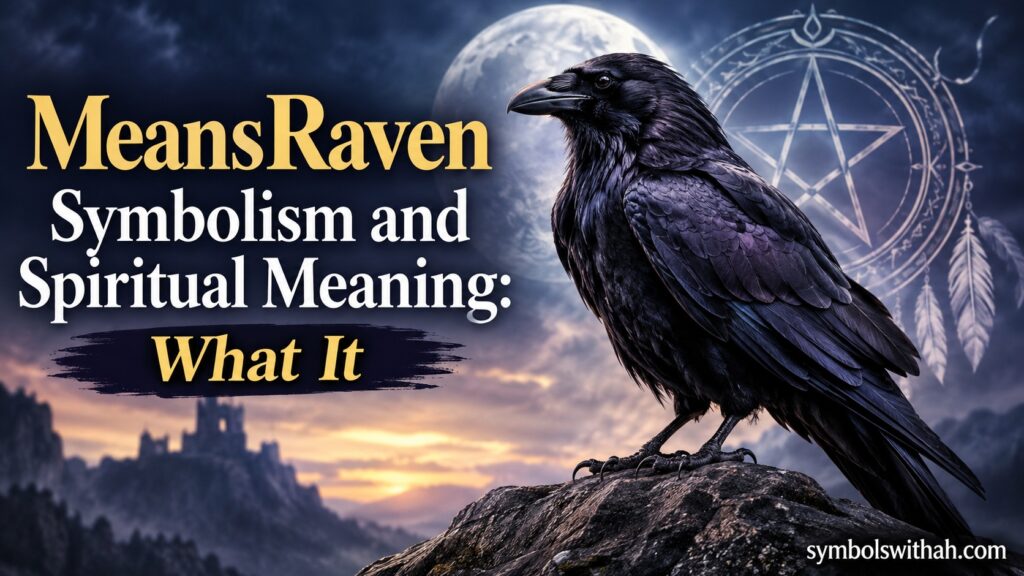

The Symbolism and Spiritual Meaning Raven carries today comes from a long history of myth, storytelling, religion, and observation. Its glossy black feathers, sharp intelligence, powerful flight, and unusual behavior have made it one of the most memorable birds in human culture.
In the United States, ravens often suggest mystery, wisdom, independence, transformation, and the unknown. However, their meaning isn’t always dark or negative. In many traditions, the raven is also a guide, messenger, creator, protector, or keeper of hidden knowledge.
Understanding raven symbolism means looking beyond the bird’s black appearance. Its meaning changes with culture, personal experience, and context. A raven in a Native story can carry a different message than a raven in a Gothic novel or a modern tattoo.
Read More: Sneezing 3 Times in a Row Spiritual Meaning and Symbolism
Quick Answer
Raven symbolism and spiritual meaning commonly points to intelligence, mystery, transformation, wisdom, and messages from the unknown. In the USA, ravens often represent independence and deeper awareness, while broader traditions connect them with creation, prophecy, death, rebirth, and spiritual guidance.
TL;DR
• Ravens commonly symbolize wisdom, intelligence, mystery, and transformation.
• Norse mythology connects ravens with Odin, thought, and memory.
• Some Indigenous traditions describe Raven as creator, trickster, or bringer of light.
• American literature often gives ravens darker meanings involving grief and mystery.
• Raven tattoos can represent independence, personal transformation, or hidden knowledge.
• Seeing a raven doesn’t automatically mean something bad will happen.
What Does a Raven Symbolize?
The raven is a large black bird belonging to the corvid family. Its strong beak, broad wings, glossy feathers, and remarkable intelligence make it visually distinctive.
Because ravens are highly adaptable, humans have observed them closely for thousands of years. Their behavior helped create symbolic associations that continue today.
The Core Symbolic Meanings
Ravens are commonly associated with:
• Intelligence and clever problem-solving
• Mystery and hidden knowledge
• Transformation and personal change
• Messages, prophecy, and spiritual awareness
• Independence and adaptability
• Death, endings, and renewal
These meanings can overlap. For example, transformation often involves leaving something familiar behind.
Likewise, mystery doesn’t necessarily mean danger. It can simply represent something not yet understood.
Why Does the Raven Feel Mysterious?
The raven’s black plumage naturally attracts attention. Black has often been associated with night, the unknown, mourning, authority, and hidden things.
The bird’s behavior adds another layer. Ravens can solve problems, remember people, use tools, mimic sounds, and investigate unfamiliar objects.
As a result, the raven can symbolize a mind that looks beyond appearances.
Raven Symbolism in Ancient History
Ravens appear in stories from Europe, Asia, the Middle East, and North America. Their symbolism developed long before modern spiritual movements.
Ancient peoples observed ravens around settlements, forests, battlefields, and places where animals died. Those observations shaped different interpretations.
Ravens and the Ancient World
In Greek mythology, ravens became connected with Apollo, a deity associated with prophecy and knowledge. One famous myth explains the raven’s black feathers through a story involving truth, betrayal, and punishment.
This connection helped reinforce the bird’s association with knowledge and prophecy.
In Celtic traditions, ravens were connected with powerful figures associated with battle, sovereignty, fate, and prophecy. Their appearance could suggest a turning point or an approaching change.
The Raven as a Threshold Symbol
A threshold is a boundary between two states.
Ravens often occupy symbolic thresholds:
• Life and death
• Known and unknown
• Darkness and light
• Wisdom and mystery
• Endings and beginnings
This explains why the bird appears so often in stories about major transitions.
Raven Symbolism in Norse Mythology
Norse mythology gives the raven one of its most famous symbolic roles. Odin, a central Norse god, was associated with two ravens named Huginn and Muninn.
Their names are commonly translated as Thought and Memory.
Thought and Memory
The two ravens traveled throughout the world and returned with information for Odin. Their role made ravens powerful symbols of observation and knowledge.
The story also connects the raven with mental awareness.
Instead of simply representing strength, the raven becomes an image of someone who watches, remembers, learns, and thinks.
Ravens, War, and Death
Ravens also became associated with warfare in Norse tradition.
Their presence around battlefields contributed to associations with death and fate. Yet this didn’t make the raven purely evil.
Instead, it connected the bird with the difficult realities of courage, mortality, destiny, and conflict.
That distinction matters when interpreting raven symbolism today.
Raven Symbolism in Indigenous North American Traditions
Raven symbolism in Indigenous North American cultures cannot be reduced to one universal meaning. Different nations have their own stories, teachings, languages, and traditions.
This diversity is especially important when discussing the Pacific Northwest.
Raven as Creator and Trickster
Among several Indigenous peoples of the Pacific Northwest, Raven appears as a major mythological figure.
In some traditions, Raven is associated with bringing light into the world. Stories may describe Raven as a creator, transformer, culture hero, or trickster.
The trickster role doesn’t simply mean a dishonest character.
Instead, trickster figures can challenge ordinary rules, create unexpected changes, and expose weaknesses in established patterns.
Why This Matters in the USA
Modern American discussions sometimes treat “Native American symbolism” as one single system.
That’s misleading.
Raven traditions belong to specific peoples and communities. Their meanings should therefore be discussed with cultural care rather than treated as a universal spiritual formula.
What Does a Raven Mean Spiritually?
Spiritual interpretations of ravens often focus on change, awareness, mystery, and inner wisdom.
These interpretations aren’t universal religious teachings. Instead, they’re modern ways people use an ancient symbol to reflect on their lives.
Transformation
A raven can represent the end of one stage and the beginning of another.
This might involve changing beliefs, leaving an old identity behind, starting a new chapter, or facing something previously avoided.
The symbolism isn’t necessarily about physical death. More often, modern spiritual interpretations use “death” metaphorically.
Hidden Knowledge
The raven can also symbolize information beneath the surface.
Its dark appearance makes it an effective symbol for things that aren’t immediately visible.
Spiritually, this may represent:
• Looking beyond first impressions
• Exploring uncomfortable truths
• Trusting thoughtful observation
• Becoming aware of hidden patterns
• Learning from difficult experiences
What Does Seeing a Raven Mean?
Seeing a raven can feel meaningful, especially when the encounter happens during an emotional or uncertain period.
However, there isn’t one fixed spiritual meaning for every sighting. A raven may simply be behaving naturally.
A Symbolic Interpretation
If someone chooses to interpret the encounter symbolically, context matters.
Ask yourself what was happening when you noticed the bird.
Were you facing a major decision? Were you ending something? Were you searching for answers?
The personal context may make the symbolism more meaningful than the bird alone.
Possible Personal Messages
Modern spiritual readers may interpret a raven encounter as a reminder to:
• Pay closer attention to your surroundings
• Think carefully before making major decisions
• Accept necessary changes
• Explore something you’ve been avoiding
• Trust curiosity instead of immediate fear
These are reflective interpretations, not predictions.
Raven Symbolism in American Culture
The raven has a fascinating place in American culture because several traditions overlap.
Indigenous stories, literature, popular entertainment, Gothic art, wildlife observation, and modern spirituality have all shaped how Americans perceive the bird.
Edgar Allan Poe and The Raven
No discussion of raven symbolism in the United States is complete without Edgar Allan Poe’s famous poem “The Raven.”
Published in 1845, the poem helped cement the raven’s connection with grief, memory, darkness, mystery, and psychological distress in American popular culture.
The repeated presence of the bird becomes part of the narrator’s emotional experience.
The Raven in Modern America
Today, Americans may encounter raven imagery in:
• Gothic and alternative fashion
• Tattoos and jewelry
• Fantasy books and films
• Nature photography
• Spiritual artwork
• Halloween decorations
• Poetry and literary references
Therefore, the American raven carries both ancient and modern meanings.
| Context | Meaning in the USA | Common Associations | Notes |
| Literature | Mystery and grief | Poe, memory, loss | Strong literary influence |
| Tattoos | Transformation and independence | Strength, identity | Meaning depends on design |
| Spiritual art | Wisdom and change | Mystery, intuition | Usually personal rather than universal |
| Nature imagery | Intelligence and adaptability | Wilderness, observation | Reflects real bird behavior |
| Gothic culture | Darkness and mystery | Night, mortality | Often aesthetic rather than religious |
Raven Symbolism and Death
Death is one of the raven’s oldest symbolic associations.
This connection comes partly from the bird’s presence around dead animals and battlefields. Stories also reinforced the connection through gods, warriors, prophecy, and the afterlife.
Death Doesn’t Always Mean Doom
In symbolism, death can represent an ending rather than literal physical death.
For example, a person may describe the “death” of an old identity after a major life change.
In this sense, the raven can represent:
• The closing of an important chapter
• Release from outdated habits
• Acceptance of life’s temporary nature
• The beginning of a different path
This interpretation explains why the raven can symbolize death and rebirth at the same time.
Raven Symbolism and Transformation
Transformation is among the most useful modern interpretations of the raven.
The bird’s association with darkness makes it a natural image for uncertain periods. Yet darkness can also represent the stage before something becomes clear.
The Shadow Side
Psychological symbolism sometimes uses darkness to represent parts of ourselves we don’t fully understand.
The raven can therefore become a symbol for facing difficult emotions, memories, fears, or unanswered questions.
That doesn’t make those things evil.
Instead, the symbolism suggests that awareness can begin when we stop avoiding what feels uncomfortable.
Rebirth and Renewal
After an ending, something new can develop.
A raven image may therefore represent:
• Personal reinvention
• Emotional growth
• New beginnings
• Greater self-awareness
• Courage during uncertainty
This is why raven imagery can feel especially meaningful during major transitions.
The Emotional and Psychological Meaning of Ravens
Ravens often create a strong emotional response.
Their black feathers, unusual calls, intelligence, and watchful behavior can make them seem both fascinating and unsettling.
Mystery and Curiosity
The raven can represent curiosity because it appears to investigate its surroundings.
Psychologically, this can symbolize a willingness to question assumptions.
Instead of accepting everything at face value, the raven suggests observing first and deciding later.
Independence and Intelligence
Ravens are often viewed as highly intelligent animals.
For this reason, they can symbolize independent thinking.
Someone who chooses raven imagery may identify with qualities such as curiosity, privacy, adaptability, or intellectual independence.
Raven Tattoos and Modern Personal Symbolism
Raven tattoos are popular because the bird offers many layers of meaning.
A simple black raven can look mysterious. A raven combined with a moon, skull, forest, feather, or geometric design can create a very different message.
Common Raven Tattoo Meanings
People may choose raven tattoos to represent:
• Surviving a major life transformation
• Remembering someone or something important
• Independence and self-reliance
• Mystery and personal depth
• Wisdom gained through hardship
• Connection with nature and mythology
The meaning ultimately belongs to the person wearing the design.
Raven Tattoo Design Details
Small visual changes can alter the emotional tone.
A flying raven often suggests freedom or movement. A perched raven can suggest observation and patience.
A raven with an open beak may feel more dramatic. A calm, detailed raven can communicate wisdom instead.
Raven Symbolism in Dreams
Dreams involving ravens can feel unusually vivid.
However, dream symbolism isn’t a universal dictionary. The same image can mean different things to different people.
A Raven in a Dream
A raven might represent mystery, change, memory, fear, intelligence, or something unresolved.
The dreamer’s emotions matter greatly.
If the raven feels threatening, the dream may reflect anxiety or uncertainty. If it feels calm, the same bird might symbolize curiosity or guidance.
Multiple Ravens
Several ravens may emphasize themes of communication, community, observation, or overwhelming thoughts.
Rather than asking only, “What does a raven mean?” consider asking, “What did the raven make me feel?”
That question often reveals more about the dream’s personal symbolism.
Raven vs. Crow: Are They the Same Symbol?
Ravens and crows are closely related birds, but they aren’t the same species.
Ravens are generally larger, with heavier bills and distinctive tail shapes. Their calls also differ from typical crow calls.
Symbolic Differences
Symbolic traditions sometimes blur the two birds together.
Both can represent intelligence, mystery, death, transformation, and adaptability. Yet ravens often carry stronger associations with mythology, prophecy, and spiritual mystery.
Crows, meanwhile, frequently appear in folklore as clever observers and tricksters.
The distinction isn’t absolute. Cultural traditions often use both birds in overlapping ways.
Is Seeing a Raven Good or Bad Luck?
There is no universal answer.
Some traditions have treated ravens as warnings, particularly because of their association with battle, death, and darkness. Other traditions have viewed them as intelligent guides, creators, protectors, or bearers of important knowledge.
Why the Symbol Has Two Sides
Raven symbolism is strongly dualistic.
The same bird can represent darkness and light, death and renewal, fear and wisdom.
This isn’t necessarily a contradiction.
Instead, it reflects the way humans experience change. Difficult moments can contain uncertainty while also opening new possibilities.
Raven Symbolism, Misuse, and Cultural Context
Raven imagery is widespread, but not every modern interpretation accurately represents its cultural origins.
One common problem is treating all Indigenous traditions as identical.
Another is presenting modern spiritual interpretations as ancient facts.
Respecting Cultural Differences
Raven traditions belong to particular communities and histories.
Therefore, it is better to say that some traditions associate Raven with creation, transformation, or trickster stories.
This approach avoids turning diverse cultures into one simplified belief system.
Avoiding the “Bad Omen” Stereotype
The raven’s dark feathers don’t automatically make it a symbol of evil.
That interpretation became especially strong through certain European traditions, literature, Gothic imagery, and modern entertainment.
A broader view shows a much richer symbol.
How Raven Meaning Has Changed Over Time
Raven symbolism has never had one fixed meaning.
Ancient stories could portray the bird as divine, prophetic, creative, or dangerous. Medieval and later European traditions sometimes emphasized death and ominous signs.
American literature then added another layer.
From Omen to Personal Symbol
Today, many Americans use raven imagery for personal reasons rather than religious ones.
A raven tattoo may represent resilience. A painting may symbolize mystery. A necklace may honor someone’s connection with nature or mythology.
Modern spirituality has also expanded the bird’s association with transformation and personal awareness.
The result is a symbol that continues to evolve.
FAQs
1. What does a raven symbolize spiritually?
A raven commonly symbolizes wisdom, transformation, mystery, intelligence, and hidden knowledge. Some spiritual traditions also connect it with messages, prophecy, or transitions.
2. Is seeing a raven a good sign?
It can be interpreted positively or negatively depending on the tradition. Modern interpretations often view a raven as a reminder to observe carefully, accept change, or explore something hidden.
3. What does a raven symbolize in Native American culture?
There isn’t one single Native American meaning. Among some Indigenous peoples of the Pacific Northwest, Raven is an important creator, transformer, or trickster figure associated with bringing light and shaping the world.
4. What does a raven symbolize in Norse mythology?
Odin’s two ravens, Huginn and Muninn, represent Thought and Memory. They traveled through the world and returned with information, making the raven a powerful symbol of knowledge and awareness.
5. Does a raven symbolize death?
Ravens have long been associated with death because of their presence around battlefields and carrion. Symbolically, however, death can also represent endings, transformation, and the start of a new stage.
6. What does a raven tattoo symbolize?
A raven tattoo can represent independence, intelligence, mystery, transformation, remembrance, or personal strength. The surrounding imagery often changes the tattoo’s specific meaning.
Conclusion
The raven is one of the most complex symbols found in mythology and modern culture. It can represent intelligence, mystery, transformation, memory, independence, death, renewal, and spiritual awareness.
Across the United States, the bird’s meaning has been shaped by Indigenous traditions, Norse mythology, American literature, Gothic culture, and modern personal spirituality. The Symbolism and Spiritual Meaning Raven offers isn’t one fixed message. Instead, it changes with history, culture, and personal experience.
Perhaps that’s the raven’s greatest symbolic strength. It encourages us to look beyond appearances, question what we think we know, and recognize that endings can sometimes lead toward something new.