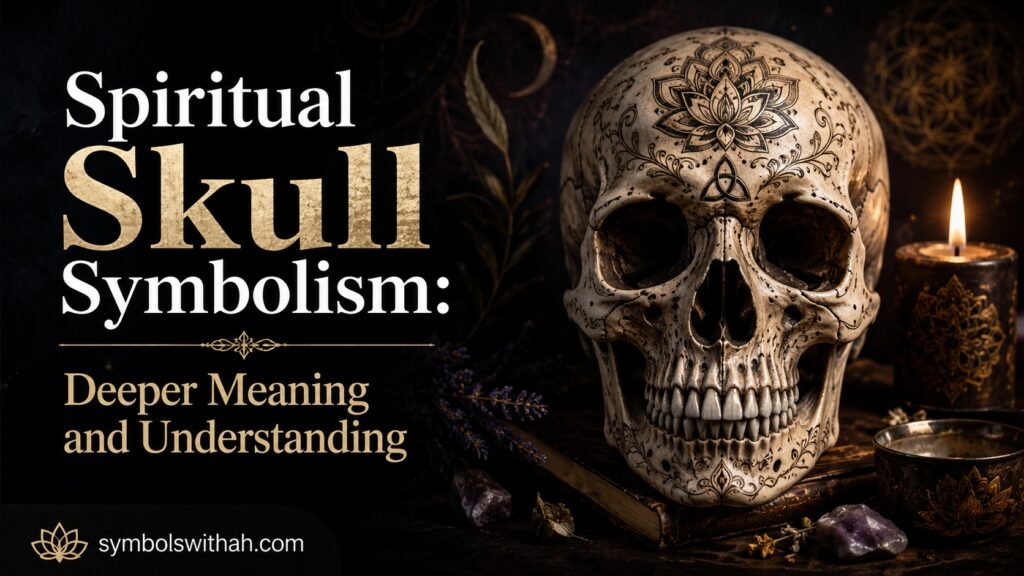

A skull is one of humanity’s most recognizable symbols. Spiritual Skull Symbolism: Deeper Meaning and Understanding goes far beyond death or fear. Across history, the skull has represented mortality, wisdom, remembrance, transformation, equality, and the fragile nature of life.
In the United States, skull imagery appears in many different settings. You may see it in Halloween decorations, military insignia, tattoos, motorcycle culture, art, fashion, and Día de los Muertos celebrations. However, the meaning changes greatly depending on its design and setting.
A plain skull can feel serious and reflective. A colorful sugar skull can express remembrance and celebration. A skull with crossed bones can warn of danger, while a skull in religious art can remind people of life’s temporary nature.
Therefore, understanding the skull requires context. Its meaning isn’t fixed, and its appearance alone doesn’t tell the whole story.
Read More: Symbolic and Spiritual Meaning of Jewelry Falling Off
Quick Answer
Spiritual Skull Symbolism: Deeper Meaning and Understanding often centers on mortality, transformation, remembrance, and the temporary nature of physical life. In the USA, it can also represent courage, rebellion, danger, protection, individuality, or remembrance, depending on context.
TL;DR
- Skulls often remind people that life is temporary.
- They can symbolize transformation, rebirth, and spiritual reflection.
- American culture uses skulls for danger, rebellion, remembrance, and identity.
- Día de los Muertos gives skulls a colorful commemorative meaning.
- Memento mori traditions connect skulls with reflection on mortality.
- Modern tattoos often personalize the skull’s meaning.
What Does a Skull Symbolize Spiritually?
The skull is powerful because it represents something universal. Every human being has one, regardless of wealth, status, culture, or background.
For that reason, the skull can become a symbol of equality. It strips away appearances and reminds us that physical identity doesn’t last forever.
Mortality and Impermanence
The most common spiritual meaning is mortality.
A skull can represent the simple truth that human life has an ending. Rather than being purely negative, this idea can encourage people to value their limited time.
This theme appears in the old concept of memento mori, meaning a reminder of death. European religious art often used skulls to encourage reflection on life’s temporary nature.
Transformation and Renewal
A skull can also represent the end of one stage and the beginning of another.
Spiritually, death doesn’t always mean literal physical death. Instead, it may represent the ending of an identity, relationship, habit, or period of life.
Because of this, skull imagery sometimes appears during major personal transitions.
Wisdom Through Awareness
Awareness of mortality can change how people view life.
A skull may therefore symbolize wisdom gained through experience. It can encourage someone to stop postponing important goals and appreciate the present.
The Historical Roots of Skull Symbolism
Skull imagery is much older than modern Halloween culture. Ancient societies used bones, human remains, and death imagery in different religious and cultural settings.
However, there isn’t one single ancient meaning that explains every skull symbol today.
Ancient Connections With Death
Human societies have long created rituals around death and burial. Bones naturally became reminders of ancestors, mortality, and the boundary between life and death.
In different cultures, the dead could be viewed with fear, respect, affection, or reverence. Therefore, skull imagery developed many meanings rather than one universal definition.
In Mesoamerica, traditions involving the dead existed long before European colonization. Later, Indigenous traditions blended with Spanish Catholic observances, helping shape modern Día de los Muertos practices.
Medieval Europe and Memento Mori
During the medieval and early modern periods, skulls became important in European religious and artistic imagery.
Artists used the skull as a visual reminder that worldly beauty and wealth eventually disappear. This idea became especially visible in memento mori artwork.
A skull could appear beside flowers, clocks, candles, books, or other objects. Each object reinforced the idea that life and earthly achievements are temporary.
The Skull as a Universal Reminder
Over time, the symbol moved beyond religious settings.
It entered paintings, gravestones, jewelry, books, military imagery, warning signs, and popular culture. As its settings changed, so did its meanings.
Today, a skull can communicate something serious, playful, rebellious, spiritual, or even humorous.
What Does a Skull Mean in American Culture?
American culture has given the skull an unusually broad range of meanings.
Instead of belonging to one tradition, skull imagery appears across many communities and lifestyles.
Danger and Warning
The skull and crossbones is one of America’s best-known warning symbols.
It has been associated with poison and dangerous substances for generations. In the United States, poison labeling helped establish the skull and crossbones as a practical warning image during the nineteenth century.
This meaning is different from spiritual skull symbolism. Here, the skull communicates immediate physical danger.
Rebellion and Individuality
American popular culture also turned skulls into symbols of independence.
They appear in motorcycle culture, rock music, tattoo traditions, fashion, and alternative art. In these settings, the skull can communicate fearlessness or rejection of conventional expectations.
However, the same design can mean something completely different in another setting.
Remembrance and Heritage
Skulls also appear in American celebrations connected with Mexican and Mexican American traditions.
Día de los Muertos has become increasingly visible in the United States, especially within Latino communities. Its skull imagery often emphasizes remembrance rather than horror.
This distinction matters because Día de los Muertos isn’t simply another version of Halloween.
Why Are Skulls Used for Día de los Muertos?
Colorful skulls are among the most recognizable images connected with Día de los Muertos.
However, their meaning is much richer than simply representing death.
Sugar Skulls and Remembrance
Sugar skulls, or calaveritas de azúcar, are commonly associated with Día de los Muertos.
They can be brightly decorated with flowers, patterns, colors, and other details. Their appearance contrasts sharply with the frightening skull imagery often associated with Halloween.
The Smithsonian explains that these skulls can serve as whimsical reminders of life’s cycles rather than purely morbid objects.
Honoring Loved Ones
Día de los Muertos traditions often include an ofrenda, or altar, where families honor deceased loved ones.
Photographs, favorite objects, flowers, food, candles, and other meaningful items may appear there. The skull becomes part of a larger language of memory and family connection.
La Catrina and Social Commentary
Skull imagery also became connected with the famous skeletal figure known as La Catrina.
Mexican printmaker José Guadalupe Posada popularized satirical calavera imagery. His skeleton figures could mock social status and remind viewers that death ultimately places everyone on equal ground.
| Context | Meaning in the USA | Common Associations | Notes |
| Plain skull | Mortality and reflection | Death, impermanence | Meaning depends heavily on setting |
| Skull and crossbones | Danger or warning | Poison, pirates | Primarily a practical warning symbol |
| Sugar skull | Remembrance and celebration | Día de los Muertos | Connected with Mexican and Mexican American traditions |
| Skull tattoo | Personal identity | Courage, memory, change | Often carries an individual story |
| Religious skull art | Reflection on mortality | Memento mori, humility | Meaning varies by religious tradition |
| Halloween skull | Death and playful fear | Costumes, horror, autumn | Often used in a seasonal entertainment context |
What Does a Skull Mean in Different Spiritual Traditions?
Skull symbolism isn’t limited to American culture. However, different traditions interpret it in distinct ways.
It’s important not to treat these traditions as interchangeable. Similar imagery can carry very different meanings.
Christian Memento Mori
Some Christian art traditions use skulls as reminders of mortality.
The purpose isn’t necessarily to glorify death. Instead, the image can encourage humility and reflection on how temporary worldly life can be.
The skull therefore becomes a prompt to consider how a person chooses to live.
Buddhist Interpretations
Certain Buddhist artistic traditions use skull imagery to represent impermanence and the temporary nature of physical existence.
In this context, the skull can encourage detachment from appearances and remind viewers that everything changes.
That meaning is quite different from the modern Western idea that a skull automatically represents rebellion.
Mesoamerican and Mexican Traditions
Skull imagery has deep connections with traditions surrounding death and remembrance in Mexico and parts of Central America.
Modern Día de los Muertos developed through a blending of Indigenous traditions and Catholic observances.
The resulting traditions emphasize memory, family, continuity, and honoring the deceased.
What Is the Psychological Meaning of a Skull?
Skull imagery can create strong emotional reactions because it represents something humans instinctively understand.
For some people, it creates discomfort. For others, it creates curiosity, acceptance, humor, or even peace.
Facing Mortality
A skull can symbolize the willingness to face uncomfortable realities.
Someone who chooses skull imagery may not be fascinated with death itself. Instead, the image may represent acceptance of life’s limits.
That interpretation can be especially meaningful after a major life change or loss.
Strength and Fearlessness
In modern American culture, skulls can also suggest toughness.
The image can communicate, “I’m not easily frightened.” This explains why skull designs frequently appear in motorcycle, military-inspired, rock, and alternative fashion.
However, this meaning is cultural rather than universal.
Remembering Someone
A skull tattoo or artwork can also memorialize someone who has died.
When combined with names, dates, flowers, wings, hearts, or personal objects, the skull may become a symbol of remembrance rather than fear.
What Does a Skull Tattoo Symbolize?
Skull tattoos are among the most flexible forms of symbolic body art.
Their meaning depends on the person, surrounding imagery, and cultural background.
Common Skull Tattoo Meanings
A skull tattoo may represent:
• Acceptance of mortality and life’s temporary nature
• Personal transformation after a difficult period
• Remembrance of someone who has died
• Courage when facing fear or uncertainty
• Rebellion against conventional expectations
• Appreciation for living fully in the present
Why Design Details Matter
A rose beside a skull creates a different impression from crossed weapons.
Likewise, wings can suggest freedom or spiritual remembrance. A clock can emphasize time, while flames can suggest destruction or rebirth.
Therefore, the surrounding imagery often provides the real explanation.
What Do Skull Colors Symbolize?
Color can dramatically change how people interpret skull imagery.
A black skull may feel serious, mysterious, or traditional. Meanwhile, bright colors can create a celebratory or artistic impression.
Black Skull
Black commonly strengthens associations with mystery, death, seriousness, and the unknown.
However, it can also communicate strength and personal independence.
White Skull
White can emphasize bones, purity, simplicity, or spiritual reflection.
In minimalist art, a white skull may appear more contemplative than frightening.
Colorful Skull
Bright colors can make the skull feel lively rather than threatening.
This is especially important with Día de los Muertos imagery, where decorated skulls can represent remembrance and the continuing relationship between families and their deceased loved ones.
What Does a Skull and Crossbones Symbolize?
The skull and crossbones has a more specific meaning than a skull alone.
Historically, it became associated with death, danger, piracy, and poisonous substances.
Pirates and Adventure
Modern Americans often connect the skull and crossbones with pirates.
Popular literature helped strengthen this association. Robert Louis Stevenson’s 1883 novel Treasure Island played an important role in making pirate imagery familiar in popular culture.
Yet historically, not every pirate used the classic skull-and-crossbones flag. Pirate flags could feature many different designs.
Poison and Danger
The symbol also became a practical warning.
By the nineteenth century, American poison labeling increasingly used skull-and-crossbones imagery. Its advantage was simple: people didn’t need to read words to understand that something could be dangerous.
What Does a Skull Represent in Dreams and Personal Symbolism?
People sometimes encounter skulls in dreams or attach personal meanings to them.
These interpretations aren’t universal predictions. Instead, they can be understood as personal associations.
Possible Symbolic Themes
A skull may appear meaningful when someone is thinking about:
• The ending of an important chapter
• Fear of change or uncertainty
• Memories of someone who has died
• A desire to accept life’s limitations
• Personal transformation and a new beginning
• Questions about identity and purpose
The most useful interpretation usually comes from the dreamer’s own circumstances.
For example, a skull appearing during a period of major change may symbolize an ending. The same image could represent remembrance for someone grieving a loss.
How Are Skulls Used in Modern American Culture?
Today, skull imagery is everywhere.
It can appear in tattoos, clothing, jewelry, artwork, home décor, music, video games, sports culture, and seasonal decorations.
Fashion and Identity
Some people use skulls because they like the visual style.
Others use them to communicate independence, toughness, creativity, or an interest in mortality. Because the image is instantly recognizable, it can communicate an attitude without words.
Halloween
Halloween has helped normalize skull imagery in mainstream American culture.
Here, skulls usually belong to a playful world of ghosts, skeletons, monsters, costumes, and spooky decorations.
The meaning is often temporary and theatrical rather than deeply spiritual.
Social Media and Digital Culture
Skull imagery has also become common in online communication.
The skull emoji, for example, can sometimes mean literal death. However, it may also express extreme laughter, shock, embarrassment, exhaustion, or disbelief.
That modern use shows how quickly symbols can change meaning.
When Can Skull Symbolism Be Misunderstood?
Because skulls have many meanings, misunderstanding is common.
A skull tattoo doesn’t automatically indicate a person’s beliefs. Likewise, a colorful skull doesn’t automatically mean someone is participating in Día de los Muertos.
Context Matters
The surrounding symbols, location, colors, and setting should always be considered.
A skull in a cemetery artwork differs from a skull on a warning label. A sugar skull differs from a pirate flag.
Cultural Respect
Día de los Muertos imagery deserves particular care.
Using sugar skulls as generic Halloween decorations can remove them from their cultural and family context. At the same time, Mexican and Mexican American communities have developed many different ways of celebrating and representing the tradition.
Therefore, it’s better to recognize the skull as part of a living cultural practice rather than treating it as a generic decoration.
Not Every Skull Is Negative
One of the biggest misunderstandings is assuming skulls always symbolize evil.
Historically and today, skulls can represent remembrance, humility, courage, transformation, equality, and appreciation for life.
The meaning comes from context.
How Has Skull Symbolism Changed Over Time?
Skull symbolism has never remained completely fixed.
Its meaning has shifted as societies changed and as artists placed the image in new settings.
From Mortality to Identity
Older religious artwork often emphasized mortality and humility.
Later, skulls entered maritime culture, medicine, warning systems, military imagery, popular entertainment, and fashion.
Today, many people use skulls as personal identity symbols.
From Fear to Celebration
Perhaps the most striking change is the coexistence of fear and celebration.
A skull can appear in a horror movie while also appearing on a colorful Día de los Muertos altar.
Both images involve death, but their emotional messages are very different.
The Modern Skull Is Multilayered
Today, the skull can simultaneously suggest:
• Mortality and the limited nature of human life
• Strength when confronting fear
• Memory of people who have passed away
• Transformation after personal change
• Rebellion and independent identity
• Celebration of cultural traditions surrounding death
This flexibility explains why skull imagery remains so powerful.
FAQs
1. What is the spiritual meaning of seeing a skull?
A skull can symbolize mortality, transformation, remembrance, or awareness of life’s temporary nature. Its personal meaning depends on the circumstances and the person’s own associations.
2. Is a skull a symbol of good or bad?
A skull isn’t automatically good or bad. It can represent danger or death, but it can also symbolize wisdom, remembrance, courage, transformation, and appreciation for life.
3. What does a skull symbolize in Christianity?
In some Christian artistic traditions, a skull represents mortality and humility. This connects with the broader memento mori tradition, which encourages reflection on life’s temporary nature.
4. What does a skull symbolize in Día de los Muertos?
Skulls can represent remembrance, family connection, and the cycle of life and death. Sugar skulls are often colorful and celebratory rather than frightening.
5. What does a skull tattoo mean spiritually?
A skull tattoo can symbolize mortality, personal transformation, remembrance, courage, or acceptance of life’s impermanence. Additional tattoo elements often reveal the owner’s intended meaning.
6. Why is the skull and crossbones a warning symbol?
The skull and crossbones became strongly associated with poison and danger. Its visual simplicity made it useful for communicating serious danger without relying on written language.
Conclusion
The skull is far more than a symbol of death. Throughout history, it has represented mortality, humility, remembrance, transformation, equality, danger, courage, and the temporary nature of physical life.
In American culture, its meaning depends heavily on context. A skull may belong to Halloween, a tattoo, a warning label, a memorial, military-inspired art, or a Día de los Muertos celebration.
Ultimately, Spiritual Skull Symbolism: Deeper Meaning and Understanding shows why this ancient image continues to attract attention. It reminds us that endings and beginnings are connected, and that awareness of mortality can make everyday life feel more meaningful.
When you encounter a skull, look beyond the image itself. Consider its colors, surrounding symbols, cultural setting, and the story behind it. That context often reveals the deeper meaning.