
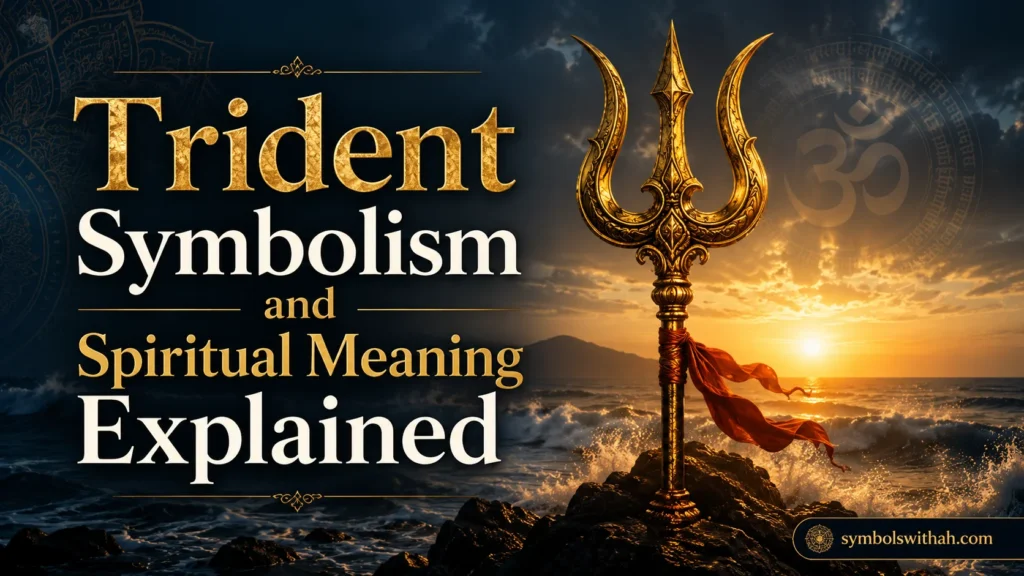

The Trident Symbolism and Spiritual Meaning has fascinated people for thousands of years. With its three sharp prongs and powerful appearance, the trident is one of the world’s most recognizable symbols. It appears in mythology, religion, art, literature, tattoos, and modern popular culture.
In the United States, many people associate the trident with strength, leadership, and control over powerful forces. Others see it as a spiritual symbol representing balance, creation, and transformation. Because it appears across many cultures, the trident carries layers of meaning that continue to evolve today.
From ancient gods to modern identity symbols, the trident remains relevant because it speaks to universal human ideas about power, protection, and purpose.
Read More: Symbolic and Spiritual Meaning of a Flock of Birds
Quick Answer
Trident Symbolism and Spiritual Meaning is most commonly associated with power, authority, protection, and mastery over natural forces. In the United States, it often represents strength, independence, and resilience, while broader spiritual traditions connect it to balance between mind, body, and spirit.
TL;DR
• Symbolizes power, authority, and leadership.
• Originates in ancient mythology and religion.
• Represents balance through its three-pronged design.
• Associated with protection and divine energy.
• Popular in tattoos, art, and modern media.
• Meanings have evolved across cultures and centuries.
Overview of the Trident Symbol
What Does a Trident Look Like?
The trident is a spear-like object with three points extending from a single shaft. While designs vary, the three-pronged structure remains its defining feature.
The symbol often appears in:
• Ancient sculptures and temple carvings
• Religious artwork and sacred objects
• Military emblems and heraldry
• Tattoos and modern graphic design
• Fantasy and mythology-inspired media
Why Three Prongs Matter
The number three has carried symbolic significance throughout history. Because of this, the trident often represents unity among three connected forces.
Common interpretations include:
• Past, present, and future
• Mind, body, and spirit
• Creation, preservation, and destruction
• Earth, sea, and sky
• Wisdom, strength, and courage
Ancient Origins of the Trident
Early Uses in Human History
Long before becoming a sacred symbol, the trident likely served practical purposes. Ancient fishing communities used three-pronged spears to catch fish in rivers and coastal waters.
Over time, practical tools gained symbolic meaning. Societies began associating the trident with survival, abundance, and mastery over nature.
The Trident in Ancient Greece
Perhaps the most famous trident belongs to the mythological sea god Poseidon.
According to Greek mythology, Poseidon used his trident to:
• Control the oceans
• Create storms and earthquakes
• Protect sailors
• Demonstrate divine authority
The image of Poseidon wielding a trident became one of the most enduring symbols in Western mythology.
Roman Adaptations
The Romans adopted many Greek symbols. Poseidon became Neptune, and the trident continued representing command over the seas.
As Roman influence spread, the trident became associated with naval power and imperial strength.
Spiritual Meaning of the Trident
Divine Authority
Many spiritual traditions view the trident as a symbol of divine power. The three points suggest a force that reaches beyond ordinary human limitations.
People often interpret the trident as representing:
• Higher wisdom
• Spiritual authority
• Cosmic order
• Sacred protection
Balance and Harmony
The three prongs can symbolize balance among important aspects of existence.
Spiritually, the trident may represent:
• Physical well-being
• Emotional stability
• Spiritual growth
This interpretation remains popular among modern spiritual seekers.
Transformation and Growth
Because the trident appears in stories involving gods and supernatural forces, it is often linked to transformation.
Many people see it as a reminder that growth sometimes requires courage, discipline, and change.
The Trident in Hindu Tradition
Shiva’s Trishula
One of the most important tridents in world spirituality is the Trishula, carried by the Hindu deity Shiva.
The Trishula symbolizes multiple spiritual concepts, including:
• Creation, preservation, and destruction
• Past, present, and future
• Knowledge, action, and willpower
Spiritual Lessons of the Trishula
The Trishula is often viewed as a symbol of overcoming ignorance and achieving spiritual awareness.
For many practitioners, it represents:
• Inner strength
• Self-mastery
• Divine protection
• Spiritual awakening
Although interpretations vary, the Trishula remains one of Hinduism’s most respected sacred symbols.
Trident Symbolism in the United States
Popular Cultural Meaning
In America, the trident is generally viewed through mythology, entertainment, and symbolic imagery rather than religious practice.
Many Americans associate it with:
• Leadership
• Personal power
• Independence
• Determination
Influence of Media
Movies, comic books, and fantasy stories have reinforced the trident’s image as a weapon of legendary power.
As a result, younger generations often recognize the trident as a symbol of heroic strength and adventure.
Modern American Associations
| Context | Meaning in the USA | Common Associations | Notes |
| Tattoos | Personal strength | Courage, resilience | Highly popular |
| Sports Symbols | Competitive spirit | Victory, determination | Often stylized |
| Entertainment | Mythological power | Heroes and gods | Common in fantasy |
| Art and Decor | Ocean energy | Freedom, exploration | Coastal themes |
| Spiritual Use | Balance and growth | Self-discovery | Modern interpretation |
Psychological Meaning of the Trident
A Symbol of Control
Psychologically, the trident often represents control over powerful emotions and challenges.
People may connect it with:
• Confidence during uncertainty
• Personal discipline
• Emotional resilience
• Inner authority
The Power of Three
Humans naturally find patterns in groups of three. Because of this, the trident feels balanced and complete.
Many psychologists and symbol researchers note that three-part structures often communicate stability and harmony.
Identity and Self-Expression
Today, people may use trident imagery to express:
• Independence
• Ambition
• Fearlessness
• Personal transformation
Trident Symbolism in Tattoos
Why People Choose Trident Tattoos
The trident has become a popular tattoo design because it combines visual simplicity with deep symbolism.
Common motivations include:
• Celebrating personal strength
• Honoring spiritual beliefs
• Showing resilience after hardship
• Expressing leadership qualities
Popular Tattoo Styles
Modern trident tattoos appear in many forms.
• Minimalist black designs
• Ocean-themed artwork
• Mythological scenes
• Tribal-inspired patterns
• Geometric interpretations
Placement Meanings
Some tattoo enthusiasts assign additional meaning based on placement, although these interpretations are personal rather than universal.
The Trident and Ocean Symbolism
Connection to Water
Because of its relationship with sea gods, the trident remains deeply connected to water symbolism.
Water often represents:
• Emotion
• Intuition
• Healing
• Adaptability
A Symbol of Nature’s Power
The ocean can be calm or destructive. Similarly, the trident reminds people of nature’s immense strength.
This dual symbolism makes it both protective and awe-inspiring.
Trident Symbolism in Modern Culture
Social Media and Design
Today, the trident appears in logos, digital art, gaming communities, and online content.
Its popularity comes from its ability to communicate:
• Power
• Mystery
• Adventure
• Confidence
Fashion and Personal Branding
Designers often use trident-inspired imagery to evoke boldness and authority.
The symbol’s clean shape makes it effective in modern visual design.
Pop Culture Influence
Fantasy stories and superhero narratives continue introducing new audiences to trident symbolism.
As a result, ancient meanings often blend with modern interpretations.
Cross-Cultural Meanings of the Trident
Shared Themes Across Cultures
Although interpretations differ, several themes appear repeatedly around the world.
• Authority over powerful forces
• Protection from danger
• Spiritual wisdom
• Balance and harmony
Regional Differences
Some cultures emphasize divine authority, while others focus on protection or transformation.
Despite these differences, the trident usually carries positive associations connected to strength and guidance.
Misunderstandings and Controversies
Not Always a Religious Symbol
One common misunderstanding is that every trident image carries religious meaning.
In reality, context matters. Many modern uses are artistic, cultural, or decorative.
Confusion with Other Symbols
The trident sometimes resembles symbols used by governments, organizations, or historical movements.
Because of this, meaning can vary depending on location and context.
Importance of Context
Understanding the symbol’s setting helps avoid incorrect assumptions.
A trident in mythology may communicate something very different from a trident in modern branding or political imagery.
How Trident Meanings Have Changed Over Time
Ancient Era
Originally, the trident symbolized practical survival and control over nature.
Mythological Period
Later, it became associated with gods, divine authority, and supernatural power.
Religious Interpretations
Various spiritual traditions expanded its meaning to include balance, wisdom, and transformation.
Modern Era
Today, many people focus on:
• Personal empowerment
• Self-discovery
• Leadership
• Resilience
This evolution shows how symbols adapt to changing cultures while retaining their core themes.
Frequently Asked Questions About Trident Symbolism and Spiritual Meaning
1. What does the trident symbolize spiritually?
The trident is commonly seen as a symbol of divine power, protection, and balance. Many spiritual traditions connect its three prongs to the harmony of mind, body, and spirit.
2. Why is the trident associated with power?
The trident became a symbol of power through its connection to ancient gods such as Poseidon, Neptune, and Shiva. These deities were believed to control natural forces, giving the trident an image of authority and strength.
3. What do the three points of a trident mean?
The three points can represent several important triads, including past, present, and future; creation, preservation, and destruction; or mind, body, and spirit. The exact meaning depends on cultural and spiritual context.
4. Is the trident a positive symbol?
Yes, in most traditions the trident is viewed positively. It often symbolizes protection, wisdom, leadership, courage, and the ability to overcome challenges.
5. What does a trident tattoo symbolize?
A trident tattoo usually represents personal strength, resilience, determination, and self-confidence. Some people also choose it to reflect spiritual growth or a connection to the ocean.
6. What is the spiritual meaning of Shiva’s trident?
Shiva’s trident, known as the Trishula, symbolizes creation, preservation, and destruction. It also represents the power to overcome ignorance and achieve spiritual awareness.
7. Is the trident connected to the ocean?
Yes. The trident is strongly associated with the sea because of its connection to Poseidon in Greek mythology and Neptune in Roman mythology. It often symbolizes the power, mystery, and depth of the ocean.
8. What does the trident symbolize in America?
In the United States, the trident is often seen as a symbol of strength, leadership, independence, and determination. It is commonly used in tattoos, sports imagery, and popular culture.
9. Can the trident represent protection?
Many cultures view the trident as a protective symbol. It is believed to guard against negative influences and provide spiritual or emotional strength.
10. How has the meaning of the trident changed over time?
The trident began as a practical fishing and hunting tool, later became a symbol of gods and divine authority, and today often represents personal empowerment, resilience, and spiritual balance.
Conclusion
The trident is far more than a simple three-pronged spear. Across centuries and cultures, it has represented authority, protection, balance, transformation, and mastery over powerful forces.
In the United States, people often view it as a symbol of strength, confidence, and resilience. At the same time, spiritual traditions continue to see deeper meanings connected to harmony and personal growth. The enduring appeal of Trident Symbolism and Spiritual Meaning comes from its ability to bridge ancient wisdom and modern identity.
Whether you encounter it in mythology, tattoos, artwork, or spiritual practice, the trident remains a powerful reminder that true strength often comes from balance, purpose, and self-mastery.