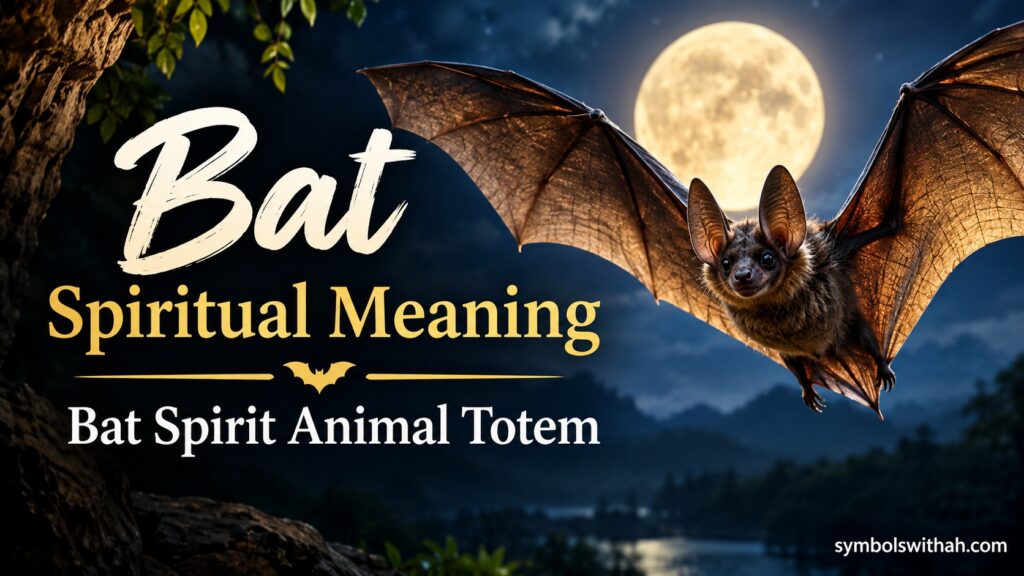

The bat spiritual meaning and bat spirit animal totem often center on transformation, intuition, mystery, adaptability, and navigating darkness. In the United States, however, bats carry a much wider range of meanings. They can represent Halloween and the supernatural, but they can also symbolize resilience, ecological balance, and the ability to find a way forward when life feels uncertain.
That contrast makes the bat an especially interesting symbol. Its nocturnal life, unusual flight, echolocation, cave dwelling, and seasonal movements naturally invite metaphor. At the same time, American movies, folklore, Halloween traditions, and vampire stories have given bats a darker reputation. (National Park Service)
Yet bats aren’t simply creatures of fear. More than 1,300 bat species exist worldwide, and bats support ecosystems through insect control, pollination, and seed dispersal. That real-world usefulness adds another layer to their symbolism: quiet work, hidden strength, adaptation, and renewal. (National Park Service)
Read More: Vulture Spiritual Meaning and Symbolism: A Deeper Guide
Quick Answer
Bat spiritual meaning often represents transformation, intuition, adaptability, rebirth, mystery, and comfort with the unknown. In the United States, bats also strongly symbolize Halloween, darkness, and the supernatural, while broader traditions may associate them with good fortune, transition, or spiritual thresholds.
TL;DR
- Bats commonly symbolize transformation, intuition, mystery, and adaptability.
- American culture strongly connects bats with Halloween and nighttime.
- Chinese art traditionally uses bats as symbols of happiness and good fortune.
- Maya traditions include powerful bat imagery connected with caves and the underworld.
- Modern bat tattoos often express individuality, resilience, mystery, or transformation.
- “Spirit animal” language should not be treated as one universal Indigenous tradition.
What Does the Bat Symbolize?
The bat is powerful symbolically because it lives between familiar categories. It is a mammal that truly flies, moves through darkness, sleeps upside down, and often disappears into caves or hidden spaces. These unusual traits have encouraged people to attach meanings involving liminality, or existing between ordinary boundaries.
In modern American symbolism, the bat can suggest something hidden that is becoming visible. It may represent a person entering a new stage, trusting their instincts, or learning to function without complete certainty.
Core Bat Symbolism
The most common symbolic ideas include:
• Transformation — moving from one stage of life into another.
• Intuition — sensing a path when visibility is limited.
• Adaptability — adjusting to unfamiliar surroundings.
• Mystery — embracing hidden knowledge and nighttime symbolism.
• Rebirth — emerging from an old phase with renewed direction.
• Independence — moving through life without following the obvious path.
These meanings are symbolic interpretations, not scientific properties of the animal. Still, they often arise from real bat behavior.
A bat does not need daylight to navigate. Instead, many species use echolocation, producing sounds and reading returning echoes to understand their surroundings. (National Park Service)
That behavior creates an appealing metaphor for finding clarity without having the entire picture.
How Bat Behavior Shapes Its Symbolism
The strongest animal symbols often begin with observable behavior. Bats are especially rich in this respect because almost every unusual trait can inspire a metaphor.
For American readers, understanding the animal itself makes the symbolism more meaningful. The spiritual interpretation becomes less like a random list of traits and more like a reflection of what people actually observe.
Night Flight and Hidden Awareness
Bats become active as daylight fades. They move through environments where humans have limited visibility.
Symbolically, this can represent trusting awareness beyond ordinary sight.
A bat therefore fits situations involving uncertainty. Someone going through a major life change might connect with the image because they are moving forward without knowing exactly what comes next.
Echolocation and Inner Guidance
Echolocation is one of the most fascinating bat abilities. Bats send out high-frequency sounds and interpret the returning echoes to navigate and locate prey. (National Park Service)
This creates a natural symbolic comparison with intuition.
You may not see the entire road ahead. However, you can still gather information, adjust your direction, and keep moving.
Caves and Hidden Spaces
Caves have long carried symbolic associations with retreat, mystery, initiation, and the unknown.
Because many bats roost in caves, mines, trees, bridges, and other sheltered places, the animal is naturally linked with hidden environments. (National Park Service)
Symbolically, entering darkness doesn’t always mean something negative. Sometimes it represents withdrawal, reflection, preparation, or transformation.
Historical Roots of Bat Symbolism
Bat symbolism did not emerge from one ancient culture or one single legend. Instead, different societies interpreted bats according to their environments, beliefs, languages, and stories.
In parts of Europe and North America, nocturnal behavior helped create associations with darkness and ominous forces. Meanwhile, Chinese decorative traditions developed a dramatically more positive symbolism. (Smithsonian Institution)
European Associations With Darkness
Bats became associated with nighttime because they were rarely visible during daylight.
That simple ecological fact had cultural consequences. In periods when nighttime was less illuminated and less understood, creatures appearing after sunset could seem mysterious or threatening.
Over time, bats became connected with:
- Darkness
- Death
- Witchcraft
- The supernatural
- Hidden places
- Omens
These associations later blended with Gothic literature and vampire stories.
The Rise of Vampire Imagery
The vampire connection is more complicated than the familiar Halloween image suggests.
The term “vampire bat” became associated with bats in European scientific writing by the late 18th century. The actual blood-feeding vampire bats live in Central and South America, not the United States. (The Library of Congress)
Later literature and film fused vampires and bats into one powerful visual symbol.
Bram Stoker’s 1897 novel Dracula helped establish the modern vampire as a major figure in Western popular culture. Later theater, film, television, and Halloween imagery strengthened the connection. (National Park Service)
Bat Symbolism in the United States
Few places have transformed the bat’s public image as dramatically as the United States.
American culture commonly presents bats through two opposing lenses. One sees the bat as creepy, nocturnal, and supernatural. The other sees it as an important native mammal that supports agriculture and ecosystems.
Halloween and American Folklore
The bat is now one of America’s most recognizable Halloween decorations.
Black bat silhouettes appear on:
- Front doors
- Party invitations
- Haunted-house signs
- Costumes
- Yard decorations
- Seasonal artwork
- Greeting cards
The Library of Congress notes that bats became deeply embedded in Halloween imagery, while the National Park Service also describes bats as an intrinsic part of the holiday’s spooky visual language. (The Library of Congress)
A Symbol of the Unknown
In American culture, the bat can represent something outside ordinary daylight life.
That makes it useful in stories about:
- Mystery
- Fear
- Hidden identity
- Supernatural forces
- Secret knowledge
- Personal transformation
Interestingly, this symbolic darkness doesn’t necessarily mean evil. Modern audiences often use bat imagery for atmosphere rather than literal supernatural belief.
Spiritual Meaning of a Bat
The spiritual meaning of a bat often becomes strongest during periods of change. Many modern spiritual interpretations view the animal as a reminder to release an old identity and become comfortable with a new one.
This interpretation fits the bat’s unusual life pattern. It moves through darkness, rests in concealed spaces, and emerges when conditions are right.
Bat as a Symbol of Transformation
A bat can symbolize leaving an old version of yourself behind.
This doesn’t have to mean a dramatic life event. It could involve changing careers, ending a relationship, becoming more independent, or simply abandoning an outdated belief.
The bat’s symbolism works particularly well when transformation feels uncomfortable.
Bat as a Symbol of Intuition
Another common interpretation involves intuition.
Because bats navigate using sophisticated sensory abilities rather than ordinary human vision, people often use them metaphorically for inner awareness.
The message is simple:
You don’t need perfect visibility to take the next step.
Bat as a Symbol of Rebirth
Bats can also represent renewal.
The image of a creature emerging from darkness naturally lends itself to stories about starting again. In this interpretation, darkness becomes a temporary environment rather than a permanent destination.
That distinction gives bat symbolism a hopeful dimension.
Bat Spirit Animal Totem Meaning Today
The phrase “bat spirit animal” is widely used in modern spiritual writing. However, it shouldn’t be presented as one universal Native American belief.
The Smithsonian’s National Museum of the American Indian specifically cautions that the popular non-Native concept of a universal “spirit animal” can oversimplify the diverse relationships Indigenous communities have with animals. Tribal traditions differ significantly from one another. (National Museum of the American Indian)
What the Bat Totem Represents in Modern Spiritual Practice
Outside specific Indigenous traditions, people may use bat symbolism personally to represent:
• Resilience during major transitions.
• Intuition when circumstances remain uncertain.
• Adaptability after unexpected changes.
• Independence from conventional expectations.
• Renewal after leaving an old chapter behind.
• Courage when confronting personal fears.
These are contemporary symbolic interpretations rather than a universal historical definition.
When Someone Feels Drawn to Bat Symbolism
A person may feel drawn to bats because their current life reflects one of these themes.
For example, someone rebuilding their life after a major change might identify with the bat’s movement through darkness.
Another person might simply admire the animal’s unusual biology and independence.
Symbolism becomes more meaningful when it reflects your actual experience, rather than forcing every encounter into a supernatural explanation.
Bat Encounters and Dreams: What They May Symbolize
Seeing a bat can feel significant, especially when the encounter is unexpected. Spiritual interpretations often focus on the timing and personal context rather than claiming that every sighting carries a fixed message.
Seeing a Bat at Night
A bat appearing at dusk or nighttime may symbolically represent:
- Entering a period of change
- Trusting your instincts
- Exploring something unfamiliar
- Becoming comfortable with uncertainty
- Paying attention to hidden opportunities
There is no scientifically established spiritual message attached to seeing a bat. The meaning is personal and interpretive.
A Bat Flying Around You
A bat repeatedly crossing your path may feel like a symbolic reminder to stay alert.
From a practical standpoint, bats naturally fly around areas where insects gather. Therefore, the encounter itself doesn’t prove anything supernatural.
Symbolically, however, you might use it as a prompt to ask:
What am I overlooking because I’m only looking in familiar places?
Dreaming About a Bat
Bat dreams can carry different meanings depending on the dream’s emotional atmosphere.
| Dream Setting | Possible Symbolic Meaning | Emotional Theme |
| Bat flying freely | Independence or change | Freedom |
| Bat emerging from darkness | New beginning | Renewal |
| Bat inside a home | Hidden issue demanding attention | Unease |
| Friendly bat | Accepting an unfamiliar part of yourself | Curiosity |
| Attacking bat | Feeling threatened or overwhelmed | Fear |
| Many bats flying | Major transition or social energy | Uncertainty |
Dream symbolism isn’t universal. Your feelings inside the dream often matter more than the animal itself.
Emotional and Psychological Meaning of the Bat
The bat carries a fascinating emotional contradiction.
People can find bats frightening because they are active at night and move unpredictably from a human perspective. Yet those same qualities can inspire admiration for their independence and unusual abilities.
Fear and Fascination
The bat often represents the unknown.
Humans naturally tend to react cautiously to unfamiliar movement in dark environments. Popular culture has amplified that reaction through horror stories and vampire imagery.
However, familiarity can change perception.
Modern conservation work increasingly presents bats as intelligent, valuable, and ecologically important animals rather than frightening pests. (Bat Conservation International)
What Bat Symbolism Can Say About Identity
A person who chooses bat imagery may be expressing qualities such as:
- Individuality
- Nonconformity
- Mystery
- Resilience
- Independence
- Comfort with unconventional interests
That doesn’t mean every bat tattoo or decoration carries these meanings.
The owner’s intention always matters.
Bat Meanings Across Cultures
Bat symbolism changes dramatically from one culture to another.
This is one of the clearest examples of why symbols should never be treated as having one universal definition.
Chinese Symbolism
Chinese bat imagery can be strongly positive.
The Chinese word for bat, fu, sounds like the word associated with happiness or good fortune. Because of this linguistic connection, bat designs became auspicious motifs in Chinese art. (The Metropolitan Museum of Art)
Five bats can represent the Five Blessings, traditionally associated with longevity, wealth, health, virtue, and a peaceful death. (The Metropolitan Museum of Art)
That is almost the opposite of the traditional Western image of the bat.
Japanese Symbolism
Japanese decorative traditions were influenced by Chinese symbolism.
Bat designs appeared on textiles and other objects as auspicious imagery. The National Park Service documents a 19th-century Japanese kimono decorated with bats, clouds, and a moon. (National Park Service)
Maya Symbolism
Bat imagery also appears in ancient Maya traditions.
The K’iche’ Maya narrative known as the Popol Vuh includes the House of Bats, where the Hero Twins encounter a dangerous supernatural environment. The bat therefore connects with themes involving caves, danger, death, and passage through an underworld-like space.
However, it would be misleading to reduce Maya bat symbolism to “death.” Ancient traditions can hold several meanings simultaneously, especially around transition and renewal.
Indigenous Traditions in North America
There is no single Native American interpretation of bats.
The Library of Congress preserves a traditional Seminole children’s song called the Bat Song, showing that bats also appear within specific Indigenous cultural contexts. (The Library of Congress)
That example is valuable precisely because it reminds readers that Indigenous relationships with animals are diverse. A single generalized “Native American bat meaning” cannot accurately represent dozens of distinct nations and traditions.
Bat Tattoos, Decor, and Modern Identity
Bat imagery has become surprisingly versatile in modern American culture.
A bat tattoo can look gothic, mystical, naturalistic, minimalist, playful, or even cute. The design choices often determine the message more than the animal alone.
Bat Tattoo Meaning
A bat tattoo may represent:
• Transformation after a major life change.
• Resilience after surviving difficult circumstances.
• Independence and unconventional identity.
• Mystery or fascination with the night.
• Gothic style and alternative culture.
• Connection with nature and nocturnal wildlife.
A realistic bat often feels more connected to nature.
A black silhouette may lean toward gothic or Halloween imagery.
A colorful bat can shift the design toward playfulness or positive symbolism.
Bat Decor
In American homes, bat decorations often appear during October.
However, year-round bat artwork can communicate something very different. Natural-history prints, botanical designs, and wildlife photography may emphasize ecology rather than horror.
The same animal can therefore move from Halloween ornament to conservation symbol without changing shape.
Bat Imagery and Pop Culture
American pop culture has also broadened the bat’s meaning.
The most obvious example is Batman, whose fictional identity transformed the bat from a symbol of fear into a symbol associated with justice, vigilance, and heroic identity.
That shift demonstrates how modern storytelling can completely remodel an older symbol.
Misunderstandings, Misuse, and Controversies
Bat symbolism carries several misconceptions that deserve careful separation from reality.
“Bats Are Blind”
This is a common myth.
Bats aren’t blind. Many species use echolocation in combination with vision, allowing them to navigate and hunt effectively at night. (National Park Service)
Symbolically, the myth is interesting because people sometimes interpret bats as creatures that “see without seeing.” The biological reality is more impressive than the cliché.
“All Bats Drink Blood”
Only three bat species are true vampire bats, and they occur in Central and South America. The overwhelming majority of bat species eat insects, fruit, nectar, or other foods. (Smithsonian Insider)
So the vampire image represents a tiny fraction of bat biology.
Bat and Rabies Concerns
The fear of bats isn’t entirely invented.
In the United States, bats are an important rabies concern. The CDC states that bats are the most frequently reported rabid animals in the country and that direct contact should be avoided. (CDC)
That fact should be kept separate from the broader stereotype that bats are inherently dangerous.
Most bats do not carry rabies. The important point is never to handle a wild bat, especially after possible direct contact.
The Problem With Universal Symbolism
Another form of misuse occurs when one cultural interpretation gets presented as universal.
For example, saying “bats always mean death” ignores Chinese traditions where bats symbolize good fortune.
Likewise, claiming that all Indigenous peoples view bats as a particular kind of spiritual guide erases enormous cultural diversity.
Good symbolism writing should preserve those differences.
How Bat Symbolism Has Changed Over Time
The bat’s symbolic journey is remarkably fluid.
In some older European contexts, darkness encouraged fearful interpretations. Later Gothic literature and vampire fiction strengthened those associations. American Halloween culture then turned the bat into a familiar seasonal emblem. (National Park Service)
At the same time, museums and conservation groups have helped Americans see bats differently.
From Omen to Halloween Decoration
The bat’s older association with darkness became less threatening as Halloween became more commercial and playful.
A paper bat hanging beside a jack-o’-lantern usually represents festive fright, not an actual belief in evil.
From Horror Creature to Ecological Hero
Modern conservation has added another layer.
There are about 47 bat species monitored across North America, and bats provide major ecosystem services. U.S. National Park Service information estimates that insect-eating bats provide more than $3.7 billion in pest-control value each year in the United States. (USGS)
White-nose syndrome and other threats have also changed public conversations about bats. The disease has affected multiple North American species since it was first detected in 2006. (U.S. Geological Survey)
Today, the bat can therefore symbolize not only mystery but also conservation, ecological balance, and survival.
Frequently Asked Questions About Bat Spiritual Meaning
What is the spiritual meaning of a bat?
A bat is commonly interpreted as a symbol of transformation, intuition, adaptability, mystery, and renewal. These are modern spiritual interpretations rather than one universal religious doctrine.
What does it mean when you see a bat?
Symbolically, seeing a bat may remind someone to embrace change or trust their awareness during uncertain circumstances. Naturally, bats also appear where food, shelter, and suitable habitat are available.
Is a bat a good spiritual sign?
It can be interpreted positively. Modern spiritual readers often connect bats with resilience, transformation, intuition, and the courage to move through uncertainty.
What does a bat symbolize in Native American culture?
There is no single Native American bat symbolism. Indigenous nations have distinct traditions, and the Smithsonian’s National Museum of the American Indian cautions against treating “spirit animal” as a universal Indigenous concept. (National Museum of the American Indian)
What does a bat symbolize in Chinese culture?
Bats traditionally carry positive meanings in Chinese art because the word for bat sounds like a word associated with happiness or good fortune. Five bats can represent the Five Blessings, including longevity, wealth, health, virtue, and peaceful death. (The Metropolitan Museum of Art)
What does a bat tattoo symbolize?
A bat tattoo can represent transformation, independence, resilience, mystery, gothic identity, or an appreciation for nocturnal wildlife. The tattoo’s style and the owner’s personal story usually determine the strongest meaning.
Conclusion
The Bat Spiritual Meaning l Bat Spirit Animal Totem carries a fascinating mixture of darkness and hope. In American culture, bats often represent Halloween, mystery, nighttime, and the supernatural. Yet their deeper symbolism can point toward transformation, intuition, adaptability, independence, and renewal.
Across cultures, the picture becomes even richer. Chinese traditions can treat bats as symbols of happiness and good fortune, while Maya traditions include powerful bat imagery connected with caves and dangerous spiritual realms. Modern America adds another layer by recognizing bats as important ecological partners rather than merely creatures of horror. (The Metropolitan Museum of Art)
Perhaps the most fitting lesson is simple: darkness isn’t always something to fear. Sometimes it is the space where awareness grows, old identities fall away, and a new direction becomes possible.