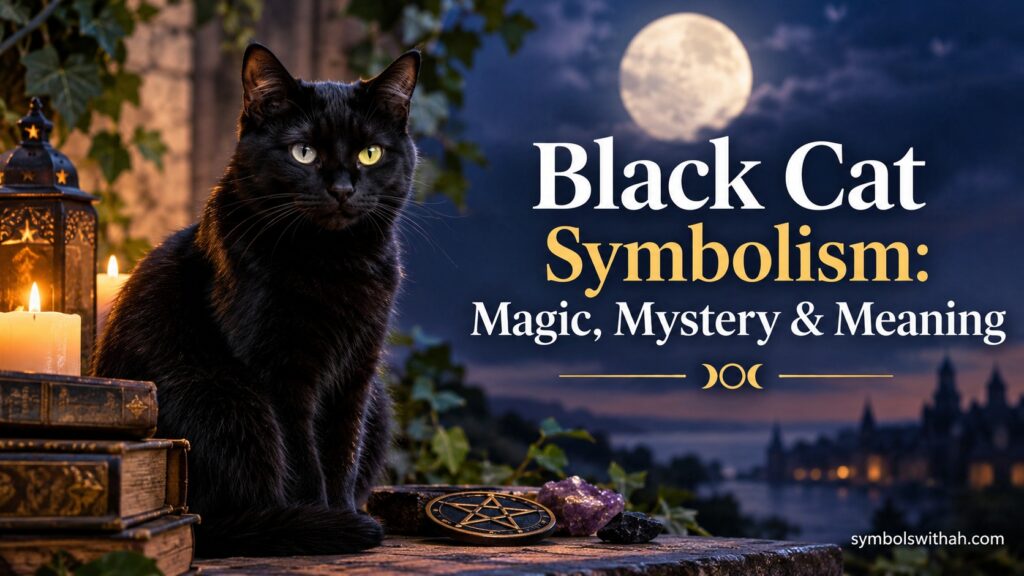

Black cats have fascinated people for centuries. Black cat symbolism meaning l magic and mystery of black cats connects ancient beliefs, folklore, Halloween traditions, spiritual ideas, and modern culture.
In the United States, black cats often appear beside witches, pumpkins, moons, and haunted houses. However, their story is much broader than Halloween. Different cultures have viewed cats as protective, lucky, mysterious, sacred, or supernatural.
The meaning also depends on context. A black cat crossing a road can feel very different from a black cat appearing in a tattoo or home decoration. Today, many people also use black cats to express independence, intuition, elegance, and a love of the mysterious.
Read More: Period on Full Moon Spiritual Meaning and Symbolism
Quick Answer
Black cat symbolism meaning l magic and mystery of black cats often centers on mystery, independence, intuition, protection, magic, and transformation in American culture. Historically, black cats have carried both positive and negative meanings, depending on the culture and period.
TL;DR
- Black cats symbolize mystery, independence, intuition, and magic.
- Ancient Egypt connected cats with protection and the goddess Bastet.
- Medieval European folklore helped create darker black-cat associations.
- American Halloween culture strongly links black cats with witches.
- Some traditions view black cats as signs of luck or prosperity.
- Modern tattoos and social media often reclaim black cats positively.
What Does a Black Cat Symbolize?
The Main Symbolic Ideas
A black cat can carry several meanings at once. Its dark coat naturally creates associations with night, secrecy, and the unknown.
At the same time, cats are known for independence and alertness. Therefore, the symbol can suggest a person who trusts their instincts and follows their own path.
Common modern meanings include:
• Mystery: Something hidden, unknown, or difficult to understand.
• Independence: Freedom, self-direction, and confidence in personal choices.
• Intuition: Awareness of subtle signals and feelings.
• Magic: Connection with folklore, fantasy, witchcraft, and the supernatural.
• Protection: Alertness and watchfulness against perceived threats.
• Transformation: Moving through uncertainty toward a new stage of life.
These meanings aren’t universal. Symbolism changes according to history, culture, personal experience, and visual context.
How Black Cat Symbolism Looks and Appears
The Visual Language of the Black Cat
The black cat is usually shown with a sleek dark coat, bright eyes, pointed ears, and a curved tail. These details can make the animal appear elegant, mysterious, playful, or intimidating.
Posture also changes the message. A relaxed cat may suggest confidence, while an arched back can create a defensive or supernatural mood.
In art and decoration, black cats frequently appear with moons, stars, candles, pumpkins, witches’ hats, or mystical objects. These combinations strengthen themes of night and magic.
Why the Color Black Matters
Black has its own symbolic history. In American culture, it can suggest sophistication, power, mourning, secrecy, formality, or the unknown.
When combined with a cat, those meanings become more specific. The result often feels mysterious without necessarily being negative.
Black Cats in Ancient Egypt
Cats, Protection, and Bastet
Ancient Egyptian culture provides one of the clearest examples of positive feline symbolism.
The goddess Bastet was represented as a cat or a woman with a cat’s head. She was associated with protection, fertility, prosperity, and the peaceful side of feline power.
Cats were also important household animals. Their ability to control rodents made them valuable in farming communities.
Museum evidence shows that cats were represented in sculptures, offerings, and sacred contexts. Some cat figures were even made to contain mummified cats.
Did Ancient Egyptians Specifically Worship Black Cats?
The popular claim that Egyptians specifically worshiped black cats is too simple.
Their religious importance centered on cats as animals associated with divine powers. The modern idea of the uniquely mystical black cat developed much later.
That distinction matters because ancient Egyptian cat symbolism was broader than modern Halloween imagery.
How Black Cats Became Associated With Magic
Medieval European Folklore
The darker reputation of black cats developed strongly in medieval Europe.
By the medieval period, some Christian European traditions connected cats with evil and the Devil. Later folklore increasingly linked cats with people accused of witchcraft.
This helped create the image of the cat as a witch’s supernatural companion.
The idea of the familiar became especially important in witchcraft folklore. A familiar was believed to be a supernatural helper associated with a witch.
From Folklore to the Modern Witch Image
Over time, stories about witches and cats became common in European storytelling.
When these traditions crossed the Atlantic, they influenced American ideas about witches and supernatural animals. The black cat eventually became one of the easiest visual symbols for magical mystery.
However, this history reflects folklore and persecution. It shouldn’t be treated as evidence that cats or particular people were actually supernatural.
Black Cat Symbolism in the United States
From Folklore to American Culture
In the United States, black cats became especially connected with Halloween.
The Library of Congress notes that the association between black cats, witches, and spooky Halloween imagery developed from older European traditions.
American Halloween art helped make this imagery familiar. Early American posters and printed materials also used black cats in imaginative and theatrical ways.
For example, a 1895 American poster for The Black Cat featured a black cat alongside a woman and a crescent moon.
Black Cats as Halloween Symbols
Today, black cats commonly appear alongside:
• Pumpkins and jack-o’-lanterns.
• Witches and pointed hats.
• Full moons and stars.
• Haunted houses and graveyards.
• Bats, spiders, and other Halloween imagery.
This doesn’t mean every American sees black cats as unlucky. Instead, Halloween has turned the animal into a playful symbol of spooky atmosphere.
Are Black Cats Good Luck or Bad Luck?
Why the Meaning Changes
There isn’t one universal meaning for a black cat.
Some American folklore treats a black cat crossing your path as an unlucky sign. Other traditions associate black cats with good fortune, prosperity, or protection.
The difference shows how symbolism depends on cultural context.
| Context | Meaning in the USA | Common Association | Notes |
| Halloween | Mystery and supernatural themes | Witches and magic | Mostly festive today |
| Crossing a path | Traditional bad-luck superstition | Omen or warning | Folkloric rather than factual |
| Tattoo | Independence or mystery | Personal identity | Meaning varies by design |
| Home decor | Elegance and mystique | Gothic or cozy style | Often playful |
| Spiritual art | Intuition and protection | Magic and transformation | Personal interpretation |
A Black Cat Isn’t Inherently Lucky or Unlucky
A cat’s coat color doesn’t determine what happens to a person.
Instead, the superstition gives ordinary events symbolic meaning. A person who believes in omens may interpret the encounter differently from someone who sees only an animal walking nearby.
That difference is important when discussing symbolism responsibly.
Black Cat Spiritual Meaning
Intuition and the Unknown
In modern spiritual discussions, black cats are often connected with intuition.
Their nighttime activity and quiet movements make them natural symbols of things that aren’t immediately visible. Therefore, some people interpret seeing one as a reminder to pay attention to subtle feelings.
Others associate black cats with protection and energetic boundaries. These interpretations belong to spiritual symbolism rather than established scientific evidence.
Transformation and Inner Awareness
Black cats can also symbolize moving through uncertainty.
Their dark color may represent the unknown, while the cat itself represents awareness and adaptability. Together, those qualities can create a powerful metaphor for personal change.
For some people, the symbol means:
• Trust your instincts when circumstances feel unclear.
• Stay observant before making an important decision.
• Protect your personal boundaries and private space.
• Accept uncertainty without immediately assuming something negative.
Black Cats in Different Cultures
Scotland and Japan
Black cats haven’t always represented misfortune.
Historical accounts note that some traditions in Scotland and Japan associate black cats with prosperity or good fortune.
This creates an important contrast with the American bad-luck superstition.
Why Cultural Differences Matter
A symbol doesn’t carry a single permanent definition.
For example, one culture may see darkness as threatening. Another may associate darkness with mystery, protection, or hidden strength.
Black cat symbolism demonstrates this perfectly. The same animal can represent danger in one tradition and prosperity in another.
What Does Seeing a Black Cat Mean?
Everyday Meaning
Seeing a black cat doesn’t automatically carry a supernatural message.
For many people, the encounter simply means a cat happened to cross their path. However, people who enjoy symbolism may use the moment for personal reflection.
The most useful interpretation depends on the surrounding situation.
Symbolic Questions to Consider
If the encounter feels meaningful to you, consider:
• What were you thinking about immediately beforehand?
• Did the cat appear during a major transition?
• What emotion did you experience during the encounter?
• Does the black cat represent something personal to you?
• Are you interpreting the event through family or cultural folklore?
These questions keep the interpretation personal rather than presenting folklore as fact.
Black Cat Psychology and Emotional Meaning
Why Black Cats Feel Mysterious
Humans naturally respond to visual contrasts.
A black cat moving through darkness can be harder to see than a lighter animal. Bright eyes against dark fur also create a dramatic visual effect.
That combination can produce feelings of curiosity, surprise, alertness, or mystery.
Independence and Personality
Cats already carry strong cultural associations with independence.
They often appear self-directed and selective about social interaction. Consequently, a black cat can symbolize someone who values freedom and personal boundaries.
This is one reason black cat imagery works well for modern identity and self-expression.
Black Cats in Tattoos and Personal Symbolism
Popular Black Cat Tattoo Meanings
Black cat tattoos can represent very different ideas.
Some people choose them because they love cats. Others connect them with Halloween, witchcraft aesthetics, personal independence, or a fascination with mystery.
Common tattoo interpretations include:
• Independence and self-confidence.
• Intuition and inner awareness.
• Protection from negativity.
• Love of the mysterious or unconventional.
• Connection with a beloved pet.
• Personal transformation after a difficult period.
Design Changes the Meaning
A black cat with a crescent moon feels mystical.
A playful black cat may represent humor or affection. Meanwhile, a realistic portrait can honor a specific pet.
Therefore, the surrounding imagery often matters as much as the cat itself.
Black Cats in Social Media, Fashion, and Decor
Modern Digital Symbolism
The black cat has found a strong place in digital culture.
The black cat emoji, 🐈⬛, was added in Emoji 13.0 in 2020. It commonly carries associations with magic, superstition, Halloween, and fantasy.
On social platforms, people may use black cat imagery to communicate a mysterious, playful, gothic, or independent personality.
Home Decor and Fashion
Black cat designs also appear in:
• Halloween decorations and seasonal displays.
• Gothic and alternative fashion.
• Posters, prints, mugs, and clothing.
• Cozy autumn and nighttime-themed decor.
• Jewelry and tattoo-inspired artwork.
Modern use often separates the black cat from older fears. Today, the symbol can be stylish, cute, humorous, or mysterious.
Black Cats and Halloween in America
From Fear to Festive Symbol
Halloween played a major role in preserving black cat imagery in American popular culture.
The Library of Congress documents early American Halloween materials featuring devils, witches, pumpkins, and black cats.
Over time, these images became part of a recognizable seasonal visual language.
Today, many people encounter black cat symbolism mainly during October. The association is often theatrical rather than literal.
Why the Symbol Still Works
Black cats combine several classic Halloween ideas.
They are nocturnal animals with striking silhouettes. Their connection to old folklore also gives them a long history of mystery.
That makes them visually effective for Halloween without requiring belief in supernatural explanations.
Black Cat Superstitions and Misunderstandings
The Crossing-Your-Path Belief
One of the best-known black cat superstitions says that crossing paths with one brings bad luck.
This belief developed from older European ideas about cats, witchcraft, and supernatural danger.
However, it isn’t a universal belief. Other traditions have assigned positive meanings to black cats.
The Myth That Black Cats Are Naturally Ominous
A black coat doesn’t make a cat more dangerous or mysterious in any biological sense.
The supernatural reputation comes from human storytelling and cultural associations. In modern America, many people recognize the stereotype while rejecting it.
The ASPCA has also highlighted unfair black-cat superstitions while promoting these cats as ordinary companion animals.
How Black Cat Meaning Has Changed Over Time
A Simple Symbolic Timeline
Black cat symbolism has shifted dramatically.
Ancient Egypt: Cats could represent divine protection, fertility, prosperity, and household power.
Medieval Europe: Some Christian folklore connected cats with the Devil and supernatural danger.
Early American culture: European witchcraft traditions crossed the Atlantic and became part of American folklore.
19th-century America: Black cats appeared in posters, literature, illustrations, and popular entertainment.
Modern America: Halloween, fantasy, gothic fashion, tattoos, social media, and pet culture have broadened the symbol.
From Fear to Personal Expression
The modern black cat is much more flexible.
It can represent darkness without evil, mystery without fear, and independence without isolation.
That shift reflects a wider cultural change. People increasingly use old symbols as personal expressions rather than fixed supernatural rules.
What Black Cats Represent in Modern Life
A Symbol With Many Layers
Today, black cat symbolism can represent different parts of identity.
For one person, it may mean a beloved pet. For another, it may express independence or an attraction to gothic aesthetics.
For someone interested in spirituality, it may represent intuition or protection. Meanwhile, Halloween enthusiasts may simply see it as a classic seasonal image.
The Meaning Depends on Context
A symbol becomes clearer when you examine its surroundings.
A black cat beside a pumpkin usually signals Halloween. A black cat beside a moon may suggest mystery or magic.
A black cat sitting peacefully in a home may communicate companionship instead.
FAQs
1. What is the spiritual meaning of a black cat?
A black cat can symbolize intuition, mystery, protection, independence, and transformation. These meanings come from spiritual and cultural interpretation rather than scientific evidence.
2. Is seeing a black cat good luck or bad luck?
Different traditions interpret black cats differently. Some American folklore connects them with bad luck, while other traditions associate them with prosperity or good fortune.
3. Why are black cats associated with witches?
Medieval and early modern European folklore increasingly connected cats with witchcraft. Stories about witches having supernatural animal companions helped establish the familiar black-cat image.
4. What did black cats symbolize in ancient Egypt?
Ancient Egyptian religion associated cats with divine protection and especially with Bastet. Cats were represented in sacred art and were used in religious offerings.
5. What does a black cat tattoo symbolize?
A black cat tattoo can represent independence, mystery, intuition, protection, transformation, or affection for a particular cat. The surrounding tattoo design often changes the interpretation.
6. Why are black cats associated with Halloween?
European folklore connected black cats with witchcraft and supernatural danger. American Halloween traditions later incorporated that imagery alongside witches, devils, pumpkins, and other spooky symbols.
Conclusion
Black cats have carried remarkably different meanings across history. They have represented protection and prosperity in ancient Egypt, while later European folklore associated them with witchcraft and supernatural danger.
In modern America, black cat symbolism meaning l magic and mystery of black cats includes far more than bad luck. The symbol can represent independence, intuition, elegance, protection, transformation, Halloween, or simply affection for a beautiful animal.
Ultimately, symbolism depends on context. A black cat can be mysterious without being frightening and magical without being supernatural. Its long history gives it depth, while modern culture continues to give the symbol new meanings.