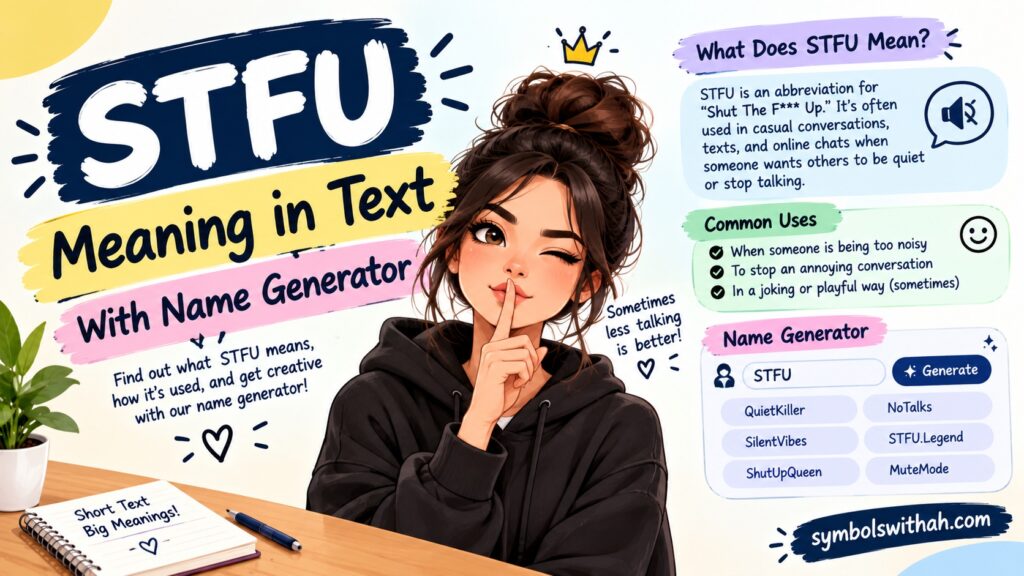

Seeing “STFU” in a text can be confusing, especially when the sender is someone you know well. Is it an insult? A joke? A shocked reaction? Or are they genuinely telling you to stop talking?
The basic STFU meaning in text is straightforward: “Shut the fuck up.” It is a vulgar, informal initialism used especially in texting, social media, and other online conversations. Collins Dictionary classifies it as slang and identifies it as an abbreviation of the taboo expression “shut the fuck up.” (Collins Dictionary)
However, the literal definition does not explain every real-world use. Close friends sometimes type “STFU 😂” after hearing surprising or exciting news, using it more like “No way!” or “You’re kidding!” In an argument, though, “STFU.” can be a blunt command intended to end the conversation. Context, relationship, punctuation, emojis, and the words around it all matter.
Read More: SN Meaning in Text: What Does “SN” Mean in a Text?
Quick Answer: What Does STFU Mean in Text?
STFU stands for “Shut the fuck up.”
In its literal sense, it tells someone to stop talking or be quiet. It is considered vulgar and highly informal. Wiktionary classifies STFU as internet slang, text-messaging language, and a vulgar initialism. (Wiktionary)
However, texting has given the expression another practical use. Among people who already share a casual relationship, STFU can express shock, disbelief, excitement, or playful teasing without literally demanding silence.
For example:
Friend: “I just met my favorite actor.”
You: “STFU 😭”
Here, the likely meaning is closer to “No way! Are you serious?”
Compare that with:
“STFU. I’m trying to talk.”
That version is much more likely to be a genuine command.
| Text | Likely interpretation | Tone |
| STFU | Stop talking | Direct |
| stfu? | Seriously? / Explain | Context-dependent |
| STFU! | Be quiet | Strong |
| STFU?! | No way! / What?! | Shocked |
| STFU 😂 | You’re kidding! | Playful |
| STFU 😭 | I can’t believe this | Dramatic/playful |
| STFU. Leave me alone. | Stop talking to me | Hostile |
The important point is simple: STFU has a fixed core meaning, but its conversational intent can change.
What Does STFU Stand For?
STFU is made from the first letters of “Shut the Fuck Up.”
- S = Shut
- T = The
- F = Fuck
- U = Up
It is therefore commonly described as an initialism, rather than an ordinary English word. The letters are normally read separately instead of being pronounced as a single word. (Wiktionary)
The F-word is what gives the expression much of its force. Saying “be quiet” and saying “shut the fuck up” communicate a similar basic instruction, but the second version carries substantially more profanity and emotional intensity.
That difference matters in texting because written messages lack vocal tone and facial expression.
A person might intend:
“I’m joking, don’t take that seriously.”
But the recipient may simply see:
“STFU.”
Without additional context, the second person has little information about the sender’s intention.
What Is the Main STFU Meaning in Texting?
The most direct meaning is “stop talking” or “be quiet.”
It is an emphatic command. Dictionary.com notes that STFU is commonly used when someone is angry or upset, particularly in online communication. (Dictionary.com)
STFU as a Literal Command
Consider this exchange:
Person A: “You’re not listening to me.”
Person B: “STFU. I’m done arguing.”
Here, the abbreviation is not playful. Person B is telling Person A to stop talking.
Another example:
“STFU and listen for a second.”
The surrounding wording makes the intention especially clear.
STFU About a Particular Topic
Someone can also use STFU to reject a repeated subject.
“STFU about my grades already.”
This means:
“Stop talking about my grades.”
The expression remains aggressive because it combines a command with profanity.
STFU During a Conflict
Arguments are one of the situations where STFU is most likely to be interpreted literally.
For example:
“You don’t know what you’re talking about.”
“STFU.”
There is little playful context here. The abbreviation functions as a verbal shutdown.
That does not necessarily mean the sender wants to end the relationship. It does mean the message itself is confrontational.
Can STFU Be Used as a Joke?
Yes, but context is crucial.
People sometimes use strong language with friends as exaggerated reactions. In those situations, STFU can resemble the spoken expression “Shut up!” when someone says it after hearing unbelievable news.
For example:
Friend: “I got backstage passes.”
You: “STFU! Seriously?!”
The intended message may be:
“No way! Seriously?”
The sender is not necessarily demanding silence.
STFU as Playful Disbelief
A friend might write:
“STFU 😂 You actually did it?”
The expression can communicate amazement rather than hostility.
STFU as Excitement
Consider:
“STFU 😭 You got tickets?!”
The sender may be genuinely excited for the other person.
STFU as Friendly Teasing
Another example:
“STFU, you’re so dramatic 😂.”
Between close friends, this may function as playful teasing.
Still, STFU is never automatically friendly. The relationship has to support that interpretation.
A stranger who sends the exact same words may intend an insult.
Is STFU Rude or Offensive?
STFU is inherently vulgar, but whether it feels rude depends on how it is used.
Collins Dictionary describes the underlying expression as a taboo expression, while Wiktionary explicitly labels the abbreviation vulgar. (Collins Dictionary)
That makes STFU much stronger than:
- “Please be quiet.”
- “Can you stop?”
- “Give me a second.”
- “Let’s pause.”
- “I’d rather not discuss this.”
Why STFU Can Be Offensive
The phrase can feel insulting because it:
- Commands another person to stop speaking.
- Contains strong profanity.
- Can dismiss someone’s opinion.
- May escalate an argument.
- Can sound contemptuous without vocal context.
- May be inappropriate around people who dislike profanity.
The recipient also matters.
A close friend may laugh at:
“STFU 😂”
A coworker might not react the same way.
When STFU Is More Likely to Be Taken Seriously
Watch for these clues:
- The conversation is already tense.
- The sender uses a period rather than a playful emoji.
- Other hostile language appears.
- The sender says “leave me alone.”
- The sender repeats STFU.
- The conversation involves an accusation or disagreement.
For example:
“STFU. Don’t message me again.”
There is little ambiguity here.
When STFU May Be Playful
A playful interpretation becomes more plausible when:
- You are close friends.
- The conversation is already humorous.
- The sender reacts to surprising news.
- Laughing or crying emojis appear.
- The sender follows it with an excited question.
For example:
“STFU 😂 You met her at the airport?!”
The surrounding wording points toward disbelief rather than hostility.
What Does STFU Mean With Different Punctuation?
Punctuation can offer useful clues, although it never provides a perfect translation.
“stfu”
Lowercase stfu often looks casual and conversational.
However, lowercase writing does not automatically mean the sender is friendly.
“STFU”
Capitalized STFU may appear stronger because the abbreviation is visually prominent.
Still, some people capitalize every abbreviation they use.
“STFU!”
An exclamation mark can increase the apparent intensity.
It may represent genuine anger:
“STFU!”
But it can also appear in an excited reaction:
“STFU! You won?!”
“STFU?!”
This combination often suggests surprise or disbelief.
“STFU?! You actually quit?”
The sender may be asking whether the information is real.
“STFU 😂”
The laughing emoji can make the phrase feel playful.
“STFU 😂 You’re actually serious?”
Even so, emojis are clues rather than guarantees.
What Does STFU Mean With Emojis?
Emojis can dramatically change how a short message feels.
| Message | Possible meaning |
| STFU 😂 | You’re kidding / That’s hilarious |
| STFU 😭 | I can’t believe this |
| STFU 💀 | That’s unbelievably funny or shocking |
| STFU 🙄 | I’m annoyed |
| STFU 😳 | I’m shocked |
| STFU ❤️ | Potentially teasing among close people |
| STFU. | More blunt or serious |
The key word is possible.
There is no universal emoji dictionary that determines exactly what the sender intended. Someone can use 😂 while still being irritated, just as someone can use no emoji while joking.
Read the entire exchange.
STFU Meaning in Different Conversations
The same abbreviation can behave differently across social situations.
STFU Between Close Friends
Close friends often share a communication style that includes sarcasm, profanity, and exaggerated reactions.
For example:
“I just spent $300 on shoes.”
“STFU 😂”
This might mean:
“You actually did that? That’s crazy.”
The friendship makes playful interpretation more plausible.
STFU Between Strangers
With strangers, there is less shared context.
If someone comments:
“STFU.”
on your post, it is much safer to read the message as hostile unless other context clearly suggests humor.
STFU During an Argument
During conflict, STFU can shut down dialogue rather than solve the disagreement.
“You never listen.”
“STFU.”
The second person is not providing clarification. They are rejecting the conversation itself.
STFU in a Romantic Relationship
Partners may sometimes use strong language playfully.
For example:
“You’re way too cute today.”
“STFU 😂”
That could be playful embarrassment.
However, during a serious disagreement:
“We need to talk about what happened.”
“STFU.”
the same abbreviation can feel dismissive and hostile.
There is no special romantic definition of STFU. The relationship only changes the context in which the abbreviation is interpreted.
STFU in a Group Chat
Group chats create another interesting use.
Someone might say:
“STFU 😭 I’m literally crying.”
Here, the abbreviation can work as an exaggerated reaction to something funny.
Alternatively:
“STFU. We’re trying to plan this.”
could be a genuine request for someone to stop interrupting.
STFU in Gaming Chats
Gaming conversations often move quickly, so short commands are convenient.
For example:
“STFU, I can hear footsteps.”
Here, the player literally wants teammates to stop talking so they can listen for an in-game sound.
The context makes the meaning unusually clear.
STFU Meaning on WhatsApp, Instagram, TikTok, Snapchat, and Discord
STFU does not gain a completely different definition on each platform.
The core phrase remains the same. What changes is the communication environment.
STFU on WhatsApp
You might see it in:
- One-to-one chats
- Friend groups
- Gaming groups
- Casual conversations
- Arguments
A WhatsApp message such as “STFU 😂” may be playful between friends, while “STFU. Leave me alone.” is much more serious.
STFU on Instagram
Instagram users may use STFU in:
- Direct messages
- Story replies
- Comment sections
- Group conversations
A comment like:
“STFU 😂”
can function as a humorous reaction to a friend’s post.
But a standalone “STFU” directed at a stranger is much more likely to be perceived as hostile.
STFU on TikTok
TikTok comments frequently rely on compressed language and exaggerated reactions.
Someone might comment:
“STFU 😭 this is actually insane.”
The likely meaning is not literally “stop talking.”
Instead, it can express overwhelming surprise or amusement.
STFU on Snapchat
Snapchat’s quick-message style makes abbreviations especially convenient.
Friends might exchange:
“STFU 😂”
after sharing unexpected gossip or news.
Again, the friendship and previous conversation provide the missing tone.
STFU on Discord
Discord conversations can range from gaming to community discussions.
A message such as:
“STFU, we’re listening for footsteps.”
is a literal request for silence.
A message such as:
“STFU 😭 you actually won?”
is more likely a reaction.
Real Examples of STFU in Text
These examples show why context matters so much.
| Situation | Example | Likely meaning |
| Genuine anger | “STFU. I’m done arguing.” | Stop talking |
| Frustration | “STFU about that already.” | Stop bringing it up |
| Surprise | “STFU! You actually won?” | No way! |
| Excitement | “STFU 😭 You got tickets?!” | That’s unbelievable |
| Friendly teasing | “STFU, you’re ridiculous 😂” | Playful criticism |
| Gaming | “STFU, we’re trying to hear footsteps.” | Be quiet |
| Argument | “STFU and listen.” | Hostile command |
| Funny story | “STFU 💀 That’s hilarious.” | I can’t believe that |
| Unexpected news | “STFU?! You’re moving?” | Seriously? |
| Stranger online | “STFU.” | Likely hostile |
How to Tell Whether Someone Means STFU Literally
When the message is ambiguous, don’t interpret the four letters by themselves.
Look at What Came Before It
Suppose someone writes:
“I just met my favorite celebrity.”
Then the reply is:
“STFU!!! 😭”
Surprise is a reasonable interpretation.
Now consider:
“You’re wrong, as usual.”
“STFU.”
The second exchange is clearly more confrontational.
Consider Your Relationship
Ask yourself:
Would this person normally joke with me using profanity?
If yes, playful use becomes more plausible.
If you barely know them, assume less familiarity.
Examine the Rest of the Message
Compare:
“STFU 😂 You actually did that?”
with:
“STFU. Don’t contact me again.”
The surrounding words dramatically change the interpretation.
Consider the Emotional Temperature
If the conversation has already become heated, STFU is more likely to be literal.
If everyone is joking, exaggerated use is more plausible.
This simple approach prevents a common mistake: treating every STFU as either completely hostile or completely harmless.
How Should You Respond to “STFU?”
Your response should match the situation rather than automatically matching the profanity.
If They Are Clearly Joking
You can answer playfully:
- “😂 You wish.”
- “Make me.”
- “I knew you’d say that.”
- “Okay, okay!”
- “I’m just getting started.”
- “You can’t handle the truth 😂.”
If You Are Unsure
A calm clarification can prevent unnecessary drama.
“Are you joking, or are you actually upset?”
Or:
“Did you mean that seriously?”
This works particularly well when the relationship matters.
If They Are Being Rude
You can establish a boundary without escalating.
“You can disagree with me without talking to me like that.”
Or:
“If you want to discuss it, I’m willing to talk respectfully.”
If You Want to End the Conversation
Sometimes the cleanest response is a pause.
“I think it’s better if we continue this later.”
You do not have to answer profanity with more profanity.
What Is a Polite Alternative to STFU?
There are many ways to communicate the same basic boundary without using profanity.
| Situation | Better alternative |
| Need quiet | “Could you keep it down?” |
| Need someone to stop | “Please stop.” |
| Need a pause | “Give me a second.” |
| Don’t want to discuss something | “I’d rather not talk about this.” |
| During an argument | “Let’s take a break.” |
| Someone keeps messaging | “Please don’t message me right now.” |
| Need someone to listen | “Can you let me finish?” |
| Casual joking | “Stop 😂” |
The right alternative depends on your goal.
If you genuinely need silence, “Could you keep it down?” is clear.
If you are angry, “I need some space right now” communicates the boundary without adding another insult.
Is STFU Appropriate in Professional Communication?
Generally, no.
STFU is vulgar and strongly informal. Collins Dictionary specifically identifies it as slang associated with social media and text messages. (Collins Dictionary)
Using it in a workplace can create unnecessary friction.
Avoid it in:
- Business emails
- Messages to clients
- Job applications
- Customer service
- Academic communication
- Messages to managers
- Formal complaints
- Professional networking
Compare these two versions:
Informal and aggressive:
“STFU about this already.”
Professional:
“I’d prefer not to continue discussing this right now.”
The second message still establishes a boundary. It simply avoids profanity and personal hostility.
Why Formal Language Helps
Professional communication often requires precision without unnecessary emotional heat.
A phrase such as:
“Could we pause this discussion and return to it later?”
gives the recipient a clear next step.
By contrast:
“STFU.”
only communicates rejection.
That difference can matter when the conversation has consequences.
STFU vs. Similar Texting Abbreviations
Several internet abbreviations resemble STFU, but their meanings differ.
STFU vs. STHU
STFU = Shut the fuck up.
STHU = Shut the hell up.
Both tell someone to stop talking, but STFU contains stronger profanity. Wiktionary lists STHU as a synonym of STFU. (Wiktionary)
STFU vs. GTFO
These are not interchangeable.
STFU tells someone to stop talking.
GTFO means “Get the fuck out.”
So:
STFU = Stop talking.
GTFO = Leave.
STFU vs. STFD
STFD is sometimes used as a euphemistic variation of STFU, with people replacing the profanity with a less offensive phrase.
These softened forms are not as universally established as STFU itself, so they should not be treated as exact equivalents in every conversation.
STFU vs. WTF
WTF generally expresses surprise, confusion, frustration, or disbelief.
STFU either tells someone to stop talking or functions as an exaggerated reaction such as “No way!”
For example:
“WTF happened?”
asks what happened.
“STFU, you actually won?”
reacts to surprising information.
STFU vs. LOL
These serve entirely different purposes.
LOL relates to laughter.
STFU is a command or emphatic reaction.
Is STFU a Slang Word or an Acronym?
STFU is best described as an initialism used in internet and text-message slang.
Wiktionary categorizes it as internet slang, text messaging, and a vulgar initialism. (Wiktionary)
The distinction is useful because people sometimes call every shortened internet expression an acronym.
An initialism is formed from initial letters and is generally pronounced letter by letter.
For STFU, people typically say the individual letters rather than pronounce them as a normal English word.
A Brief History of STFU
The full expression “shut up” is much older than modern texting. The abbreviation STFU belongs to the later world of digital communication.
Online communities increasingly developed compact expressions as chat rooms, forums, instant messaging, and texting became widespread.
The exact origin of the internet abbreviation is difficult to pin to one person or one platform. Know Your Meme documents an early online example from 1999, while also noting complications caused by another historical meaning of STFU: the Southern Tenant Farmers Union. (Know Your Meme)
That distinction is important.
The modern internet meaning should not be confused with the historical U.S. organization that used the same four letters. Wiktionary also records that separate historical expansion. (Wiktionary)
Today, the slang meaning is familiar across texting, social media, online communities, and gaming.
Common Mistakes When Interpreting STFU
Short messages invite quick assumptions. Those assumptions can be wrong.
Assuming Every STFU Is an Insult
A close friend may use it as exaggerated disbelief.
“STFU 😂 That’s actually amazing.”
The speaker may be expressing excitement.
Assuming Every STFU Is a Joke
The opposite mistake is just as important.
“STFU. I’m serious.”
That is not playful.
Ignoring the Relationship
A friend’s profanity can have a different social meaning from a stranger’s profanity.
Looking Only at Capitalization
STFU does not automatically mean someone is shouting.
Some people capitalize abbreviations routinely.
Treating an Emoji as Proof
An emoji provides a clue, not a guarantee.
Someone can be genuinely annoyed while still using an emoji.
Assuming It Has a Secret Romantic Meaning
STFU has no standard romantic definition.
If someone uses it while flirting, the flirtatious meaning comes from the broader conversation.
Is STFU Flirty?
STFU is not inherently flirty.
Someone may use it during a playful or romantic conversation, but the abbreviation itself does not indicate attraction.
For example:
“You’re seriously the cutest person I’ve ever met.”
“STFU 😂”
The second person may be playfully embarrassed.
But that does not make STFU a romantic abbreviation.
The actual signal comes from the surrounding conversation, relationship, and behavior.
What Does STFU Mean From a Girl?
The meaning does not change simply because a woman sends it.
STFU still means “shut the fuck up.”
The important clues are:
- What she was responding to
- Whether you are friends
- Whether the conversation was playful
- Whether an argument was happening
- Which emojis were used
- What she said before and after STFU
For example:
“STFU 😂 You actually said that?”
can sound playful.
Meanwhile:
“STFU. I’m done talking.”
is much more serious.
Gender does not provide enough information to determine the tone.
What Does STFU Mean From a Guy?
The same principle applies when a man sends it.
There is no separate male-specific definition of STFU.
A guy might use it:
- Literally
- As a joke
- To express disbelief
- During an argument
- As friendly teasing
- As an excited reaction
Context is more informative than the sender’s gender.
When Should You Avoid Using STFU?
Because STFU contains strong profanity, there are situations where using it is unnecessarily risky.
Avoid it when:
- You are speaking to someone you barely know.
- You are communicating professionally.
- The topic is sensitive.
- You are already in a serious argument.
- You are dealing with a customer or client.
- You are speaking to a teacher or manager.
- You are unsure whether the other person appreciates profanity.
- You want to establish a respectful boundary.
A useful rule is:
If the relationship does not already support strong joking language, choose a clearer and calmer phrase.
Four letters may be quick to type, but they can carry considerable social weight.
A Practical Case Study: One STFU, Three Different Meanings
Consider the exact same message:
“STFU?”
Its meaning can shift dramatically depending on context.
Case One: Genuine Confusion
Alex: “I’m not going to the party anymore.”
Jordan: “STFU?”
Here, Jordan may be asking:
“What? Why?”
Case Two: Playful Surprise
Alex: “I just met Taylor Swift.”
Jordan: “STFU 😭”
Here, Jordan probably means:
“No way! Seriously?”
Case Three: Hostile Reaction
Alex: “You need to admit you were wrong.”
Jordan: “STFU.”
Here, the abbreviation is much more likely to function as a hostile command.
The four letters stayed exactly the same. The context changed everything.
That is why dictionary definitions alone cannot always explain what someone meant in a real conversation.
STFU Meaning at a Glance
| Question | Answer |
| What does STFU mean? | Shut the fuck up |
| What does STFU mean in text? | Usually a blunt command to stop talking |
| Is STFU slang? | Yes |
| Is STFU vulgar? | Yes |
| Is STFU always angry? | No |
| Can STFU be playful? | Yes, especially among close friends |
| Can STFU be offensive? | Yes |
| Is STFU professional? | Generally no |
| Can STFU mean “no way”? | In some casual contexts, yes |
| Is STFU flirty? | Not inherently |
| Does gender change the definition? | No |
| What is a polite alternative? | “Please stop,” “Give me a moment,” or “Could you let me finish?” |
FAQs About STFU Meaning in Text
What does STFU mean in text?
STFU means “shut the fuck up.” It is a vulgar internet and texting initialism that can literally tell someone to stop talking. In casual conversations, it can also express surprise or disbelief. (Collins Dictionary)
What does STFU stand for?
STFU stands for “Shut the Fuck Up.” The letters come from the first letter of each word.
Is STFU rude?
It can be very rude, especially when used literally or during an argument. It contains profanity and directly commands another person to stop talking.
Is STFU always meant seriously?
No. Close friends sometimes use it as exaggerated slang for “No way!”, “You’re kidding!”, or “I can’t believe you!”
Can STFU mean “no way”?
Yes, in some informal conversations.
For example:
“I met my favorite singer today.”
“STFU 😭”
Here, the likely meaning is “No way! Really?”
What does STFU mean from a girl?
It has the same basic meaning regardless of gender: “Shut the fuck up.” Context determines whether the phrase is playful, surprised, annoyed, or hostile.
What does STFU mean from a guy?
The definition is also the same. The surrounding conversation matters more than the sender’s gender.
Is STFU flirty?
Not by itself. A person can use STFU jokingly during flirtation, but STFU is not inherently a flirting abbreviation.
What does STFU mean on Snapchat?
It generally means the same thing as elsewhere: “Shut the fuck up.” On Snapchat, friends may also use it playfully to express shock or disbelief.
What does STFU mean on TikTok?
On TikTok, STFU can appear in comments and replies. Depending on context, it may be a genuine insult or an exaggerated reaction to something funny, surprising, or unbelievable.
How should I respond when someone says STFU?
First, consider whether they are joking.
If they are clearly playful, you can respond casually:
“😂 You wish.”
If the message seems hostile, stay calm:
“You can disagree with me without speaking to me like that.”
What is a polite alternative to STFU?
Depending on the situation, try:
- “Please stop.”
- “Could you give me a moment?”
- “Can you let me finish?”
- “I’d rather not discuss this.”
- “Let’s take a break.”
Is STFU appropriate at work?
Generally, no. It is vulgar and strongly informal. A professional alternative such as “Could we pause this conversation?” communicates the boundary without profanity.
Conclusion: Understanding STFU Meaning in Text
The STFU meaning in text is fundamentally “Shut the fuck up.” It is an informal, vulgar initialism used to tell someone to stop talking or be quiet. Collins Dictionary and Wiktionary both identify the expression as slang and connect it specifically with texting and online communication. (Collins Dictionary)
Yet real conversations are rarely that simple. Among close friends, “STFU 😂” can express disbelief, excitement, or playful teasing. During an argument, “STFU.” can be a genuinely hostile command. Punctuation, emojis, relationship, and the preceding message can all provide useful clues.
The safest approach is to read the whole conversation rather than the abbreviation alone. If the sender is joking, a playful reply may fit. If the message feels hostile, a calm boundary is usually more useful than escalating the exchange.
In short, STFU has one clear core definition, but context determines how that definition lands.