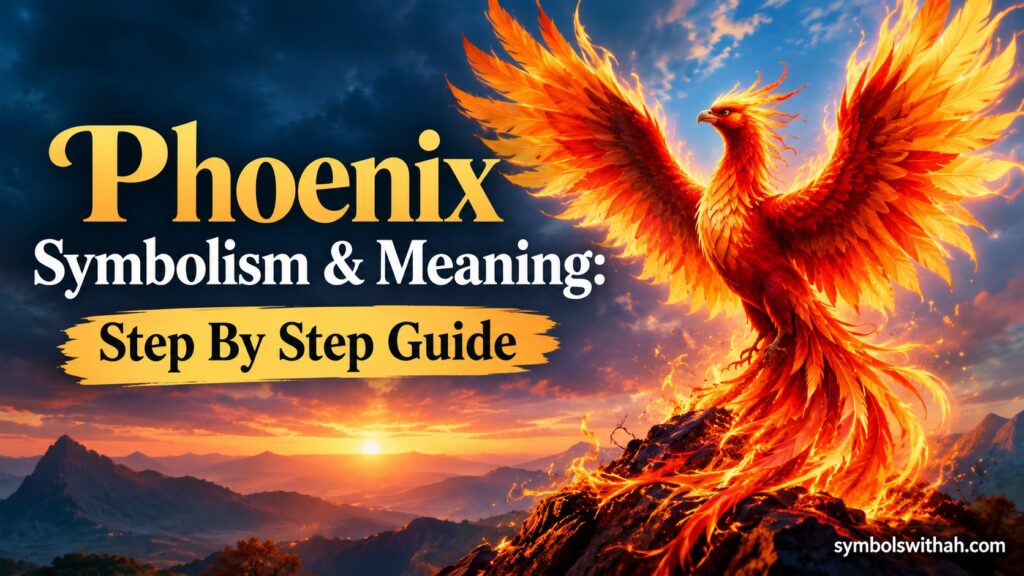

The Phoenix Symbolism & Meaning: Step by Step Guide explores one of the world’s most recognizable symbols of renewal, resilience, and transformation. This mythical bird appears in ancient stories, religious imagery, modern tattoos, literature, and popular culture. Its most familiar image shows a brilliant bird rising from flames or ashes, ready to begin again.
In the United States, the phoenix often represents overcoming hardship and rebuilding a life after difficult experiences. People choose phoenix tattoos after major life changes, use its image in creative projects, and share it as a message of hope. However, its meaning reaches far beyond personal recovery.
The phoenix has a long history connected with ancient Egyptian traditions and classical Greek and Roman literature. Over time, different communities adapted the bird to express ideas about the sun, immortality, resurrection, and renewal. Understanding these changes helps explain why the phoenix remains powerful today.
Whether you encountered the phoenix in a dream, considered it for a tattoo, or simply wondered about its spiritual meaning, its story offers several ways to understand change. The key is to explore its history while recognizing that its meaning can differ from person to person.
Read More: Butterfly Symbolism: Spiritual Meaning Behind the Animal
Quick Answer
Phoenix symbolism and meaning in the United States centers on rebirth, resilience, hope, and the ability to begin again after hardship. The mythical bird also represents immortality, spiritual renewal, transformation, and the courage to move forward. Its exact meaning depends on the cultural tradition and personal context.
TL;DR
• The phoenix symbolizes rebirth, renewal, strength, and new beginnings.
• Ancient Egyptian beliefs about the Bennu bird may have influenced its mythology.
• In American culture, the phoenix represents recovery after personal or collective hardship.
• Red, gold, and orange feathers often suggest fire, energy, and transformation.
• Phoenix tattoos can express survival, independence, and a fresh start.
• Spiritual interpretations include awakening, hope, and the continuation of life.
1. What Is the Phoenix Symbol?
The phoenix is a mythical bird famous for its extraordinary cycle of death and renewal. In the most familiar version of its story, the bird burns or dies, then returns to life from its ashes. This image makes it a powerful symbol of change.
Unlike ordinary birds, the phoenix doesn’t represent only beauty or freedom. Instead, its story focuses on what becomes possible after an ending.
What Does a Phoenix Look Like?
Artists portray the phoenix in different ways, but several features appear repeatedly.
• Fiery red, orange, and gold feathers suggest heat, sunlight, and vitality.
• A long, sweeping tail creates a sense of movement and grandeur.
• Broad wings symbolize freedom, expansion, and rising above limitations.
• Flames and ashes represent endings that lead toward renewal.
• A bright halo or sunrise can suggest hope and spiritual awakening.
Some illustrations resemble eagles or pheasants, while others show a fantastical bird with flowing feathers. However, no single appearance defines every phoenix tradition.
Why Is the Phoenix So Recognizable?
The phoenix combines two powerful ideas: destruction and creation. Something old must end before something new can emerge in the familiar rebirth story.
For modern readers, this makes the bird easy to connect with personal experiences. It can represent rebuilding confidence, recovering from disappointment, or choosing a different direction.
2. The Core Meanings of Phoenix Symbolism
Although the phoenix has many interpretations, three meanings stand out in contemporary American culture. These are rebirth, resilience, and transformation.
Rebirth and New Beginnings
Rebirth means beginning again after an ending. The phoenix expresses this idea through its return from fire and ashes.
For example, someone might associate the bird with starting a new career, leaving an unhealthy situation, or rebuilding after a major life change. The symbol suggests that an ending doesn’t have to define the future.
Strength and Resilience
Resilience is the ability to adapt and continue after difficulty. Because the phoenix survives its own destruction in myth, it represents strength that emerges through change.
However, resilience doesn’t mean you must handle every problem alone. The phoenix can also remind you that recovery takes time, support, and patience.
Transformation and Personal Growth
Transformation involves becoming different from who you were before. The phoenix represents a fresh beginning rather than a simple return to the past.
Its symbolism can encourage you to release outdated expectations and develop new priorities. In this sense, rising from the ashes means carrying wisdom forward instead of repeating the same cycle.
3. The Ancient Origins of Phoenix Symbolism
The phoenix story developed through centuries of cultural exchange, storytelling, and religious interpretation. Its origins are not entirely certain, but ancient Egyptian traditions provide an important historical connection.
Understanding that background also helps separate the original stories from meanings added much later.
Ancient Egypt and the Bennu Bird
Ancient Egyptian religion included the Bennu, a sacred bird commonly represented as a heron. It was associated with the sun, creation, renewal, and the sacred city of Heliopolis.
The Bennu appeared in religious traditions connected with the sun god Ra and the creator deity Atum. Its symbolism reflected the sun’s daily return and the renewal of life.
Scholars often discuss the Bennu as a possible precursor to the classical phoenix. However, the two figures shouldn’t be treated as completely identical. Their stories and religious roles developed in different settings.
The Phoenix in Ancient Greece
The Greek phoenix appears in ancient literary traditions, including accounts associated with the poet Hesiod and the historian Herodotus.
Around 450 BCE, Herodotus described a remarkable bird connected with Egypt and its sun worship. His account emphasized its long life and unusual treatment of its deceased parent, rather than the familiar story of rising from ashes.
Later Greek and Roman writers expanded the legend. Consequently, the phoenix acquired additional features, including a cycle of death and renewal.
How the Myth Changed in Rome
Roman writers adapted the phoenix to express ideas about endurance and the continuation of power. The bird appeared in literary works and imperial imagery.
Its renewal made it useful as a metaphor for the strength of the Roman state. Meanwhile, early Christian writers also adopted the phoenix as an image of resurrection.
These different interpretations helped carry the bird into medieval European literature, religious art, and later popular culture.
4. Phoenix Symbolism in the United States
In the United States, the phoenix is strongly associated with personal reinvention and recovery. Its familiar image fits a culture that often celebrates second chances, determination, and the ability to rebuild after setbacks.
However, American interpretations also reflect literature, entertainment, civic history, and the experiences of individuals and communities.
The Phoenix as a Symbol of Starting Over
Many Americans use the phoenix to express the idea that a difficult chapter doesn’t have to determine the rest of their lives. This meaning appears in personal stories about recovery, career changes, family challenges, and new beginnings.
The phrase “rising from the ashes” has become a common way to describe recovery after loss. It can refer to rebuilding a home, restoring a business, or finding confidence after disappointment.
Phoenix Symbolism in American History and Cities
The phoenix also appears in civic and institutional imagery. Communities sometimes use it to represent rebuilding after destructive events, particularly when fire or disaster has damaged important places.
The name Phoenix, Arizona, provides a notable American connection. The city took its name from the idea of a new settlement rising from the remains of an earlier civilization. The choice connected the city’s future with a powerful image of renewal.
The bird’s meaning is not limited to cities. Schools, organizations, creative groups, and sports identities may also use phoenix imagery to suggest determination or a fresh start.
The Phoenix in American Popular Culture
American audiences encounter phoenix stories through fantasy, film, books, games, and television. These portrayals often emphasize extraordinary abilities, loyalty, sacrifice, or recovery after destruction.
The recurring image helps audiences understand a character’s transformation without lengthy explanations. When a phoenix appears after a dramatic loss, it often signals that the story isn’t over.
5. Spiritual Meaning of the Phoenix
Spiritually, the phoenix is often interpreted as a symbol of renewal, awakening, and hope. These interpretations build on the bird’s ancient associations with sunlight and its later stories of rebirth.
There is no single spiritual meaning that everyone must accept. Instead, the phoenix can serve as a personal reminder of change, depending on your beliefs and experiences.
Spiritual Rebirth and Awakening
Some people interpret the phoenix as representing an inner awakening. This may involve recognizing personal values, changing old habits, or developing a deeper sense of purpose.
The fire in the story can symbolize a period of intense change. The renewed bird then represents what emerges when someone reflects, learns, and moves forward.
However, spiritual rebirth doesn’t have to involve a dramatic event. It can also describe a gradual change in how you understand yourself and the world.
Hope During Difficult Times
The phoenix can provide a meaningful image of hope when the future feels uncertain. Its story suggests that a painful ending doesn’t eliminate every possibility.
• It may represent hope after disappointment or loss.
• It can symbolize renewed faith in yourself or your future.
• It may remind you to approach change with patience.
• It can express gratitude for the lessons gained through experience.
These are personal interpretations rather than promises about what will happen. The phoenix is best understood as a symbol of possibility, not a guarantee of success.
6. Phoenix Symbolism in Different Cultures and Religions
The phoenix belongs to a broader family of traditions involving remarkable birds, renewal, and long life. However, similar-looking creatures don’t always share the same origin or meaning.
Comparing these traditions requires care because each developed within a distinct religious and cultural setting.
Christianity and Resurrection
Early Christian writers used the phoenix as an illustration of resurrection and renewed life. Its legendary return after death provided a vivid image for discussing hope beyond mortality.
The bird consequently appeared in some Christian writings and works of religious art. However, the phoenix is not a central figure in every Christian tradition, and its symbolism should not be confused with a universal Christian teaching.
Chinese Fenghuang
The Chinese fenghuang is often translated as “Chinese phoenix,” although it has its own distinct history and symbolism. It has been associated with virtue, harmony, prosperity, and auspicious leadership.
In many traditional representations, it has elaborate feathers and a majestic, composite appearance. It can appear alongside the dragon in art associated with balance and complementary qualities.
Unlike the familiar Western phoenix, the fenghuang isn’t defined primarily by a cycle of burning and rising from ashes.
Other Spiritual and Cultural Connections
Across cultures, stories about extraordinary birds can express ideas about the sun, life, renewal, and the relationship between humans and the natural world. Yet resemblance alone doesn’t prove that one tradition originated from another.
The safest approach is to understand each symbol within its own context. This allows you to appreciate shared themes without erasing meaningful cultural differences.
7. Phoenix Colors and Their Symbolic Meanings
Phoenix colors strongly influence how an image feels and what it communicates. Artists often use fiery shades to emphasize energy, while cooler or darker shades can create a different emotional effect.
These meanings are common artistic interpretations, not fixed rules that apply to every culture.
Red, Orange, and Gold Phoenix
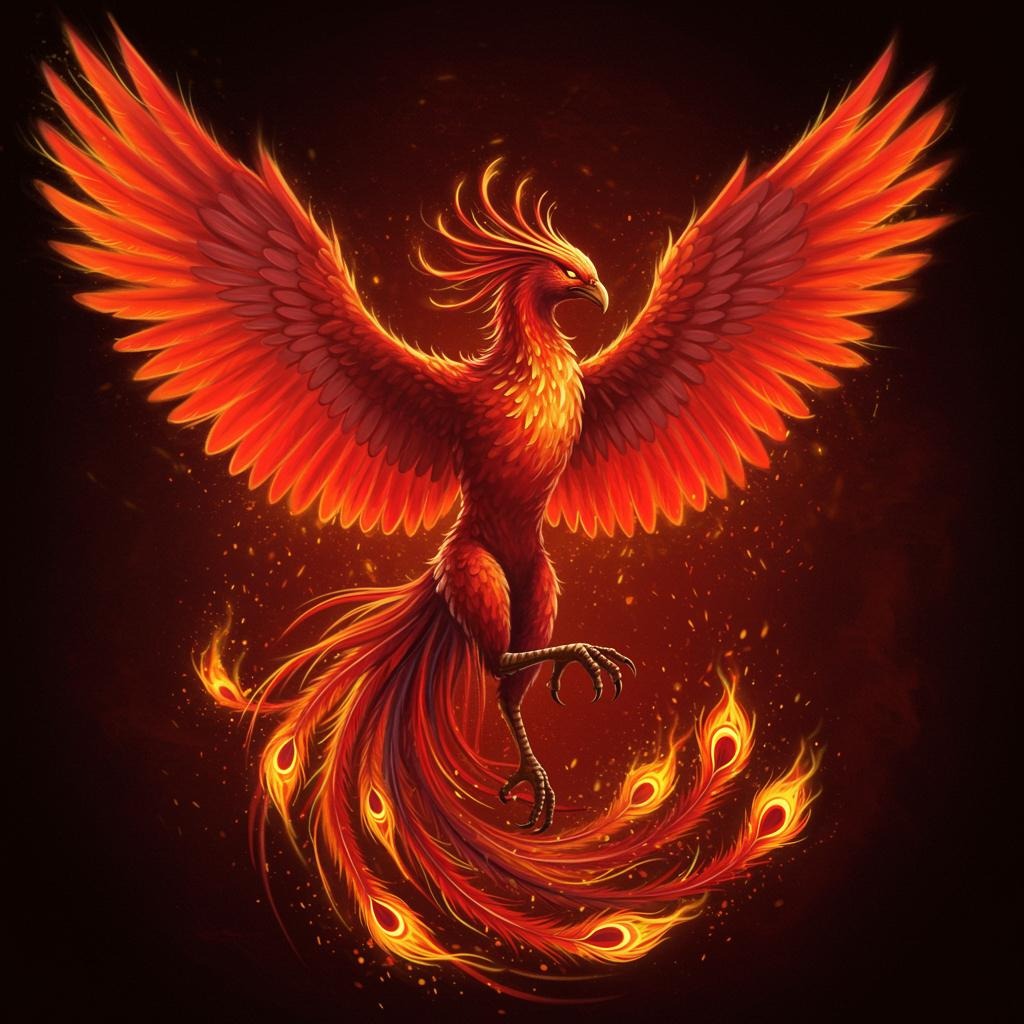
Red Phoenix
Red often suggests courage, passion, vitality, and powerful emotions. A red phoenix can represent determination during a difficult period or the strength to make a bold change.
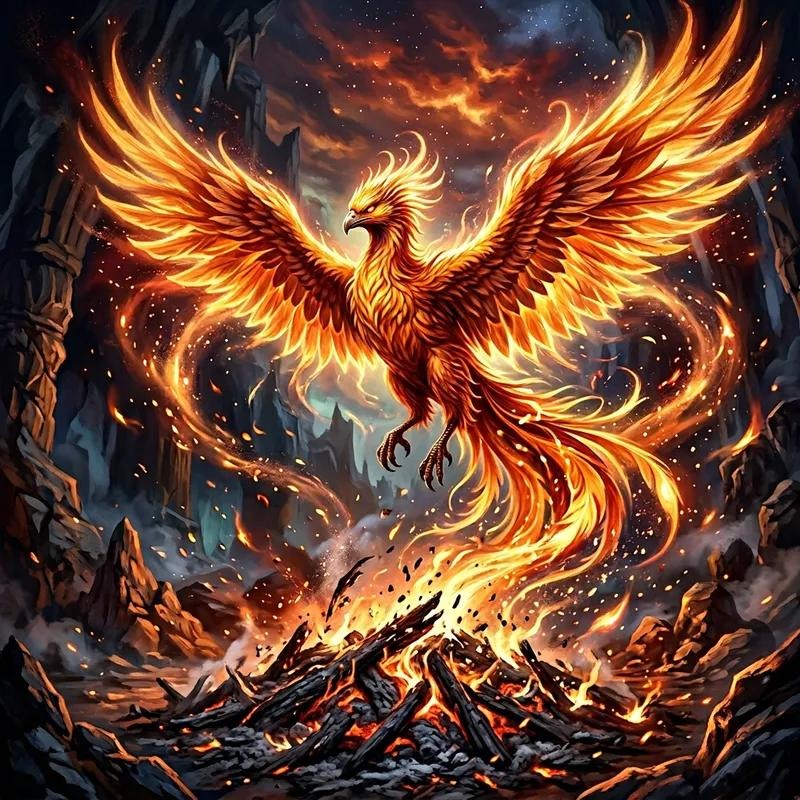
Orange Phoenix
Orange can communicate creativity, enthusiasm, and movement. It suits interpretations centered on fresh opportunities, renewed motivation, and a willingness to explore new possibilities.

Gold Phoenix
Gold often suggests wisdom, achievement, abundance, and illumination. A golden bird may express the belief that experience can lead to greater understanding.
Black, White, and Blue Phoenix
Other colors can shift the symbol away from its traditional fiery appearance. These interpretations are especially common in contemporary art and personal designs.
• A black phoenix may suggest mystery, endurance, or transformation through a difficult chapter.
• A white phoenix can represent peace, purity, hope, or spiritual renewal.
• A blue phoenix may express calmness, wisdom, emotional balance, or freedom.
• A purple phoenix can suggest imagination, individuality, or spiritual exploration.
These associations depend on the design and the viewer. For instance, a black phoenix might represent grief for one person and independence for another.
8. Phoenix Symbolism in Dreams
A phoenix appearing in a dream can feel memorable because the image combines fire, loss, and renewal. Some people interpret it as a reflection of changes happening in their waking lives.
However, dreams don’t have universally established symbolic meanings. Your emotions, memories, and current circumstances matter more than a single interpretation.
Common Phoenix Dream Scenarios
| Dream image | Possible personal association | A question to consider |
| A phoenix rising from ashes | Hope after a difficult experience | What am I ready to rebuild? |
| A phoenix spreading its wings | Confidence or independence | Where do I want greater freedom? |
| A phoenix surrounded by flames | Intense change or strong emotions | What feels overwhelming right now? |
| A golden phoenix flying | Aspiration or renewed purpose | What goal matters most to me? |
| A phoenix dying or disappearing | Fear of change or an ending | What am I struggling to release? |
How to Reflect on a Phoenix Dream
Instead of treating the dream as a prediction, consider how it made you feel. Relief, fear, excitement, or sadness may offer clues about what the image means to you.
You can also write down what happened in the dream and connect it with recent experiences. This approach encourages self-reflection without assuming that every dream carries a supernatural message.
9. Emotional and Psychological Meaning of the Phoenix
The phoenix often appeals to people who want to give difficult experiences a meaningful place in their personal stories. Its image offers a way to describe change without pretending that hardship never happened.
Psychologically, the symbol can support reflection on identity, hope, and the possibility of growth. However, the bird itself doesn’t explain or resolve emotional difficulties.
The Phoenix and Personal Identity
People sometimes connect with the phoenix when their sense of identity changes. This can happen after moving to a new place, ending a relationship, changing careers, or reaching a major life milestone.
The symbol offers a simple message: your past can shape you without defining every part of your future. You can acknowledge what happened while choosing what comes next.
Why the Phoenix Feels Empowering
The phoenix doesn’t return as an unchanged version of its former self in every interpretation. Instead, its rebirth suggests a new beginning shaped by the previous cycle.
This idea can feel empowering because it makes room for both vulnerability and strength. You don’t have to deny a difficult experience to recognize your capacity for change.
For many people, the phoenix represents the possibility of moving forward with greater self-awareness. That meaning can be personal even without a religious or spiritual belief.
10. Phoenix Tattoo Meaning and Symbolism
Phoenix tattoos are popular choices for people who want a lasting reminder of resilience, transformation, or a fresh start. Their meaning often comes from a combination of the bird’s mythology and the wearer’s personal experience.
The design can be dramatic and colorful or quiet and minimal. Either way, the details influence how others may interpret it.
Common Phoenix Tattoo Designs
• Rising phoenix: Represents rebirth, hope, and moving beyond a difficult chapter.
• Phoenix with flames: Emphasizes transformation, intensity, and the power of renewal.
• Phoenix with spread wings: Suggests freedom, confidence, and personal independence.
• Minimalist phoenix outline: Offers a subtle reminder of resilience without elaborate detail.
• Phoenix with a sun: Connects the bird with light, vitality, and recurring renewal.
Where People Place Phoenix Tattoos
Placement can add personal meaning, although no location has a universal symbolic definition. Some people choose visible areas to express their values openly, while others prefer a more private reminder.
A phoenix on the forearm may be easy to see during everyday life. A back or shoulder design can provide more room for expansive wings and intricate feathers.
Before choosing a design, consider what the symbol means to you. A thoughtful tattoo reflects your own story rather than relying only on popular interpretations.
11. Phoenix Symbolism in Art, Fashion, and Everyday Life
The phoenix has moved far beyond ancient stories. Today, its image appears in clothing, jewelry, decorative art, digital illustrations, and personal creative projects.
In American culture, these uses often focus on individuality, strength, and renewal. The symbol can communicate an idea quickly, even when the viewer knows little about its history.
Home Decor and Personal Objects
A phoenix artwork can serve as a reminder of change or an expression of personal style. Its fiery colors often suit bold interiors, while simplified designs fit quieter spaces.
Jewelry and accessories offer another way to carry the symbol. A phoenix pendant, for example, may represent a meaningful transition or a personal connection to the myth.
Social Media and Digital Culture
On social media, phoenix imagery can accompany posts about fresh starts, achievements, and lessons learned from setbacks. People may use the bird in profile pictures, digital artwork, or motivational graphics.
Its meaning can also shift with context. A phoenix shared after a personal milestone may express hope, while the same image in a fantasy game might simply represent a powerful mythical creature.
The Phoenix in Branding and Creative Work
Organizations and creators may choose phoenix imagery to communicate renewal, ambition, or lasting strength. The bird’s recognizable shape makes it useful for logos, book covers, and event artwork.
However, its presence doesn’t automatically indicate a spiritual message. Sometimes the image is selected for its visual energy or connection with fantasy and adventure.
12. Phoenix Symbolism in Literature, Religion, and Popular Culture
Stories have helped preserve the phoenix for thousands of years. Each era has adapted the bird to reflect its own concerns, whether those involve faith, political power, personal identity, or imagination.
For American audiences, modern entertainment provides one of the most familiar ways to encounter this ancient symbol.
The Phoenix as a Literary Symbol
Writers use the phoenix to represent characters, relationships, or communities undergoing major change. Its appearance can suggest that a loss may lead to a new phase of the story.
The symbol also allows authors to explore the difference between survival and transformation. A character may survive a crisis yet still need to rethink their beliefs or choices.
The Phoenix in Fantasy and Entertainment
Fantasy stories often portray the phoenix as a rare creature with unusual powers. It may heal, return after death, protect a character, or appear at a decisive moment.
These features build on older traditions but don’t necessarily preserve their original religious meanings. Modern creators are free to reinterpret the bird within the rules of their fictional worlds.
Why the Symbol Continues to Work
The phoenix connects a visually dramatic event with an experience many people understand: change after difficulty. Its meaning remains accessible even when its ancient history is unfamiliar.
That flexibility helps explain its continued presence in American books, films, games, and visual art.
13. Misunderstandings and Controversies About Phoenix Symbolism
Although the phoenix is generally associated with positive ideas, some interpretations can become misleading when people treat every version as identical. Its long history includes distinct religious, cultural, and literary traditions.
Understanding these differences helps you appreciate the symbol without oversimplifying it.
Is the Phoenix a Religious Symbol?
The phoenix has appeared in both religious and nonreligious contexts. Early Christian writers connected it with resurrection, while ancient Egyptian traditions associated the Bennu with creation and the sun.
However, the phoenix isn’t exclusive to one religion. Many modern people use it as a secular symbol of recovery or personal growth.
Is the Phoenix the Same as the Chinese Fenghuang?
No. The Western phoenix and the Chinese fenghuang have different histories and symbolic roles.
Both may be described as extraordinary birds, but their stories aren’t interchangeable. Treating them as identical can obscure the cultural meanings that make each one distinctive.
Does a Phoenix Always Mean Rebirth?
Rebirth is the best-known meaning, but it isn’t the only one. Depending on the context, the phoenix may also represent immortality, uniqueness, endurance, spiritual renewal, or civic recovery.
Some modern designs use the bird mainly for its beauty or dramatic appearance. Therefore, it’s better to consider the surrounding imagery and the creator’s intention before assigning a specific meaning.
Can Phoenix Symbolism Be Misused?
Like many widely recognized symbols, the phoenix can be used in ways that differ from its traditional associations. An organization might adopt it for a political message, commercial identity, or personal statement.
The image alone doesn’t establish that the message is harmful or beneficial. Context, accompanying language, and the actions of the people using it matter more than the bird by itself.
14. How Phoenix Symbolism Has Changed Over Time
The phoenix has survived because different societies have repeatedly reshaped its meaning. Its story began in ancient traditions, developed through classical literature, and gained new interpretations through religious writing and modern entertainment.
A Simple Timeline of Phoenix Meaning
Ancient Egypt
Creation and the sun
The Bennu bird was connected with solar cycles, creation, and renewal in Egyptian religious traditions.
Ancient Greece
Longevity and wonder
Greek accounts developed the phoenix as a remarkable bird with an extraordinary lifespan.
Roman era
Endurance and continuity
Roman writers and imagery used the phoenix to express renewal and lasting power.
Early Christianity
Resurrection and hope
Christian writers adapted the bird as an illustration of renewed life and resurrection.
Modern era
Personal transformation
Tattoos, literature, entertainment, and civic imagery emphasize resilience and starting over.
What Has Stayed the Same?
The details of the myth have changed, but renewal remains central to the phoenix’s appeal. Across many interpretations, the bird represents something extraordinary continuing beyond an apparent ending.
However, the familiar story of rising directly from ashes isn’t present in every early account. The myth developed gradually, and its most recognizable features became more prominent through later retellings.
Why the Phoenix Still Matters in 2026
In 2026, the phoenix remains relevant because people continue to search for ways to express change and resilience. Its image fits conversations about personal reinvention, creative identity, and rebuilding after collective hardship.
Modern interpretations don’t erase the bird’s history. Instead, they add new layers to a symbol that has repeatedly adapted to changing times.
15. FAQs About Phoenix Symbolism and Meaning
1. What Does a Phoenix Symbolize Spiritually?
A phoenix often symbolizes spiritual renewal, awakening, hope, and transformation. Some people connect it with finding purpose after a difficult period, while others see it as a reminder that change is part of life.
2. What Does a Phoenix Rising From Ashes Mean?
A phoenix rising from ashes represents recovery and a new beginning after destruction or loss. In everyday American usage, it can describe rebuilding a life, restoring a community, or finding strength after a major setback.
3. Is the Phoenix a Symbol of Good Luck?
Some people associate the phoenix with good fortune, prosperity, and positive change. However, its traditional meanings focus more strongly on renewal, longevity, and transformation than on luck alone.
4. What Does a Phoenix Tattoo Mean?
A phoenix tattoo commonly represents resilience, rebirth, independence, or personal growth. Its meaning can become more specific through colors, flames, other design elements, and the wearer’s own experiences.
5. What Is the Difference Between the Phoenix and the Fenghuang?
The Western phoenix is widely known for its legendary cycle of death and rebirth. The Chinese fenghuang has its own cultural history and is often associated with harmony, virtue, and auspiciousness.
6. What Does a Phoenix Mean in a Dream?
A phoenix in a dream may reflect personal change, hope, or a desire to begin again. However, dreams don’t have universal interpretations, so your feelings and current circumstances are important when considering their meaning.
Conclusion
Phoenix Symbolism & Meaning: Step By Step Guide shows why this mythical bird continues to inspire people across generations. From ancient Egyptian solar traditions and classical mythology to modern American tattoos and popular culture, the phoenix has come to represent rebirth, resilience, hope, and transformation.
Its story reminds us that endings can create space for new possibilities. However, the phoenix doesn’t suggest that every hardship is easy or that every change happens quickly. Instead, it offers an image of persistence and the potential to move forward.
If the phoenix resonates with you, consider what it represents in your own life. Perhaps it’s the courage to begin again, the strength to accept change, or the hope of becoming someone new. Its most meaningful message is the one that helps you understand your own journey.