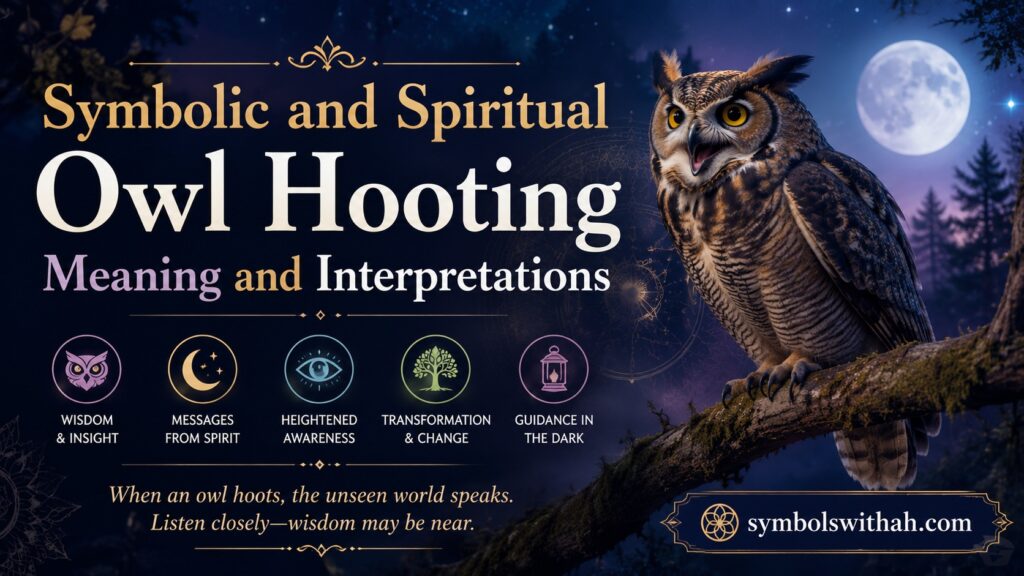

Owls have fascinated people for thousands of years. Their silent flight, sharp eyesight, and haunting nighttime calls make them one of the world’s most mysterious birds. Because of these traits, the Symbolic and Spiritual Owl Hooting Meaning and Interpretations have become an important topic in folklore, spirituality, and modern culture.
In the United States, hearing an owl hoot can inspire curiosity, reflection, or even concern. Some people believe it carries a spiritual message, while others simply enjoy the peaceful sound of nature after dark. Throughout history, different cultures have connected owl hooting with wisdom, protection, mystery, and change.
Although no single interpretation fits every situation, understanding the history and symbolism behind an owl’s call helps explain why it continues to capture people’s imagination today.
Read More: Symbols and Spiritual Meaning of Black and White Feathers
Quick Answer
Symbolic and Spiritual Owl Hooting Meaning and Interpretations often represent wisdom, awareness, transformation, and hidden knowledge. In the United States, many people see an owl’s hoot as a reminder to pay attention to life’s changes, while other traditions connect it with guidance, intuition, or messages from the unseen world.
TL;DR
- • Owl hooting often symbolizes wisdom and awareness.
- • Ancient cultures gave owls many different meanings.
- • American folklore includes both hopeful and mysterious beliefs.
- • Many spiritual traditions link owls with intuition.
- • Modern culture often portrays owls as intelligent guides.
- • Meanings depend on personal beliefs and cultural traditions.
What Does Owl Hooting Symbolize?
Hearing an owl hoot has inspired symbolic meanings across many cultures. While science explains hooting as natural communication, symbolism focuses on the feelings and ideas people connect with the sound.
A Symbol of Wisdom
Owls are famous for intelligence because they observe quietly before acting.
People often associate owl hooting with:
- • Learning from experience.
- • Making thoughtful decisions.
- • Looking beyond appearances.
- • Seeking deeper understanding.
- • Trusting careful observation.
A Call to Pay Attention
Many people believe an unexpected owl hoot encourages awareness.
It may remind someone to:
- • Slow down.
- • Notice overlooked details.
- • Listen carefully.
- • Think before making choices.
- • Reflect on life’s direction.
A Sign of Transformation
Because owls appear during darkness, many traditions connect them with personal growth through difficult times.
Rather than fearing change, the owl often symbolizes moving through uncertainty toward greater understanding.
Owl Hooting in American Culture
For many Americans, owls represent mystery mixed with respect. National parks, forests, and rural communities frequently hear owl calls after sunset, making the experience familiar across the country.
Native American Perspectives
Many Native American nations have their own beliefs about owls. These traditions are diverse and should never be treated as one single viewpoint.
Some tribes viewed owls as:
- • Protectors of sacred knowledge.
- • Messengers from the spirit world.
- • Symbols of caution.
- • Night guardians.
- • Guides through difficult transitions.
Other tribes interpreted owl calls differently. Because traditions vary widely, it’s important to understand each nation’s beliefs within its own cultural context.
Rural American Folklore
Generations of Americans created stories around nighttime owl calls.
Common beliefs include:
- • Change may be approaching.
- • Someone should stay alert.
- • Nature is communicating.
- • A quiet evening encourages reflection.
- • The woods remain full of life after sunset.
Historical Origins of Owl Symbolism
Owls have appeared in myths for thousands of years. Their unusual behavior made ancient people curious long before modern science explained their habits.
Ancient Greece
Ancient Greece strongly connected owls with wisdom.
The little owl became associated with Athena, the goddess of wisdom, strategy, and knowledge. Because of this connection, owls came to symbolize intelligence throughout much of Western culture.
Ancient Rome
Roman traditions sometimes viewed owl calls as warnings.
Certain historical stories claimed an owl’s appearance before major events predicted change or uncertainty. These beliefs later influenced European folklore.
Ancient Egypt
Egyptians admired the owl’s ability to move through darkness.
The bird represented:
- • Night.
- • Hidden knowledge.
- • Protection.
- • Observation.
- • Mystery.
Why Do People Think Owl Hooting Has Spiritual Meaning?
Throughout history, nighttime has represented the unknown. Since owls thrive after dark, people naturally linked them with spiritual ideas.
Connection to Intuition
Many spiritual traditions encourage trusting inner wisdom.
An owl’s hoot may remind people to:
- • Listen to intuition.
- • Stay calm.
- • Observe quietly.
- • Accept uncertainty.
- • Remain patient.
Symbol of Hidden Truth
Owls see clearly at night.
Because of this ability, many symbolic traditions believe they represent discovering truths that were previously hidden.
Encouragement During Change
Life transitions often feel uncertain.
Many people view owl hooting as encouragement to remain steady while adapting to new circumstances.
Different Owl Species and Their Symbolism
Not every owl inspires exactly the same symbolic associations. Different species have unique appearances and behaviors.
| Owl Species | Common Symbolism | American Associations | Notes |
| Great Horned Owl | Strength and leadership | Forest guardian | Powerful presence |
| Barn Owl | Mystery and intuition | Rural landscapes | Silent flight |
| Snowy Owl | Clarity and hope | Winter beauty | Bright appearance |
| Barred Owl | Communication | Woodland life | Famous “Who cooks for you?” call |
| Screech Owl | Adaptability | Backyard wildlife | Small but resilient |
Why Species Matter
Although symbolism overlaps, appearance and habitat sometimes shape people’s interpretations.
For example, snowy owls often symbolize hope because of their bright white feathers, while great horned owls represent confidence and strength because of their commanding appearance.
Modern Spiritual Interpretations of Owl Hooting
Today, many people connect owl hooting with personal growth rather than predicting specific events. While these interpretations vary from person to person, they often focus on mindfulness, awareness, and inner wisdom instead of fear.
A Reminder to Trust Yourself
Many people believe an owl’s call encourages self-reflection.
It may symbolize:
- • Trusting your instincts.
- • Listening before reacting.
- • Looking beyond first impressions.
- • Remaining calm during uncertainty.
- • Believing in your own judgment.
Letting Go of the Past
Some spiritual traditions view nighttime as a symbol of endings before new beginnings.
In this view, an owl’s hoot may encourage someone to:
- • Release old habits.
- • Accept personal growth.
- • Forgive past mistakes.
- • Welcome new opportunities.
- • Move forward with confidence.
Finding Peace in Silence
Owls spend much of their lives quietly observing their surroundings.
Because of this, many people see owl hooting as a reminder that wisdom often comes through patience rather than constant activity.
What Does It Mean If an Owl Hoots Outside Your House?
One of the most common questions people ask is whether hearing an owl outside their home has a special meaning.
From a wildlife perspective, owls hoot to communicate with other owls, defend territory, or attract mates. Spiritually, however, people often attach personal meaning to the experience.
Common Symbolic Interpretations
Some people believe it represents:
- • Protection over the home.
- • Increased awareness.
- • A period of reflection.
- • Personal transformation.
- • Guidance during uncertain times.
Does It Mean Good Luck or Bad Luck?
There isn’t one universal answer.
In the United States, many people now view owl hooting as neither good nor bad. Instead, they see it as a reminder to slow down and pay attention to life.
Older folklore sometimes connected owl calls with misfortune, but those beliefs are only one part of a much larger history.
Owl Hooting in Different Cultures
Although owls appear around the world, their symbolic meanings differ from one culture to another.
Native American Traditions
Many Native American nations have unique stories about owls.
Depending on the nation, owls may represent:
- • Wisdom.
- • Spiritual guidance.
- • Protection.
- • Caution.
- • Respect for nature.
These traditions vary greatly and shouldn’t be generalized.
Celtic Beliefs
In Celtic traditions, owls often symbolized hidden wisdom and mystery.
Their nighttime habits connected them with the unseen world and the changing seasons.
Japanese Traditions
Owls are widely viewed as lucky symbols in Japan.
They often represent:
- • Good fortune.
- • Happiness.
- • Protection.
- • Success.
- • Wisdom.
Hindu Traditions
In some Hindu traditions, the owl is associated with the goddess Lakshmi.
Depending on the context, it may symbolize wisdom, prosperity, or careful judgment.
Owl Hooting and Emotional Symbolism
Symbols often reflect human emotions as much as cultural traditions.
An owl’s call can create different feelings depending on the listener’s experiences.
Feelings Commonly Associated With Owl Hooting
People often describe feeling:
- • Curious.
- • Peaceful.
- • Thoughtful.
- • Hopeful.
- • Respectful.
- • Calm.
Others may feel uneasy simply because nighttime sounds are unfamiliar.
Why the Sound Feels Powerful
An owl’s hoot is:
- Slow.
- Deep.
- Repetitive.
- Easy to recognize.
These qualities naturally capture attention, making the sound memorable and emotionally meaningful.
Owl Symbolism in Modern America
Owls remain one of America’s most recognizable wildlife symbols.
They appear everywhere from classrooms to sports mascots and home decorations.
Popular Uses
Today, owl imagery appears in:
- • Home décor.
- • Jewelry.
- • Tattoos.
- • Greeting cards.
- • Children’s books.
- • Holiday decorations.
- • Educational materials.
Social Media and Digital Culture
Owls frequently represent:
- • Intelligence.
- • Book lovers.
- • Quiet personalities.
- • Nature enthusiasts.
- • Nighttime creativity.
Because of these positive associations, owl designs remain popular across many age groups.
Owl Tattoos and Their Meaning
Owl tattoos have become increasingly popular in the United States.
Many people choose them because they represent personal growth rather than superstition.
Common Tattoo Meanings
An owl tattoo may symbolize:
- • Wisdom.
- • Independence.
- • Knowledge.
- • Protection.
- • Resilience.
- • Spiritual growth.
- • New beginnings.
Popular Tattoo Styles
People often combine owls with:
- • The moon.
- • Stars.
- • Forest scenes.
- • Feathers.
- • Flowers.
- • Clocks.
- • Dreamcatchers.
Each design adds personal meaning while keeping the owl as the central symbol.
Misunderstandings and Common Myths About Owl Hooting
Owls have inspired many stories over the centuries. However, not every belief reflects modern understanding.
Myth: Every Owl Hoot Predicts the Future
There is no evidence that an owl’s call predicts specific events.
Many symbolic interpretations are personal, cultural, or spiritual rather than factual.
Myth: Owl Hooting Always Means Death
This idea appears in some traditions but is far from universal.
Many cultures instead connect owls with wisdom, protection, or guidance.
Myth: Owls Are Always Spiritual Messengers
Owls are wild birds with natural behaviors.
People may find personal meaning in hearing one, but the hoot itself is part of normal communication between owls.
How Owl Hooting Symbolism Has Changed Over Time
The meaning of owl hooting has changed as societies have evolved. In ancient times, people often explained mysterious natural sounds through myths and legends. Today, many people appreciate both the scientific reasons behind owl calls and the symbolic meanings that have been passed down through generations.
Ancient Beliefs
Early civilizations often viewed owls as creatures connected with the unknown because they hunted at night and were rarely seen during daylight.
Common ancient associations included:
- • Wisdom and sacred knowledge.
- • Mystery and hidden truths.
- • Guardians of the night.
- • Messages from the spiritual world.
- • Change and transformation.
Medieval and Early European Views
During the Middle Ages, some European stories portrayed owls as symbols of loneliness, bad luck, or mystery. These ideas spread through folklore and influenced later beliefs in North America.
However, not every community shared these views. Many people continued to admire owls for their intelligence and remarkable hunting skills.
Modern Interpretations
Today, attitudes toward owls are generally more positive.
Many Americans now see owl hooting as a reminder to:
- • Stay observant.
- • Trust personal wisdom.
- • Respect nature.
- • Embrace change.
- • Appreciate quiet moments.
Instead of fearing an owl’s call, many people simply enjoy it as one of nature’s most recognizable nighttime sounds.
Frequently Asked Questions
1. What does hearing an owl hoot mean spiritually?
Many people believe an owl hoot symbolizes wisdom, intuition, or a time for reflection. The meaning often depends on personal beliefs, cultural traditions, and the situation in which the owl is heard.
2. Is hearing an owl at night good luck?
There is no universal belief. Some traditions see it as a sign of protection or guidance, while others connect it with caution. In modern American culture, it is commonly viewed as a meaningful encounter with nature rather than a prediction of future events.
3. Why do owls hoot outside someone’s house?
From a scientific perspective, owls hoot to communicate with other owls, establish territory, or attract a mate. Symbolically, some people interpret the experience as a reminder to remain aware, patient, or open to personal growth.
4. Does an owl hooting mean someone will die?
This is a traditional belief found in some cultures, but it is not supported by evidence and is not shared universally. Across the world, many traditions instead associate owls with wisdom, protection, learning, and transformation.
5. Which owl species is considered the most symbolic?
The great horned owl is one of the most recognized symbolic owls in North America because of its striking appearance and commanding presence. The barn owl, barred owl, and snowy owl also carry unique symbolic meanings based on their habitats and characteristics.
6. Can owl hooting be a personal spiritual message?
Many people choose to reflect on an owl encounter as a meaningful personal experience. Whether someone sees it as a spiritual message, a moment of mindfulness, or simply a beautiful wildlife encounter depends on their own beliefs and perspective.
Conclusion
The Symbolic and Spiritual Owl Hooting Meaning and Interpretations have evolved over thousands of years, blending history, folklore, spirituality, and observations of nature. From the wisdom of ancient Greece to the diverse traditions of Native American nations and today’s appreciation of wildlife, the owl’s nighttime call has inspired countless stories and personal reflections.
For many people in the United States, an owl’s hoot represents awareness, patience, wisdom, and transformation rather than fear. While different cultures offer different interpretations, the owl continues to remind us to look beyond the obvious, trust our judgment, and respect the mysteries of the natural world.
Whether you hear an owl deep in the forest, outside your home, or during a quiet evening walk, its haunting call can be an invitation to pause, observe, and appreciate the enduring connection between nature and human imagination.