
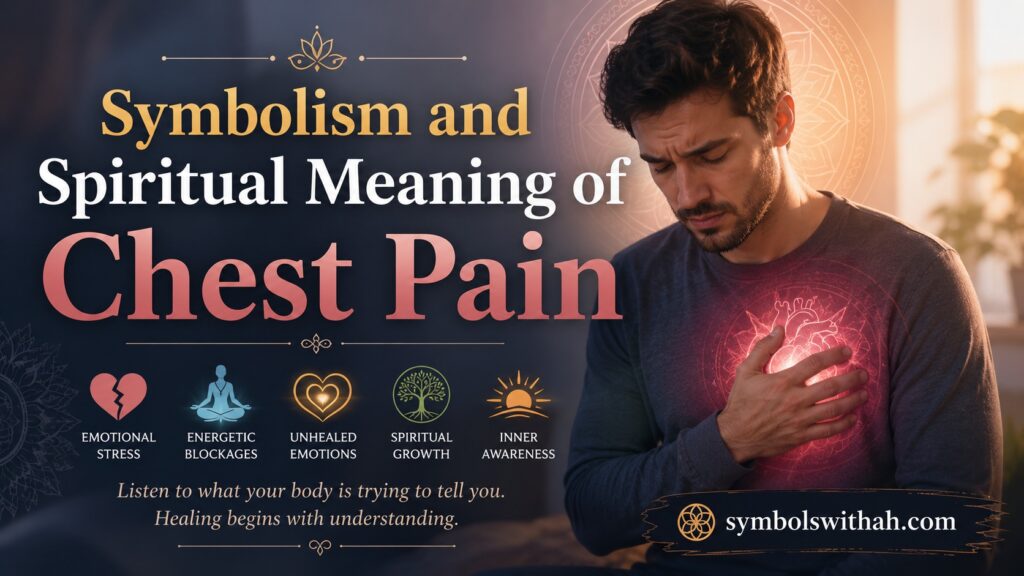

Chest pain can be alarming because the chest is closely associated with the heart, breath, protection, and emotion. In symbolism, people often connect this area of the body with love, grief, stress, vulnerability, and personal boundaries.
The symbolism and spiritual meaning of chest pain does not mean the sensation has a mystical cause. Instead, many traditions treat the chest as a symbolic center of emotional life. People may reflect on relationships, unspoken feelings, pressure, or major life changes when they think about symbolic meaning.
For readers in the United States, this topic is often explored through personal growth, mindfulness, spirituality, and emotional wellness. The key is to keep symbolic reflection separate from medical care: physical chest pain should always be taken seriously.
Read More: Symbolic and Spiritual Meaning of a Turtle Crossing Your Path
Quick answer
The symbolism and spiritual meaning of chest pain is often linked to emotional burden, grief, love, vulnerability, stress, and the need for protection. In modern American spiritual reflection, the chest is commonly seen as the symbolic area of the heart and personal boundaries.
However, symbolic interpretation should never replace medical evaluation. If chest pain is sudden, severe, recurring, or accompanied by symptoms such as shortness of breath, dizziness, nausea, or pain spreading to the arm or jaw, seek urgent medical care.
TL;DR
- Chest pain is often symbolically linked to the heart and emotions.
- Common meanings include grief, stress, love, vulnerability, and protection.
- Many spiritual traditions connect the chest with the heart center.
- In the U.S., people often explore it through emotional wellness and self-reflection.
- Symbolic meaning is personal and should not replace medical care.
What chest pain symbolizes at a glance
The chest as an emotional center
In symbolic language, the chest is more than a physical area. It is often associated with the heart, lungs, breath, courage, affection, and the feeling of being emotionally open or protected.
Because of this, chest discomfort is sometimes interpreted as a sign that something feels emotionally heavy, unresolved, guarded, or deeply important.
Common symbolic meanings
- Emotional burden or pressure
- Grief, heartbreak, or loss
- Love, attachment, or longing
- Vulnerability and openness
- Stress, anxiety, or overwhelm
- Protection, boundaries, and self-defense
- Unspoken feelings
- Need for healing or release
Historical and symbolic roots of the chest
Ancient associations with the heart
Across many ancient cultures, the heart was viewed as more than a physical organ. It was often considered the center of feeling, intention, memory, courage, and identity.
In ancient Egyptian belief, the heart was associated with truth and moral character. In Greek thought, the chest was connected with courage and spirit. Many religious and philosophical traditions also used the heart as a symbol of compassion, devotion, and inner life.
The chest as protection
The chest also protects vital organs. Because of this, it has long carried symbolic meanings related to safety, defense, armor, and emotional shielding.
When people describe feeling “guarded,” “closed off,” or “hurt in the heart,” they are using symbolic language that connects emotional experience with the chest area.
Spiritual meaning of chest pain
Emotional weight and unresolved feelings
A common spiritual interpretation is that chest pain symbolizes emotional weight. This may include grief, resentment, disappointment, guilt, or feelings that have not been expressed.
People may reflect on whether they are holding onto something painful or carrying responsibility that feels too heavy.
The heart center
In many spiritual systems, the center of the chest is associated with the heart center, often called the heart chakra in some traditions. This symbolic center is linked with love, compassion, forgiveness, connection, and emotional balance.
When this area is discussed spiritually, people may associate discomfort with questions such as:
- Am I withholding affection?
- Am I grieving a loss?
- Do I feel emotionally unsupported?
- Am I protecting myself too strongly?
- Do I need to forgive or release something?
A call for reflection
Spiritually, chest pain is often interpreted not as a prediction, but as an invitation to pause. People may use it as a moment to examine emotional patterns, relationships, stress, and personal boundaries.
Symbolism of chest pain in the United States
Modern American interpretation
In the United States, symbolic discussions of chest pain are often influenced by psychology, mindfulness, self-help culture, and spiritual wellness practices.
Many Americans use symbolic language to describe emotional experiences:
- “My heart feels heavy.”
- “I’m carrying too much.”
- “That broke my heart.”
- “I feel closed off.”
- “I need to protect myself.”
Common situations people connect to chest symbolism
| Situation | Possible symbolic association |
| Breakup or heartbreak | Loss, longing, emotional pain |
| Grief | Sorrow, remembrance, heaviness |
| Stressful work or family pressure | Overwhelm, responsibility |
| Conflict | Unspoken feelings, tension |
| Fear of vulnerability | Emotional guarding |
| Personal growth | Opening, healing, release |
Emotional and psychological associations
Grief and heartbreak
The chest is strongly associated with grief. People often describe loss as feeling physically heavy, tight, aching, or painful in the chest area.
This is why heartbreak has become such a powerful cultural metaphor in American language and storytelling.
Stress and anxiety
Chest tightness is also commonly associated with stress and anxiety. Symbolically, this may represent pressure, worry, fear, or the feeling of being emotionally compressed.
Common emotional themes include:
- Feeling overwhelmed
- Carrying too many responsibilities
- Fear of failure
- Fear of loss
- Difficulty relaxing
- Difficulty expressing emotions
Vulnerability and protection
The chest is one of the body’s most protected areas. Symbolically, discomfort here may reflect a desire to protect oneself emotionally.
People may interpret it as a sign that they feel exposed, hurt, rejected, or uncertain about trust.
Chest pain and the symbolism of love
Love, attachment, and longing
Because the chest is associated with the heart, it is often connected to love and attachment. Symbolically, chest pain may represent deep affection, longing, separation, or emotional closeness.
This interpretation appears frequently in poetry, music, films, and everyday conversation.
When love feels painful
People may connect chest discomfort symbolically with:
- Missing someone
- Unrequited love
- Relationship conflict
- Fear of abandonment
- Emotional disappointment
- Difficulty letting go
Chest pain as a sign of emotional boundaries
Protecting yourself
Another common symbolic meaning is protection. The chest surrounds the heart and lungs, so it naturally represents what we guard most carefully.
People may reflect on whether they are:
- Protecting themselves from being hurt
- Avoiding emotional intimacy
- Holding back honesty
- Carrying resentment
- Feeling unsafe in a relationship
- Taking on other people’s problems
Opening versus closing
In spiritual language, an “open heart” often symbolizes compassion and connection. A “closed heart” may symbolize fear, self-protection, or emotional withdrawal.
Chest symbolism often explores the balance between openness and safety.
Cross-cultural and spiritual perspectives
Eastern spiritual traditions
In some Eastern traditions, the center of the chest is associated with the heart chakra. This symbolic center relates to love, compassion, forgiveness, empathy, and connection with others.
A balanced heart center is often described as open and compassionate, while imbalance may be associated symbolically with emotional difficulty.
Religious symbolism
In Christianity, the heart is often associated with love, devotion, mercy, and sincerity. Other traditions also use the heart as a symbol of inner truth, compassion, and spiritual life.
These interpretations vary widely and should be understood as cultural or spiritual perspectives, not universal facts.
Modern spiritual and wellness interpretations
Mindfulness and self-reflection
Today, many people approach chest symbolism through mindfulness and emotional awareness. They may ask what feelings are present when the discomfort occurs.
Common reflective questions include:
- What am I holding onto?
- What feels heavy right now?
- What have I not expressed?
- Where do I need support?
- What boundary needs attention?
- What would healing look like?
A symbolic invitation
In this modern context, chest pain is often viewed symbolically as an invitation to slow down, notice emotions, and care for one’s inner life.
Again, this is a reflective practice, not a medical explanation.
Misunderstandings and important caution
Symbolism is not a diagnosis
It is important to separate symbolic interpretation from physical health. Chest pain can have serious medical causes, including heart and lung conditions.
A symbolic meaning should never be used to explain away physical symptoms.
Important health note
Seek urgent medical care for chest pain that is sudden, severe, recurring, worsening, or accompanied by shortness of breath, dizziness, fainting, nausea, sweating, or pain spreading to the arm, jaw, back, or shoulder.
This article discusses symbolic and cultural interpretations only. It does not provide medical advice or diagnosis.
Avoiding harmful assumptions
It can be comforting to reflect on emotional meaning. However, it is not safe to assume that chest pain is “just stress” or “just spiritual.”
Both physical health and emotional reflection can be taken seriously at the same time.
How the meaning has shifted over time
From sacred heart to emotional wellness
Historically, the heart was often viewed as the center of the soul, courage, or moral character. Today, many people interpret chest symbolism through the language of emotions, trauma, relationships, and self-care.
This shift reflects modern interest in psychological well-being and personal growth.
Contemporary meaning
Modern symbolic interpretations tend to focus on:
- Emotional awareness
- Stress and overwhelm
- Healing after loss
- Forgiveness
- Boundaries
- Compassion
- Authentic connection
FAQs
What does chest pain symbolize spiritually?
Spiritually, chest pain is often associated with emotional burden, grief, love, vulnerability, stress, or the need for protection. The exact meaning is personal and depends on context.
Can chest pain be related to emotions?
Many people notice that stress, anxiety, grief, or emotional conflict can feel connected to the chest area. Symbolically, this is often described as heaviness, tightness, or pressure.
What does a heavy feeling in the chest mean spiritually?
A heavy feeling in the chest is often interpreted as carrying unresolved emotions, responsibility, sadness, or emotional pressure. It may invite reflection on what feels difficult to release.
Is chest pain connected to the heart chakra?
In some spiritual traditions, the chest area is associated with the heart chakra, which symbolizes love, compassion, forgiveness, and connection. This is a spiritual interpretation, not a medical explanation.
Can heartbreak cause symbolic chest pain?
Yes. In symbolic language, heartbreak is one of the strongest associations with chest pain. It represents loss, longing, emotional pain, and attachment.
Should I treat chest pain as a spiritual sign?
You may reflect on symbolic meaning if it feels helpful, but chest pain should not be treated only as a spiritual sign. Physical symptoms should be evaluated by a healthcare professional when appropriate.
Conclusion
The symbolism and spiritual meaning of chest pain often centers on the heart: love, grief, stress, vulnerability, protection, and emotional burden. Across cultures and modern American wellness practices, the chest is frequently seen as a symbolic place where deep feelings are carried and expressed.
At the same time, symbolic reflection should remain separate from medical care. If chest pain is concerning, sudden, severe, or accompanied by other symptoms, seek professional medical attention.
When approached safely, chest symbolism can offer a gentle invitation to reflect on emotions, relationships, boundaries, and healing. It is less about finding one fixed meaning and more about understanding what feels heavy, guarded, or ready to be released.